Charles Hodge, James McCosh, B. B. Warfield -- these leading professors at Princeton College and Seminary in the nineteenth and early twentieth centuries are famous for their orthodox Protestant positions on the doctrine of evolution. In this book Bradley Gundlach explores the surprisingly positive embrace of developmental views by the whole community of thinkers at old Princeton, showing how they embraced the development not only of the cosmos and life-forms but also of Scripture and the history of doctrine, even as they defended their historic Christian creed.
Decrying an intellectual world gone "evolution-mad," the old Princetonians nevertheless welcomed evolution "properly limited and explained." Rejecting historicism and Darwinism, they affirmed developmentalism and certain non-Darwinian evolutionary theories, finding process over time through the agency of second causes — God's providential rule in the world -- both enlightening and polemically useful. They also took care to identify the pernicious causes and effects of antisupernatural evolutionisms. By the 1920s their nuanced distinctions, together with their advocacy of both biblical inerrancy and modern science, were overwhelmed by the brewing fundamentalist controversy.
From the first American review of the pre-Darwinian
Vestiges of the Natural History of Creation to the Scopes Trial and the forced reorganization of Princeton Seminary in 1929,
Process and Providence reliably portrays the preeminent conservative Protestants in America as they defined, contested, and answered -- precisely and incisively -- the many facets of the evolution question.
eBook - ePub
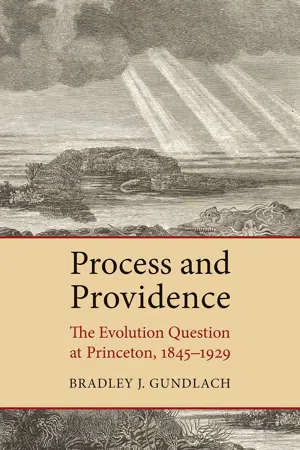
Process and Providence
The Evolution Question at Princeton, 1845-1929
- 352 pages
- English
- ePUB (mobile friendly)
- Available on iOS & Android
eBook - ePub
About this book
Information
Topic
Theology & ReligionSubtopic
Christian TheologyCHAPTER ONE
Natural History and the Moral Sphere
Dull atheist, could a giddy dance
Of atoms lawlessly hurl’d
Construct so wonderful, so wise,
So harmonized a world?
Of atoms lawlessly hurl’d
Construct so wonderful, so wise,
So harmonized a world?
Erasmus Darwin1
The Horrible Vision
One summer’s day in 1845, Albert B. Dod, professor of mathematics at the College of New Jersey, picked up his pen to write a review of Robert Chambers’s new book, Vestiges of the Natural History of Creation.2 The article appeared in the October number of the Biblical Repertory and Princeton Review, a highly respected theological quarterly under the firm editorial hand of Charles Hodge of Princeton Seminary. Chambers’s anonymous book was the first publication to attempt to popularize an evolutionary theory in the English-speaking world. Dod’s review was the first significant treatment of evolutionism to emanate from Princeton, and one of the first American reviews of the Vestiges.3
However pleasant the weather may have been that day, Dod’s mood was by no means sunny. A pious and keen-witted man whom Charles Hodge admired for his gentle spirit and childlike faith,4 Dod was vexed at the philosophical and religious implications of the book. His review was scathing. “Of what avail is it,” he asked, “to give us the idea of a Creator, if He who created does not govern us?” Chambers gave his readers a creation of sorts — creation by a natural process of evolution — but no providence. If God were but a remote First Cause who merely set the universe to turning some vast ages ago, Dod argued, we may as well have no God at all in the here and now. Chambers’s theory was a specimen of applied deism, and deism was practical atheism.5
The Vestiges magnified the reign of natural law, applying to the biological world the analogy of Newtonian physics: just as the wonder of orderliness in the inorganic world had inspired reverence for an intelligent First Cause, Chambers argued, so the discovery of lawfulness in the organic world should redound to the greater glory of God. But Dod pointed out that by Chambers’s account God had created of necessity, and all things in the universe, from galactic nebulae to the minutest microbes, were bound together in the inexorable chain of cause and effect. The implication was that “the universe, in all its parts and beings, in all its processes and results, is but a stupendous machine, whirled about by its own inherent tendencies and driving on to we know not what end.” The Vestiges so distanced God from his works that the individual soul had no solace in its Creator’s attentions. Dod pressed the point to its logical entailments: adoration of the divine wisdom and power would be inappropriate, for raw intelligence and raw power could serve evil as easily as good — and in a fatalistic system, evil and good had no meaning anyway. Worse, this vast, brute force took no consideration of us as individual persons. Law and order prevailed in the grand scheme of things, but this relentless mechanism left the individual unable to call upon a watchful, caring heavenly Father. Here Dod’s rhetoric of moral horror reached its height: “Abandoned to the operation of general laws, that without any discernible purpose or feeling work out their results, — left to take our chance amid the prizes and the blanks, and worse than blanks, distributed by a stern undiscriminating necessity, — we see not that there is any occasion for admiration, reverence, or love towards the Creator. To love Him would be, as Spinosa says, to deny His nature. To pray to Him would be as idle as a dog baying at the moon.”6
Clearly Dod’s condemnation of the book was no cool, dispassionate dismissal. This professor of mathematics waxed eloquent in his ardor, painting a Horrible Vision of the loveless fatalism Chambers’s system entailed. He appealed to the heart as well as to the intellect, drawing the reader into a lively sense of the consequences at stake. If the universe really were governed by “stern, undiscriminating necessity,” then the practices of devotion and prayer were idle — or worse than idle, a pitiable, empty delusion. To the believing Christian the picture was horrible indeed.
Thus it was not the Vestiges’ lack of empirical evidence nor its flights of speculation that troubled Dod (though he did take pains to point these out) — nor the doctrine of the transmutation of species (though he rejected that as well) — but rather the book’s moral and philosophical entailments, which he viewed not as dry academic points but as matters of extreme urgency to the human heart. Did God indeed notice the fall of every sparrow, and bring forth every lily of the field, and number every hair of our heads? For Dod the vital question was religious: “In what relation then do we stand to the Creator?”7
Here, then, at the first appearance of a modern evolutionary theory in the English-speaking world, the point of controversy was not the “how” of origins, nor primarily the question of fit with Genesis chapters 1 and 2, but rather the religious and metaphysical issue of God’s relation to his works. Chambers put this religious dimension very much in the forefront of the Vestiges. He had no interest in isolating the “scientific” question from the “religious” one. But note the critical eye that Princeton turned toward science’s tribute to God. Not all paeans to divine handiwork were created equal: the philosophical tendencies and spiritual ramifications might be healthy — or they might be disastrous. For Dod, the Vestiges tended emphatically in the latter direction.
From Chambers’s point of view, however, the Vestiges made a most edifying contribution to natural theology, the study of the knowledge of God accessible to all people prior to any supernatural revelation. By revealing a grand design in the origin of species, Chambers meant to bolster the teleological argument for the existence of God — that the evident purposefulness of nature implied a Designer. He intended to confirm and elevate teleology, not to promote atheism.8 An outsider to the scientific community, he wrote the Vestiges to sketch out for the reading public a grand developmental view of the history of the earth and the life upon it — a panoramic spectacle that would show forth the wonderful outworking of a divine plan programmed into nature. Later overshadowed by Charles Darwin’s On the Origin of Species, the Vestiges was in its time a sensation, widely read and discussed by all classes, from working men to Queen Victoria and Abraham Lincoln. According to James Secord, the book reached at least a hundred thousand readers. “Mentioned in thousands of letters and diaries, denounced and praised in pulpits, discussed on railway journeys, and annotated on an Alabama River steamboat,” the Vestiges went through fourteen editions in Britain and twenty in the United States, creating a controversy that lasted decades. Jonathan Topham adds that it was the Vestiges, not Darwin’s work, that made “sweeping narratives of evolutionary progress . . . central to British culture” — and that influence crossed the ocean to America.9
The Vestiges began with an exposition of the “nebular hypothesis” of Kant and Laplace, the theory that the solar system had formed out of an original cloud of stardust under the natural operation of Newtonian gravitational forces.10 This elegant, natural-law explanation of cosmogony cut two ways, religiously speaking, as observers had been quick to point out. Laplace had earned a reputation as a notorious infidel, for when Napoleon asked him where God was in the process, he replied that he had no need of “that hypothesis.” But others pointed out that natural law implied a Lawgiver; therefore an emphasis on the regularity of nature, far from banishing divine providence from the world, gave evidence of providential design on a grand scale. This was Chambers’s view; he embraced the nebular theory as eminently purposeful, and therefore eminently theistic. Scientific scrutiny of the ways of God in his works became a doxological, or worship-inspiring, endeavor.11
Chambers’s new contribution to theistic argument lay in his finding a biological parallel to the progressiveness of the physical world portrayed in the nebular theory. Unveiling the process of formation of the solar system had magnified the hand of God; so now unveiling the process of organic evolution, right up to man, would evoke similar praise for the all-wise Creator. As Newton had glorified God by revealing the simple yet grand law of gravitation, now Chambers would glorify God by tracing an equally simple and equally grand law for living things. “It is most interesting to observe into how small a field the whole of the mysteries of nature thus ultimately resolve themselves. The inorganic has one final comprehensive law, GRAVITATION. The organic, the other great department of mundane things, rests in like manner on one law, and that is, — DEVELOPMENT.” Perhaps, Chambers suggested, these two overarching laws of physical existence might even resolve into one. He fairly gasped with awe at the prospect of discovering a “unity which man’s wit can scarcely separate from Deity itself.”12
Chambers thus expected his extension of doxological science into the realm of living things to please scientist and religionist alike. His history of the creation of life on earth presented a linear, goal-oriented, inevitable ascent up the chain of being — concepts all welcome in the scientific and religious discourses of his day — but it substituted transmutation for special creation. In this way Chambers tried to rehabilitate the ancient idea of evolution — a theory dating back to the pagan Greeks — baptizing it for the glory of God.13
Chambers was drawing upon a new version of teleological argument, one that historian Peter Bowler has called the “idealist version of design.” In contrast to William Paley’s popular argument in Natural Theology (1802) — that the utilitarian contrivances of specific adaptations, such as the wing for flight, bore testimony to a divine designer — from about 1830 onward proponents of the idealist argument saw more profound evidence of intelligence and purpose in the whole system of laws governing our world.14 The idealist argument carried the additional advantage of not seeking exact correspondences between science and Scripture. The scientist was freed up to find the laws behind the processes without worrying about how they fit with the Bible, for in any case law must imply a Lawgiver.15
But a God above nature, to whom the reign of law testified, was not necessarily the Bible’s covenant God who heareth prayer. The idealist argument from design could go too far, ending up in deism — or worse. The regularity of nature was one thing; rank fatalistic mechanism was quite another. This, as we have seen, was Dod’s chief concern in his review. Though he devoted considerable space to refuting Chambers’s development hypothesis, Dod reserved his strongest words for the implications of utter uniformitarianism. His Horrible Vision was a picture not of a man or a woman descended from an ape,16 but of a universe whirling on inexorably without any intervening or even superintending Providence — of mankind orphaned in a cold and fatherless cosmos.
Chambers held no brief for materialism or atheism. Where, then, did this horrible tendency to fatalism come from? Dod’s answer is very instructive. The tendency sprang from a surprising source: the scientific method itself, Baconian induction, that icon of enlightenment and key to unlocking the mysteries of God’s creation.
Like the many Puritans and later evangelicals who took part in the scientific revolution of the seventeenth and eighteenth centuries, antebellum American Protestants eagerly followed the inductive method Francis Bacon had set forth in his classic Novum Organum (1620).17 Thanks to induction — the careful collection of data from real experience rather than from venerable thinkers such as Aristotle — early modern science had made more progress in a few generations than at any other time in history. Empirical observation and a carefulness not to run ahead of the evidence had unseated ancient misapprehensions of the natural world and dispelled many superstitions — which for Protestants included many doctrines of Roman Catholicism. Protestantism and enlightened science had moved forward arm in arm.18 No wonder Bacon was such a h...
Table of contents
- Cover Page
- Title Page
- Copyright Page
- Dedication
- Contents
- Preface
- Introduction
- 1. Natural History and the Moral Sphere
- 2. The Battle Cry
- 3. Seize and Master
- 4. McCosh and Hodge
- 5. To Mold the Age
- 6. Theism and Evolution
- 7. Natural Religion
- 8. Supernaturalism
- 9. Fundamentalism
- Conclusion
- Bibliography
- Index
- Supplemental Index: Subjects By Thinkers
Trusted by 375,005 students
Access to over 1.5 million titles for a fair monthly price.
Study more efficiently using our study tools.
Frequently asked questions
Yes, you can cancel anytime from the Subscription tab in your account settings on the Perlego website. Your subscription will stay active until the end of your current billing period. Learn how to cancel your subscription
No, books cannot be downloaded as external files, such as PDFs, for use outside of Perlego. However, you can download books within the Perlego app for offline reading on mobile or tablet. Learn how to download books offline
Perlego offers two plans: Essential and Complete
- Essential is ideal for learners and professionals who enjoy exploring a wide range of subjects. Access the Essential Library with 800,000+ trusted titles and best-sellers across business, personal growth, and the humanities. Includes unlimited reading time and Standard Read Aloud voice.
- Complete: Perfect for advanced learners and researchers needing full, unrestricted access. Unlock 1.5M+ books across hundreds of subjects, including academic and specialized titles. The Complete Plan also includes advanced features like Premium Read Aloud and Research Assistant.
We are an online textbook subscription service, where you can get access to an entire online library for less than the price of a single book per month. With over 1.5 million books across 990+ topics, we’ve got you covered! Learn about our mission
Look out for the read-aloud symbol on your next book to see if you can listen to it. The read-aloud tool reads text aloud for you, highlighting the text as it is being read. You can pause it, speed it up and slow it down. Learn more about Read Aloud
Yes! You can use the Perlego app on both iOS and Android devices to read anytime, anywhere — even offline. Perfect for commutes or when you’re on the go.
Please note we cannot support devices running on iOS 13 and Android 7 or earlier. Learn more about using the app
Please note we cannot support devices running on iOS 13 and Android 7 or earlier. Learn more about using the app
Yes, you can access Process and Providence by Bradley J. Gundlach in PDF and/or ePUB format, as well as other popular books in Theology & Religion & Christian Theology. We have over 1.5 million books available in our catalogue for you to explore.