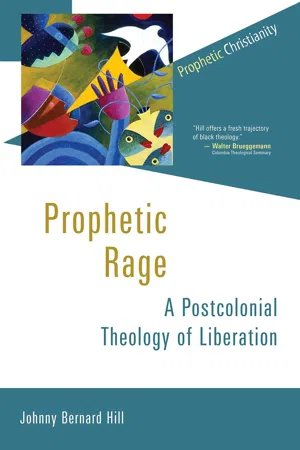
In this book Johnny Bernard Hill argues that prophetic rage, or righteous anger, is a necessary response to our present culture of imperialism and nihilism. The most powerful way to resist meaninglessness, he says, is refusing to accept the realities of structural injustice, such as poverty, escalating militarism, genocide, and housing discrimination.
Hill's
Prophetic Rage is interdisciplinary, integrating art, music, and literature with theology. It is constructive, passionate, and provocative. Hill weaves through a myriad of creative and prophetic voices of protest -- from Jesus to W. E. B. DuBois, Martin Luther King Jr., Malcolm X, and President Barack Obama -- as well as multiple approaches, including liberation theology and black religion, to reflect theologically on the nature of liberation, justice, and hope on contemporary culture.
- 192 pages
- English
- ePUB (mobile friendly)
- Available on iOS & Android
eBook - ePub
Prophetic Rage
About this book
Information
Topic
Theology & ReligionSubtopic
Christian TheologyCHAPTER ONE
Black Religion and Nihilism
Love your enemies. . . . Let no man pull you so low as to make you hate him. . . . If you will protest courageously, and yet with dignity and Christian love, when the history books are written in future generations, the historians will have to pause to say “There lived a great people — a black people — who injected new meaning and dignity into the veins of civilization.” This is our challenge and our overwhelming responsibility.1
Let your motto be resistance! resistance! resistance! No oppressed people have ever secured their liberty without resistance. What kind of resistance you had better make, you must decide by the circumstances that surround you, and according to the suggestion of expediency. Brethren, adieu! Trust in the living God. Labor for the peace of the human race, and remember that you are four millions.2
Prophetic rage has signified the power and courage of black people to fight against those very systems that have sought to undermine their very being. Black religion has also played a pivotal role in offering a prophetic critique of the values, beliefs, and rituals that the Western world in general, and America in particular, has held in such high regard when it comes to freedom, justice, human dignity, and the like. Even in the context of the Christian tradition, it was black religion, whether in apartheid South Africa or in the Jim Crow segregation of southern America, that demonstrated the meaning of faithfulness and Christian love. On black religion, C. Eric Lincoln observed that “our strange dilemma is that the human values we hold as individuals are routinely eviscerated by the inhuman systems we create to negate them in our consuming passion to distinguish and separate humans from other humans.”3 Rooted in the painful horrors of slavery and colonialism, black religion (and subsequently black theology) has been marked by a theology of resistance and prophetic protest, paving the way for and in concert with liberationist movements around the world. Even with the election of the nation’s first black president (Barack Obama) in 2008, and reelection in 2012, the deep legacy of black religion’s struggle with empire remains a constant reminder of its unshakable hope and the challenges that persist as well.
Those challenges and struggles are played out in the geopolitical theater of black life. My own experience as a black boy growing up in the belly of the South is no different. I was raised as part of the post–civil rights generation. The promised land of which Dr. King spoke was not realized and remains evasive. I was born in 1971 and raised in a small wood house in the back hills of Georgia in a lumber town in the deep woods. In the house, I was reared as the only brother of seven sisters. In that little house, life was hard. We were poor and black in the South. Although the systemic and legalized structures of segregation had been dismantled, the forces of racism and segregation were ingrained in the very fabric of southern culture. In the summers, we toiled in tobacco fields in sizzling heat. The world of blackness, my world, was separate and distinct from the outer world. As W. E. B. Du Bois observed in his description of the “veil” in the Souls of Black Folks, southern life was still persistently segregated and unequal. I rarely recall even engaging a white person or persons of other cultural groups for much of my early childhood. Although the school system was supposedly integrated, there was segregation in integration. Blacks were segregated in different classrooms and often presented with inferior and subpar resources and educational opportunities. Up until I graduated high school in 1989, my school system and the surrounding counties still held separate proms. Not only was there segregation in school programming, nearly every social, political, and economic institution in the South remained segregated. The churches were segregated. Barbershops, beauty salons, restaurants, and even day-care centers were separate. With the separation came different worlds with often very different rules and norms. Early on when I expressed interest in taking college-bound classes or participating in certain kinds of school activities and encountered resistance, I realized that what was at stake was power and the stabilization of white supremacist ideologies, which were in fact intertwined with the larger forces of empire. Practices of racism and discrimination at the local level are directly linked to larger, wider systems of empire and nihilism. These experiences were simply a microcosm of the challenges faced in black life particularly, and in a much broader sense in the struggles of marginalized persons the world over. Empire and its systems are personal and structural, blatant and subtle, visible and invisible all at once.
The greatest lie and deception of empire is found in the presumed sense of individual agency. Empire, on which white supremacy (and other systems) is dependent, is a narrative that is stabilized and held intact by the guise of personal preference. It is presumed somehow that even within these systems individuals have the ability to exercise their rational capacities and somehow emerge victoriously above these systems if they so desire. In some ways, this thesis holds true. Through reason, personal autonomy, and the power of self-determination it is possible to change and transform one’s circumstances and perhaps, in a Niebuhrian sense, to reconfigure societal structures. However, for the masses living in poverty and hopelessness, the odds are not in their favor. The systems themselves, when buttressed by ideologies of white supremacy, patriarchy, heterosexism, and militarism, are designed to advance a particular narrative of cultural normativity, which in turn stabilizes the system. Black life stands at the epicenter and crossroads of modernity, at the intersection of its dream and its nightmare. Black life exposes the myth of reason and enlightenment as the key to progress and moral perfection. In short, the realities of black life and its struggle for hope and redemption have laid out before the Western world its greatest sin — the negation of humanity by humanity. By denying black life, the Western world, America in particular, in some sense denies its own existence and is confronted with the end of its own history.
In the small town of my birth, there were two churches, one Baptist and the other Presbyterian. One church ebbed up from the gallows of poverty and came into being as part of the carpetbagging industries of Reconstruction, rooted in those pseudoforms of slavery and black codes that introduced indentured servitude that lasted more than a hundred years after the Emancipation Proclamation. The other stood in this small, seductively tranquil community, as a symbol of privilege and state power. Members of the two churches never interacted on Sundays, the days of worship, but throughout the week daily in the fields and workhouses as a curious dance of bondage and privilege, friend and foe, slave and free.
On the fiftieth anniversary of the March on Washington, and the sesquicentennial anniversary of the Emancipation Proclamation, critical questions persist as to the ways in which movements for peace, justice, and reconciliation are increasingly challenged by the intensification of conflicts, competing narratives, globalization, and most notably the problem of difference and pluralism. Indeed, for oppressed peoples the world over, postmodernity comes not merely as a philosophical problem but as a material and social crisis of hope and survival. Black people, in particular, are suffering like never before. In spite of all the hype about the black middle class, and public images of celebrities like Oprah Winfrey, Jay-Z, Chris Rock, and the fabulous life of Sean “P. Diddy” Combs, the drowning sense of hopelessness and despair overtaking many poor urban and rural communities alike makes postmodernity appear as not just the end of “meaning” but as the end of “existence.” Literally, where do we go from here? Experience has shown that the economic, political, and intellectual structures of modernity militate against black existence. Hence, what seems to be called for is a reassessment of the social, theological, and philosophical systems that have been taken for granted in the lives of black folks, and assumed as fact in black theology and European and American theological discourse in general.
Nihilism and Black Theology
If black theology, in its current state, is not dead, it is certainly on life support. As a movement, black theology remains, on the one hand, one of the most powerful theological inventions of the twentieth century inasmuch as it spoke to the very core of white supremacist ideologies, Western imperialism, and the broader plight of the poor and dispossessed in the West and globally. On the other hand, with its institutionalization and reliance on modern theological presuppositions and lack of critical, sustained engagement with the black church and praxis, black theology as a movement is suffering from the drumbeat of prophetic zeal. Before putting forth a prophetic vision of black theology that incorporates both postmodern and postcolonial critiques, we must as a point of departure briefly assess the development, shifts, and trends in black theology.
Nihilism: The Greatest Threat to Black Survival
The developments and emerging trends in black theology are unintelligible apart from the current threat of nihilism. Nihilism has always been the greatest enemy of oppressed peoples. Black theology has devoted much of its attention to dismantling white supremacy in theology. But white supremacy has never been the greatest enemy of black people. That enemy has appeared again and again in the form of a deadly dance with hopelessness, lovelessness, and despair. Nihilism, historically and today, has been the greatest and most crushing foe of the survival and thriving of black life in America and through the African diaspora. For enslaved and colonized peoples, as well as those bodies gripped by the entangled beast of patriarchy and heterosexism, nihilism, the reality of hopelessness, is what kills the will to fight. Without hope, there is no struggle. Without hope, there is no resistance. Without hope, there is no future. Nihilism appears as the invisible force that robs oppressed people of the desire and courage to organize, strategize, and mobilize to envision new realities. It comes as acquiescence to present systems, as silence to the status quo in the face of injustice. Nihilism, emerging from the ancient thrust of empire as the will to power, to control, to dominate, and to define reality for all human beings, is what steals the very desire and impulse for survival and life. As Cornel West observed, nihilism is “a natural consequence of a culture (or civilization) ruled and regulated by categories that mask manipulation, mastery and domination of peoples and nature.” In short, as West reminds us, “the faith in the categories of reason is the cause of nihilism.”4 Maurice Blanchot offers a compelling summation of nihilism: “The moment Nihilism outlines the world for us, its counterpart, science, creates the tools to dominate it. The era of universal mastery is opened. But there are some consequences: first, science can only be nihilistic; it is the meaning of a world deprived of meaning, a knowledge that ultimately has ignorance as its foundation. . . . Nihilism becomes the possibility of science — which means that the human world can be destroyed by it.”5
I have seen this nihilism up close in my own experience. For most of my childhood, I lived a relatively quiet existence in a small country house in a little town called McGregor, Georgia, on the edge of what was once a slave plantation. Winters were cold then and summers were blistering hot. I recall very early on observing the deep hardship and pain of black life. There was a small store in town, owned by the family who lived in the “big house” with big trees. The store allowed the few who lived in the community to purchase staples like milk, flour, and bread. Many of the people who frequented the store also worked for the store owner and were allowed a line of credit for such goods. My family lived about two miles from the store, and occasionally we would walk to the store to pick up what we needed. On the walk to the store one day with my father, I walked by a small, deep crimson, shotgun house. It was very small, with barely enough room for one person. I entered the house with my father. There was no running water or electricity. An old potbelly stove sat in the middle of the floor with a silver pipe protruding from its head to a hole in the ceiling. There stood an old man in the house, stooped over, as if carrying a heavy load. His face was dark and weathered. He looked tired but fully awake. His hands were withered and his voice was like sound breaking through shattered glass on his tonsils. It seemed as if his soul was weary. My father reminded me that he worked for the landowner his entire life. After a brief and pleasant exchange, we prepared to leave. As we looked toward the door, he reached deep in his pocket and pulled out the shiniest coin I had ever seen. It was a half-dollar. What I had seen in the face of this old man was the face of nihilism and its bitter defeat. I had seen the weight of empire and the hope that makes empires tremble. I had seen at once death and life in one fragile, withered body. It was indeed the tragedy and triumph of modern philosophy and the prophetic determination of resistance and hope, of the refusal to die, give up, give in, and give out.
American and European philosophers, in their preoccupation with distinctions and categories, from Richard Rorty, Jürgen Habermas, Gilles Deleuze, Paul Ricoeur, W. V. O. Quine, Thomas Kuhn, and Larry Rasmussen, to Jacques Derrida, are victims of nihilism’s destructive tendencies even as they resist its seductive lure. These viewpoints result in a sophisticated and complex matrix of meaninglessness that erupts over into a culture of lifelessness, lovelessness, and despair. It has been this meaninglessness that, since the days of slavery colonialism, black bodies have resisted and contested.
Black theology, in its curious reflection on black life, has sought to articulate God-talk and God-thought as a response to the nihilistic threat. Black theology is multidimensional. It incorporates a multitude of voices, theological perspectives, ideas, methodologies, disciplines, cultures, and experiences. Black theology is “an eff...
Table of contents
- Cover Page
- Title Page
- Copyright Page
- Dedication
- Contents
- Acknowledgments
- Introduction
- 1. Black Religion and Nihilism
- 2. Empire and Black Suffering
- 3. Resistance, Rage, and Revolution
- 4. Profits Versus Prophets
- 5. Dark Waters
- 6. No Ways Tired
- 7. Building the World House
- Bibliography
- Index
Trusted by 375,005 students
Access to over 1.5 million titles for a fair monthly price.
Study more efficiently using our study tools.
Frequently asked questions
Yes, you can cancel anytime from the Subscription tab in your account settings on the Perlego website. Your subscription will stay active until the end of your current billing period. Learn how to cancel your subscription
No, books cannot be downloaded as external files, such as PDFs, for use outside of Perlego. However, you can download books within the Perlego app for offline reading on mobile or tablet. Learn how to download books offline
We are an online textbook subscription service, where you can get access to an entire online library for less than the price of a single book per month. With over 1.5 million books across 990+ topics, we’ve got you covered! Learn about our mission
Look out for the read-aloud symbol on your next book to see if you can listen to it. The read-aloud tool reads text aloud for you, highlighting the text as it is being read. You can pause it, speed it up and slow it down. Learn more about Read Aloud
Yes! You can use the Perlego app on both iOS and Android devices to read anytime, anywhere — even offline. Perfect for commutes or when you’re on the go.
Please note we cannot support devices running on iOS 13 and Android 7 or earlier. Learn more about using the app
Please note we cannot support devices running on iOS 13 and Android 7 or earlier. Learn more about using the app
Yes, you can access Prophetic Rage by Johnny Bernard Hill in PDF and/or ePUB format, as well as other popular books in Theology & Religion & Christian Theology. We have over 1.5 million books available in our catalogue for you to explore.