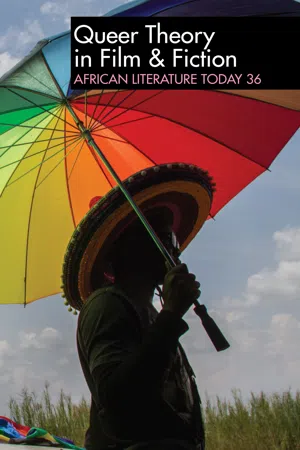
Debates on the future of the African continent and the role of gender identities in these visions are increasingly present in literary criticism forums as African writers become bolder in exploring the challenges they face and celebrating gender diversity in the writing of short stories, novels, poetry, plays and films. Controversies over the rights of Lesbian, Gay, Bisexual, Trans, Intersex, Queer (LGBTIQ) communities in Africa, as elsewhere, continue in the context of criminalization and/or intimidation of these groups. Residual colonial moralizing and contemporary western identity norms and politics vie with longstanding polyvalent indigenous sexual expression. In addition to traditional media, the new social media have gained importance, both as sources of information exchange and as sites of virtual construction of gender identities. As with many such contentious issues, the variety of responses to the "state of the question" is strikingly visible across the continent. In this issue of ALT, guest editor John Hawley has sampled the ongoing conversations, in both African writing and in the analysis of contemporary African cinema, to show how queer studies can break with old concepts and theories and point the way to new gender perspectives on literary and cinematic output. This volume also includes a non-themed section of Featured Articles and a Literary Supplement. Guest Editor: John C. Hawley is Professor in the Department of English, Santa Clara University Series Editor: Ernest N. Emenyonu is Professor of Africana Studies at the University of Michigan-Flint, USA. Reviews Editor: Obi Nwakanma
eBook - ePub
ALT 36: Queer Theory in Film & Fiction
African Literature Today
- 295 pages
- English
- ePUB (mobile friendly)
- Available on iOS & Android
eBook - ePub
About this book
Information
Visual Activism
A Look at the Documentary Born This Way
When I think of visual activism and the African LGBT community, I think of Neo Musangi of Kenya, a gender-nonconforming feminist academic, activist and performer. One of Neo’s public performances called ‘Time and Space’ demonstrates gender fluidity. Neo gets to the centre of a public space with both male and female clothing. Neo performs each gender with a complete wardrobe. While this goes on, the audience, a variety of people, from civil servants and pedestrians, to passers-by, form a large crowd and surround Neo as Neo switches from male to female clothing. Each full display leaves the audience confused and wondering to which gender Neo belongs. Neo’s visual activism forces live audiences to think about the blurred line between gender identities.
When I think of visual activism and the African LGBT community, I think of South Africa’s Zanele Muholi and her long-term outstanding project called ‘Faces and Phases’. This project consists of a photograph series created between 2007 and 2014. These portraits ‘commemorate and celebrate lives of black queers’. The pictures are of mostly women Muholi met in her journeys all across South Africa. Her objective in these projects is to ‘counter invisibility, marginality and systemic silence’. She seeks, instead, to include LGBT people at the forefront of South Africa’s liberation narrative. In these series of photographs, Muholi’s mission is to create an archive of ‘visual, oral and textual materials that include black lesbians and the role they have played in our communities’ (Muholi ‘Faces and Phases’).
When I think of visual activism and the African LGBT community, I think of the timeline for movies like Dakan, released in 1997, the first Sub-Saharan African feature film on a gay theme. I think of the documentary Woubi Cheri, another pioneer film from Ivory Coast, released in 1998. Then, 2001 was the Senegalese movie, Karmen Gei, a movie that dared to feature a lesbian protagonist. There is Z-Yaanbo from Burkina Faso, which was released in 2011, Call Me Kuchu, from Uganda, released in 2012. I think further about that country’s David Kato who was right in the middle of this movie project when he was murdered. The film was nevertheless completed. Then there is God Loves Uganda, released in 2013 and Veil of Silence, released in 2014 when Nigeria was on the verge of enacting the anti-same-sex marriage law. The production and release of these visual representations of LGBT lives emerged from the restlessness of African LGBT activists who are tired of being weighed down and repressed by draconian anti-gay laws across Africa.
The urgency for African LGBT members to be heard and be seen is captured when Tullman, one of the producers of the documentary Born This Way spoke to a Cameroonian LGBT person. In her words: ‘we are tired of Cameroon pretending that gay people don’t exist. We are ready to step forward.’ Additionally, the movie Woubi Cheri is described as a ‘cry of protest against a society which refuses to see, let alone accept, homosexual relationships’ (California Newsreel Woubi Cheri). The director of Dakan, Mohamed Camara made the movie Dakan ‘to pay tribute to those who express their love in whatever way they feel it, despite society’s efforts to repress it’ (California Newsreel Dakan). The resolve to be acknowledged, to be heard and to be respected gave rise to these visual movements. In this pile of visual representation of LGBT Africans, human rights documentaries like Born This Way are changing lives.
Documentaries are tools of revolution; documentaries change lives and opinions. The renowned filmmaker, Sam Kauffman, affirms that ‘the job of documentary filmmakers … is to shed some light on a neglected people or issue’ (Thurston ‘Can a Film Change the World?’). The persecution of a sexual minority group is one such issue. To further show the power of documentaries, the sociologist John Abraham Stover adds that he believes ‘quite strongly both as a sociologist and as an individual in the power of [documentaries] to change people’s lives and shape public opinion’ (Stover ‘The Intersections of Social Activism, Collective Identity, and Artistic Expression in Documentary Filmmaking’: 3). These words of affirmation speak to the importance of Born This Way in the way it portrays homosexual lives in Cameroon. Directed and produced by Shaun Kadlec and Debb Tullmann, the film traces the lives of four gay Cameroonians: Cedric, Gertrude, Pascaline and Esther. All are defendants in a legal action in which Alice Nkom, a famous Cameroonian gay rights attorney represents them. The film is impressive in many ways, not the least of which is its portrayal of the ‘hustle’ of gay life in the Cameroonian city of Douala against the general bustle of the urban scene. The documentary portrays the challenges of these four individual lives, inspiring respect and compassion for them – sometimes also shown by those around them.
There are three revolutionary scenes in this documentary. Because the scenes reveal how the activists in Born This Way confront and fight oppression, I call the scenes ‘sites of resistance’; they represent a revolt and a social movement. The first site of resistance is the scene where Pascaline shares her sexual orientation with the taxi driver who is taking her to a safe space. The second site of resistance is the scene where Attorney Alice Nkom defends homosexuals as citizens who should not be criminalised. The third site of resistance is the scene where Gertrude ‘comes out’ to the mother superior that raised her as a child.
The site of resistance where Pascaline shares her sexual orientation with the taxi driver shows the importance of conversations and dialogues. The taxi driver finds the topic of homosexuality strange and far-fetched. However, his ability to initiate a moment of learning empowers Pascaline to open up to him. Her story wins over the taxi driver’s heart. He ends up not being distant, indifferent or even hateful of such a strange sexual attraction; instead, he appreciates the knowledge.
The section where Attorney Alice Nkom defends homosexuals on Cameroonian national television in a country that has the highest rate of arrest of homosexual cases also reveals a moment of revolt. That instance of challenging the criminalisation of a group is a moment of ‘revolution.’ Homosexuality is a stigmatised word in Cameroon; hence, the television firm represents the state as a public sphere. It is one of the sites where LGBT advocacy faces the most resistance just as the spiritual also presents a daunting site. Nevertheless, the attorney creates a movement when she single handedly challenges the state and public site by daring to defend a marginalised group. The spiritual site, which is embodied in the scene where Gertrude ‘comes out’ to the mother superior symbolises the most brutal site of opposition. Religion is a well-known roadblock. For instance, scholars like Peter Geschiere have noted that ‘Christian communities in Cameroon as well as the judiciary system persistently denounce homosexuality’ (Lyonga ‘The Homophobic Trinity’: 56). In deconstructing these sites of resistance, de Ridder et al., in the article ‘Towards a Pragmatic Approach to Resistance and Subversion in Media Research on Gay and Lesbian Identities’, offer a framework that defines these three scenes by arguing:
For social change to occur there needs to be a symbiosis between agency and structure. To this end, a dialectic approach is needed that bridges the gaps between, on the one hand, a … project that creates awareness of norms, discourse and hegemony, and on the other, identity politics that have the potential to change laws and institutions. (de Ridder et al. ‘Queer Theory and Change’: 204)
The symbiotic relationship between Nkom as a guest at the Cameroonian television station and the television station itself makes it such that, while she fills in their time slot for that programme to be aired, she utilises that platform to attack homophobia and the injustice meted out to Cameroonian homosexuals. On Gertrude’s side, she returns to the convent to show her appreciation for a mother superior who cared for her in place of her own mother. She shows the mother superior appreciation and affection, but she uses that opportunity to unmask herself by ‘coming out’ to her. That burden of secrecy she bore for a long time is lifted. In the case of Pascaline and the cab driver, by driving Pascaline he earns money, while Pascaline through his services gets to her safe-space destination. The dialectic approaches are evident in the tension or conflicts created within these scenes, even as we are made aware of the norms or laws that disenfranchise a marginalised group. Alice Nkom straddles the identity politics in the hope that the laws against homosexuals in Cameroon can be changed or dismantled.
Lundberg defines a social movement as ‘a voluntary association of people engaged in concerted efforts to change attitudes, behavior and social relationships in a larger society’ (quoted in Triangular Chair ‘What is the meaning of the term Social Movement?’). These four people fight social injustice at their sites of resistance because their lives and their views are rejected in their community. This is consistent with the traits of any group that is likely to form a social movement: they have little chance of becoming integrated into the life of the community; they are marginalised, not fully accepted, isolated, and threatened by economic insecurity and loss of social status. These three scenes embody the marks of a social movement, which Anderson and Parker describe as a ‘dynamic …behavior, which progressively develops structure through time and aims at partial or complete modification of a social order’ (Sociology: Its Organization and Operation). Pascaline, Gertrude and Alice Nkom form a social movement at these sites with their ability to counter dominant attitudes and cultural norms. They form a social movement that has created a shift in the prevalent homophobic prejudice in Cameroon.
When one looks at homosexuality and the multiple fronts from which it is being attacked, especially in Africa, it becomes interesting to note that before colonialists introduced sodomy laws, there existed, and still exist, non-heterosexual practices on the continent. However, recently, religious fundamentalists have promoted a serious wave of homophobia. Drawing upon history, there is a need for a new orientation of African governments on the subject of homosexuality. Hence, the emergence of gay-themed documentaries in Africa is especially welcome as a tactical strategy in the tackling of homophobia, notably those coming from Uganda, South Africa, Nigeria and Cameroon.
The documentary medium used to tell the Cameroonian LGBT story enhances its message and delivery. Some may argue that documentaries have no impact on the lives of LGBT Africans especially when these movies are shot by foreigners and featured mostly abroad. The issue of who shoots the movies may not be as significant as whose story is being told. Besides, the lives of LGBT Cameroonians and Africans in general are impacted even when such effect or progress may not always be so apparent because of setbacks and cases of violence. Nevertheless, the immediate impact of Born This Way can be seen through the lives of Cedric and other featured protagonists in this documentary. Cedric for example, got the opportunity to relocate to the US and work after the documentary gave him prominence. With his current position, he is able to assist the Cameroonian LGBT community. In his words:
Today, I continue to help my former colleagues in Cameroon. I advise them on important matters and help write reports that aim to assist those still suffering the indignities heaped on them just for being gay. Despite the sadness that is always present, I plan to live a long … life so that I can play a role in changing the environment for LGBT people in not only Cameroon, but also anywhere we are persecuted for being born different from others. (Tchante ‘African LGBT Activist Escapes Death Threat’)
Pascaline was able to get support and funding for her legal battles. Incidentally, the prosecutions and convictions of LGBT people in Cameroon have dropped remarkably. The LGBT organisation Alternative Cameroon continues to provide legal, social and health services to the Cameroonian LGBT community including the incarcerated ones. Born This Way has given the oppression of the LGBT community in Cameroon global attention. When Born This Way was premiered in Berlin for the 63rd annual Berlinale, for instance, the Cameroonian Ambassador to Germany admitted as much: ‘Documentary films can help to highlight marginalized populations, the disabled, native cultures or homosexuals’ (Jacobs ‘Born This Way in Berlin’).
A good number of LGBT organisations in Africa like Alternative Cameroon and The Initiative for Equal Rights (TIERS) in Nigeria have started promoting and featuring LGBT movies in their community centres. In the case of Nigeria for instance, a TIERS administrator shared that the documentary they promoted called Veil of Silence stirred a lot of controversy and got many people talking when it was released in Lagos. A second documentary they promoted called Hell or High Waters, according to him, produced a tremendous response and excitement in the Nigerian LGBT community in Lagos. Beyond these reformist trends is also the fact that when African LGBT persons see people like themselves in movies and stories that recognise their lives, it motivates them to self-love and self-affirmation, the two crucial steps to paths that lead to fighting for self-rights. The transgender screenwriter and producer of Veil of Silence, Nigerian Noni Salma, adds her voice to the need for LGBT documentaries when she states that the use of
documentaries as a tool for advocacy works … From my experience working on my film Veil of Silence, I realized that the more visible LGBTIQ people are, the more normalized it can get. Because ...
Table of contents
- Cover
- Title
- Contents
- Notes on Contributors
- Editorial Article
- Articles
- Featured Articles
- Literary Supplement
- Reviews
- Copyright
Trusted by 375,005 students
Access to over 1.5 million titles for a fair monthly price.
Study more efficiently using our study tools.
Frequently asked questions
Yes, you can cancel anytime from the Subscription tab in your account settings on the Perlego website. Your subscription will stay active until the end of your current billing period. Learn how to cancel your subscription
No, books cannot be downloaded as external files, such as PDFs, for use outside of Perlego. However, you can download books within the Perlego app for offline reading on mobile or tablet. Learn how to download books offline
Perlego offers two plans: Essential and Complete
- Essential is ideal for learners and professionals who enjoy exploring a wide range of subjects. Access the Essential Library with 800,000+ trusted titles and best-sellers across business, personal growth, and the humanities. Includes unlimited reading time and Standard Read Aloud voice.
- Complete: Perfect for advanced learners and researchers needing full, unrestricted access. Unlock 1.5M+ books across hundreds of subjects, including academic and specialized titles. The Complete Plan also includes advanced features like Premium Read Aloud and Research Assistant.
We are an online textbook subscription service, where you can get access to an entire online library for less than the price of a single book per month. With over 1.5 million books across 990+ topics, we’ve got you covered! Learn about our mission
Look out for the read-aloud symbol on your next book to see if you can listen to it. The read-aloud tool reads text aloud for you, highlighting the text as it is being read. You can pause it, speed it up and slow it down. Learn more about Read Aloud
Yes! You can use the Perlego app on both iOS and Android devices to read anytime, anywhere — even offline. Perfect for commutes or when you’re on the go.
Please note we cannot support devices running on iOS 13 and Android 7 or earlier. Learn more about using the app
Please note we cannot support devices running on iOS 13 and Android 7 or earlier. Learn more about using the app
Yes, you can access ALT 36: Queer Theory in Film & Fiction by Ernest N. Emenyonu, John C. Hawley in PDF and/or ePUB format, as well as other popular books in Literature & African Literary Criticism. We have over 1.5 million books available in our catalogue for you to explore.