- 537 pages
- English
- ePUB (mobile friendly)
- Available on iOS & Android
eBook - ePub
Ground Mechanics in Hard Rock Mining
About this book
This book illustrates the advantages of the application of ground mechanic concepts to hard rock mining. It examines the ground stability for various mine layouts using specific case histories. The book deals with ground support, reinforcement, and stabilization of mining structures.
Information
Analysis of the nature of stress can be achieved by mathematical and analytical theories which deal with the description of the state of stress throughout the body. The concept of force, stress, normal stress and shear stress is based on the physical definitions and the relations between these quantities which are mathematically formulated. These theoretical principles can be applied to any body composed of a continuous distribution of matter. In some instances, restrictions should be made as to the nature of the material i.e. rock.
In order to evaluate the rock behaviour in the underground mining it is necessary to understand the meaning of the terms stress and strain and how these are connected in the constitutive laws. It will then be easier to understand the various relationships which govern the deformations which are produced from given stress or loading conditions. It should be pointed out that stress and strain are defined independently from the material properties and therefore apply to all types of rock material.
1.1 PRINCIPLES OF STRESS
When rocks are subjected to stresses, several states of stress could be detected as individually described under this subheading.
To discuss the stresses from a theoretical point of view, it is necessary to return to fundamentals and explain the nature of the stresses in relation to the rock.
The stress is considered in a very simplified context, so that understanding of this phenomenon cannot be a problem. A full discussion of stress theory is found in several books on Rock Mechanics.1,2,3
Finally it should be understood that the virgin stress in rock mass is caused by the overburden load or geological structure, whose state can be physically defined and mathematically formulated.
1.1.1 Definition of the stresses
In order to clarify the stress phenomena, it is necessary to give a principal definition of the forces as follows:1
(a) Body force is produced without physical contact with other bodies (i.e. gravitation, magnetism, lithostatic, inertia, etc.). It is defined as a force per unit volume which depends on the volume and specific gravity of rock mass. The body force of volume AN has the resultant forces which act along respective principal coordinate systems (X,Y,Z).
(b) Surface force is produced by physical contact with other bodies. When a body is subjected to a system of forces the resultant and the moment of which are both nil, it suffers no accelerations.1
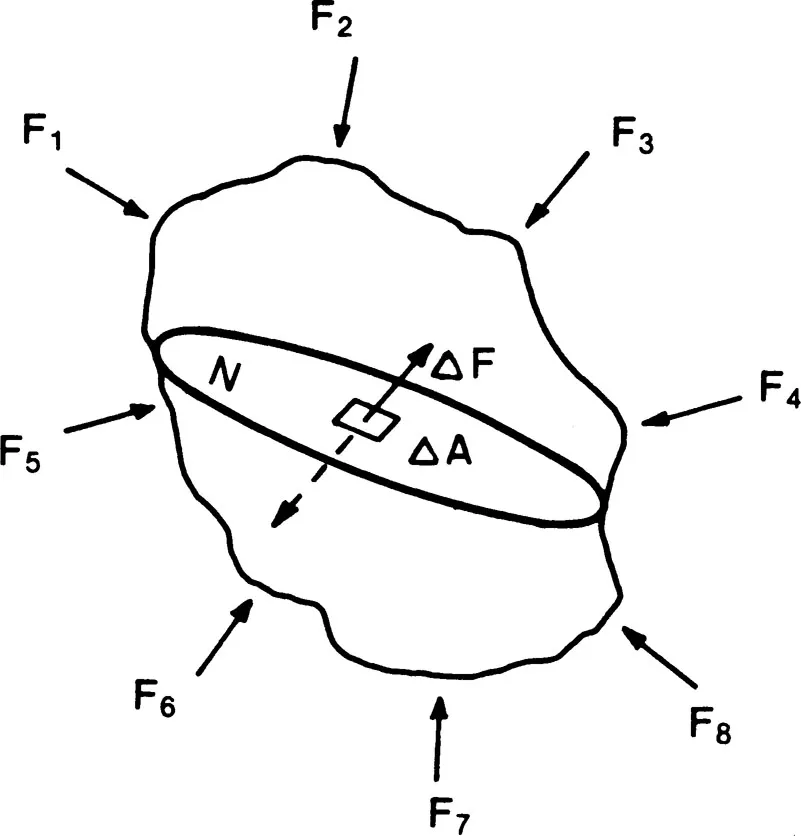
(c) Internal forces are induced by the forces on the body. They maintain equilibrium and prevent the collapse of the body. Internal stresses can be defined by analyzing the forces upon arbitrary virtual plane which divide the solid body into two parts which are in the state of equilibrium (Figure 1.1.1). By considering a small portion of the plane of area ΔA, and force ΔF acts upon the plane, the value of ΔF will vary with the area ΔA, but the state of stress at that point is constant and is defined as:
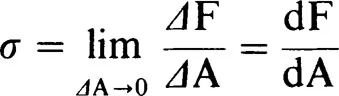
This is the definition of internal stress, which also could be decomposed in the components of respective principal co-ordinate systems (X, Y, Z). It should be understood that the force is a vector quantity defined by magnitude and direction, but the stress is a tensor quantity and is not only defined by its magnitude and direction but also by the direction of the plane upon which it acts.
1.1.2 Stress state at a point in plane
The state of stress at a point considers a small element enclosing the point. If the body is in equilibrium, the stresses are balanced by equal and opposite forces across the element. The components of the traction on the X plane are σx normal to the X plane and τxy along it. The first subscript defines the plane upon which the stress acts and the second subscript defines the direction in which the stress acts. Because the normal st...
Table of contents
- Cover
- Half Title
- Title Page
- Copyright Page
- Table of Contents
- Preface
- 1. Concept of Stress and Strain
- 2. Deformations of Rocks
- 3. Failure of Rocks
- 4. Strength of Rocks
- 5. Monitoring of Rock Structures
- 6. Ground Conditions
- 7. Ground Stresses
- 8. Mine Pillar Structures
- 9. Open Stoping
- 10. Artificially Supported Stope Structure
- 11. Caving and Drawing Methods
- 12. Combined Open/Filled Structures
- 13. External Ground Support
- 14. Internal Ground Support
- 15. Ground Stabilization
- Subject Index
Trusted by 375,005 students
Access to over 1.5 million titles for a fair monthly price.
Study more efficiently using our study tools.
Frequently asked questions
Yes, you can cancel anytime from the Subscription tab in your account settings on the Perlego website. Your subscription will stay active until the end of your current billing period. Learn how to cancel your subscription
No, books cannot be downloaded as external files, such as PDFs, for use outside of Perlego. However, you can download books within the Perlego app for offline reading on mobile or tablet. Learn how to download books offline
Perlego offers two plans: Essential and Complete
- Essential is ideal for learners and professionals who enjoy exploring a wide range of subjects. Access the Essential Library with 800,000+ trusted titles and best-sellers across business, personal growth, and the humanities. Includes unlimited reading time and Standard Read Aloud voice.
- Complete: Perfect for advanced learners and researchers needing full, unrestricted access. Unlock 1.5M+ books across hundreds of subjects, including academic and specialized titles. The Complete Plan also includes advanced features like Premium Read Aloud and Research Assistant.
We are an online textbook subscription service, where you can get access to an entire online library for less than the price of a single book per month. With over 1.5 million books across 990+ topics, we’ve got you covered! Learn about our mission
Look out for the read-aloud symbol on your next book to see if you can listen to it. The read-aloud tool reads text aloud for you, highlighting the text as it is being read. You can pause it, speed it up and slow it down. Learn more about Read Aloud
Yes! You can use the Perlego app on both iOS and Android devices to read anytime, anywhere — even offline. Perfect for commutes or when you’re on the go.
Please note we cannot support devices running on iOS 13 and Android 7 or earlier. Learn more about using the app
Please note we cannot support devices running on iOS 13 and Android 7 or earlier. Learn more about using the app
Yes, you can access Ground Mechanics in Hard Rock Mining by M.L. Jeremic in PDF and/or ePUB format, as well as other popular books in Technology & Engineering & Geology & Earth Sciences. We have over 1.5 million books available in our catalogue for you to explore.