- 448 pages
- English
- ePUB (mobile friendly)
- Available on iOS & Android
eBook - ePub
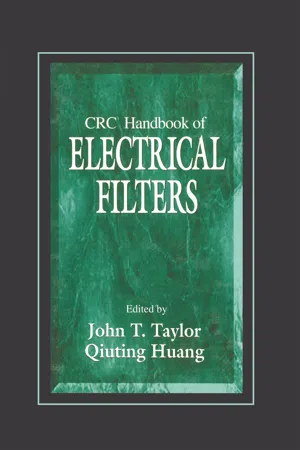
CRC Handbook of Electrical Filters
About this book
Interest in filter theory and design has been growing with the telecommunications industry since the late nineteenth century. Now that telecommunications has become so critical to industry, filter research has assumed even greater importance at companies and academic institutions around the world. The CRC Handbook of Electrical Filters fills in the gaps for engineers and scientists who need a basic introduction to the subject. Unlike the currently available textbooks, which are filled with detailed, highly technical analysis geared to the specialist, this practical guide provides useful information for the non-specialist about the various types of filters, their design, and applications.
The handbook covers approximation theory and methods and introduces CAD packages that perform approximation and synthesis for both analog and digital filters. Also included are design methods for LCR, active-RC, digital, mechanical, and switched capacitor (SC) filters. A thorough survey of current design trends rounds out this complete assessment of a key field of study.
Information
ChapterIntroductionJohn T. Taylor and Qiuting Huang |
1 |
CONTENTS
1. Brief History
2. Purpose and Scope of This Handbook
1. BRIEF HISTORY
Interest in filter theory and design began with the development of the early telecommunications industry in Europe and the U.S., beginning in the late 19th century. Specifically, the need for frequency division multiplexing (FDM) systems to extend the scope of voice telephone networks was a key factor in the stimulation of early research in the area. This led to the discovery of the first image-parameter electric wave filters (independently by Wagner in Germany and Campbell in the U.S.) in 1915. These filters were passive, lumped-element systems which provided an approximate solution to the problem of filtering in the frequency domain. Subsequently, the definition of what a filter is was substantially enlarged to include the time-domain as well as the frequency-domain response.
During the 1920s and 1930s much effort went into developing the theory of the filter design problem, that is, the problem of designing a network with real components to provide a prescribed response to a particular stimulus. This problem divides naturally into two parts: approximation and synthesis. Approximation is concerned with choosing a mathematical function which (1) describes the problem to be solved with sufficient accuracy and (2) is of a form which is known to be realizable using real components (during the period under discussion the components available were passive, consisting of inductors, capacitors, resistors, and transformers). Synthesis identifies the topology and component values of an electrical network (which may or may not be unique) which realizes the approximating function.
In addition to theoretical research, the practical requirement for high-quality filters stimulated the development of components for use in passive LCR filters. Most voice-frequency filters (f < 4 kHz) were realized using these techniques up to the 1960s, and passive LCR filters are still extensively used today in specialized applications where, e.g., wide dynamic range and low noise are required.
In the period following World War II, stimulated by the practical difficulties associated with inductors suitable for low-frequency filtering applications, an interest in inductorless filters began to develop. These active RC filters employed active components (initially thermionic valves, later semiconductor devices and subsystems) in combination with resistors and capacitors to simulate the electrical properties of inductors without incurring the penalties of the use of physical inductors. However, since the time constants of these active RC filters depended on RC products, each unit had to be tuned individually, making the approach fundamentally incompatible with the emerging integrated circuit technologies. This situation was drastically changed in the 1970s by the appearance of switched-capacitor filters. In this approach, which employs both sampled data and analogue techniques, the time constants are defined by capacitor ratios and by the frequency of an externally generated clock, both of which can be specified to high levels of accuracy. In addition, more recently, methods have been described which enable fully integrated continuous-time active-RC filters to be fabricated.
In very demanding applications where bandpass characteristics are required with very sharp attenuation characteristics which cannot be realized using passive LCR filters, mechanical filters are frequently employed. These devices make use of acoustic (mechanical) resonances to perform the filtering of electrical signals. In addition, mechanical filters are highly stable to temperature changes and ageing and are readily manufacturable in miniaturized form at low frequencies. Other types of discrete mechanical filters, employing different types of electromechanical resonance, have also been evolved which are suitable for use in certain important application areas. The main types include crystal filters and ceramic filters, both of which use the piezoelectric effect, but with fundamentally different materials and surface acoustic wave (SAW) filters. All these devices are extensively used in radio communication transceivers, where the noise and dynamic range requirements preclude active filters. Because of the rapid growth of wireless communications services currently, miniaturized passive filters have been the focus of research and development by major manufacturers and their performance improves continually. The chapter on mechanical, crystal, ceramic, and SAW filters will have particular relevance to RF designers.
In complete contrast to the types of filters mentioned above, digital filters have become extremely important in recent years. These filters process binary-coded versions of samples obtained by uniformly and linearly sampling an analogue signal and are therefore entirely digital in operation, unlike switched-capacitor filters, which retain many aspects of analogue signal processing. Digital filters have gained popularity steadily since the 1980s when the first inexpensive single-chip digital signal processors became available.
At the present time, filter research continues at a great pace in industrial companies and academic institutions around the world. For example, much work is being done in the design and development of advanced digital filters, mirroring developments in the design of integrated digital signal processors. Integrated continuous-time filters have also made tremendous progress. They can be found in products such as a disk drive, where the linearity and noise requirements are not so stringent as in other, more traditional applications. As the design of such filters involves a great deal of transistor circuit-level details, it is left out of this handbook.
2. PURPOSE AND SCOPE OF THIS HANDBOOK
This handbook was written as a practical guide for electronic and electrical engineers who are nonspecialists in the areas of filter theory and design. The intention was therefore to provide enough general theory and general information about the various types to be useful, without entering into detailed analysis of the various filter types. Such detailed material can be found in the very many specialist textbooks which already exist on the subject (an exception to this occurs in Chapter 2 where it was felt appropriate to include a section giving some detailed explanation of approximation theory to back up the CAD packages described later on). The handbook covers the frequency range approximately DC-1 GHz and so, e.g., microwave filters are not included, since these are a separate study in themselves.
ChapterApproximation MethodsJürgen Kintscher and R. Unbehauen | 2 |
CONTENTS
1. Survey
1.1 Problem
1.2 Specifications
1.3 Methods
2. Function Parametrizations
2.1 Continuous-Time Systems
2.2 Discrete-Time Systems
3. Error Calculation
3.1 Error Functions
3.2 Generalized Specifications
3.3 Error Criteria
4. Accessory Conditions
4.1 Parameter Fixings and Couplings
4.2 Parameter Constraints
5. Optimization Procedure
5.1 Fundamental Proceeding
5.2 Step Damping
6. Examples
6.1 Analog Lowpass with Prescribed Step Response
6.2 Digital Bandpass with Group Delay Equalization
7. Conclusions
References
1. SURVEY
1.1 PROBLEM
The design of linear, time-invariant, and stable lumped-element filters is mostly based on the evaluation of real, rational transfer functions assuming that the specifications are given in the form of prescriptions for the transfer behavior of the network. This is typical for the synthesis of continuous as well as for the synthesis of digital filters.1,2,3,4 In the case of continuous-time filters the transfer function H(s) must be free of poles in the half-plane Re s ≥ 0, normally excluding “indifferent (simple) poles” on the imaginary axis of the s-plane; in the case of digital filters the transfer function must be free of poles outside of the closed unit disk. This condition guarant...
Table of contents
- Cover
- Half Title
- Title Page
- Copyright Page
- Preface
- The Editors
- Contributors
- Table of Contents
- Chapter 1 Introduction
- Chapter 2 Approximation Methods
- Chapter 3 Computer-Aided Design Methods in Filter Design: S/FILSYN and Other Packages
- Chapter 4 LCR Filters
- Chapter 5 Continuous-Time Active RC Filters
- Chapter 6 Digital Filters
- Chapter 7 Switched-Capacitor Filters
- Chapter 8 Electromechanical Filters
- Index
Trusted by 375,005 students
Access to over 1.5 million titles for a fair monthly price.
Study more efficiently using our study tools.
Frequently asked questions
Yes, you can cancel anytime from the Subscription tab in your account settings on the Perlego website. Your subscription will stay active until the end of your current billing period. Learn how to cancel your subscription
No, books cannot be downloaded as external files, such as PDFs, for use outside of Perlego. However, you can download books within the Perlego app for offline reading on mobile or tablet. Learn how to download books offline
Perlego offers two plans: Essential and Complete
- Essential is ideal for learners and professionals who enjoy exploring a wide range of subjects. Access the Essential Library with 800,000+ trusted titles and best-sellers across business, personal growth, and the humanities. Includes unlimited reading time and Standard Read Aloud voice.
- Complete: Perfect for advanced learners and researchers needing full, unrestricted access. Unlock 1.5M+ books across hundreds of subjects, including academic and specialized titles. The Complete Plan also includes advanced features like Premium Read Aloud and Research Assistant.
We are an online textbook subscription service, where you can get access to an entire online library for less than the price of a single book per month. With over 1.5 million books across 990+ topics, we’ve got you covered! Learn about our mission
Look out for the read-aloud symbol on your next book to see if you can listen to it. The read-aloud tool reads text aloud for you, highlighting the text as it is being read. You can pause it, speed it up and slow it down. Learn more about Read Aloud
Yes! You can use the Perlego app on both iOS and Android devices to read anytime, anywhere — even offline. Perfect for commutes or when you’re on the go.
Please note we cannot support devices running on iOS 13 and Android 7 or earlier. Learn more about using the app
Please note we cannot support devices running on iOS 13 and Android 7 or earlier. Learn more about using the app
Yes, you can access CRC Handbook of Electrical Filters by John Taylor,Qiuting Huang in PDF and/or ePUB format, as well as other popular books in Technology & Engineering & Electrical Engineering & Telecommunications. We have over 1.5 million books available in our catalogue for you to explore.