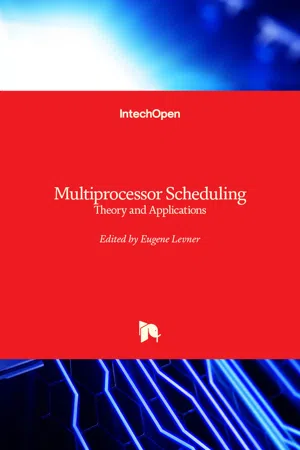
A major goal of the book is to continue a good tradition - to bring together reputable researchers from different countries in order to provide a comprehensive coverage of advanced and modern topics in scheduling not yet reflected by other books. The virtual consortium of the authors has been created by using electronic exchanges; it comprises 50 authors from 18 different countries who have submitted 23 contributions to this collective product. In this sense, the volume can be added to a bookshelf with similar collective publications in scheduling, started by Coffman (1976) and successfully continued by Chretienne et al. (1995), Gutin and Punnen (2002), and Leung (2004).This volume contains four major parts that cover the following directions: the state of the art in theory and algorithms for classical and non-standard scheduling problems; new exact optimization algorithms, approximation algorithms with performance guarantees, heuristics and metaheuristics; novel models and approaches to scheduling; and, last but least, several real-life applications and case studies.
- 452 pages
- English
- PDF
- Available on iOS & Android
eBook - PDF
About this book
Information
Topic
InformatikSubtopic
ProgrammieralgorithmusTable of contents
- Multiprocessor Scheduling, Theory and Applications
- Preface
- Contents
- 1. Cyclic Scheduling in Robotic Cells: An Extension of Basic Models in MachineScheduling Theory
- 2. Combinatorial Models for Multi-agent Scheduling Problems
- 3. Scheduling under Unavailability Constraints to Minimize Flow-time Criteria
- 4. Scheduling with Communication Delays
- 5. Minimizing the Weighted Number of Late Jobs with Batch Setup Times and Delivery Costs on a Single Machine
- 6. On-line Scheduling on Identical Machines for Jobs with Arbitrary Release Times
- 7. A NeuroGenetic Approach for Multiprocessor Scheduling
- 8. Heuristics for Unrelated Parallel Machine Scheduling with Secondary Resource Constraints
- 9. A hybrid genetic algorithm for the re-entrant flow-shop scheduling problem
- 10. Hybrid Search Heuristics to Schedule Bottleneck Facility in Manufacturing Systems
- 11. Solving a Multi-Objective No-Wait Flow Shop Problem by a Hybrid Multi-Objective Immune Algorithm
- 12. Concurrent Open shop Problem to Minimize the Weighted Number of Late Jobs1
- 13. Integral Approaches to Integrated Scheduling
- 14. Scheduling with Setup Considerations: An MIP Approach
- 15. A New Mathematical Model for Flexible Flow Lines with Blocking Processor and Sequence-Dependent Setup Time
- 16. Hybrid Job Shop and parallel machine scheduling problems: minimization of total tardiness criterion
- 17. Identical Parallel Machine Scheduling with Dynamical Networks using Time-Varying Penalty Parameters
- 18. A Heuristic Rule-Based Approach for Dynamic Scheduling of Flexible Manufacturing Systems
- 19. A geometric approach to scheduling of concurrent real-time processes sharing resources
- 20. Sequencing and scheduling in the sheet metal shop
- 21. Decentralized scheduling of baggage handling using multi-agent technologies
- 22. Synchronized scheduling of manufacturing and 3PL transportation
- 23. Scheduling for Dedicated Machine Constraint
Trusted by 375,005 students
Access to over 1.5 million titles for a fair monthly price.
Study more efficiently using our study tools.
Frequently asked questions
Yes, you can cancel anytime from the Subscription tab in your account settings on the Perlego website. Your subscription will stay active until the end of your current billing period. Learn how to cancel your subscription
No, books cannot be downloaded as external files, such as PDFs, for use outside of Perlego. However, you can download books within the Perlego app for offline reading on mobile or tablet. Learn how to download books offline
Perlego offers two plans: Essential and Complete
- Essential is ideal for learners and professionals who enjoy exploring a wide range of subjects. Access the Essential Library with 800,000+ trusted titles and best-sellers across business, personal growth, and the humanities. Includes unlimited reading time and Standard Read Aloud voice.
- Complete: Perfect for advanced learners and researchers needing full, unrestricted access. Unlock 1.5M+ books across hundreds of subjects, including academic and specialized titles. The Complete Plan also includes advanced features like Premium Read Aloud and Research Assistant.
We are an online textbook subscription service, where you can get access to an entire online library for less than the price of a single book per month. With over 1.5 million books across 990+ topics, we’ve got you covered! Learn about our mission
Look out for the read-aloud symbol on your next book to see if you can listen to it. The read-aloud tool reads text aloud for you, highlighting the text as it is being read. You can pause it, speed it up and slow it down. Learn more about Read Aloud
Yes! You can use the Perlego app on both iOS and Android devices to read anytime, anywhere — even offline. Perfect for commutes or when you’re on the go.
Please note we cannot support devices running on iOS 13 and Android 7 or earlier. Learn more about using the app
Please note we cannot support devices running on iOS 13 and Android 7 or earlier. Learn more about using the app
Yes, you can access Multiprocessor Scheduling by Eugene Levner in PDF and/or ePUB format, as well as other popular books in Informatik & Programmieralgorithmus. We have over 1.5 million books available in our catalogue for you to explore.