Sharpening the debate over the values that formed America's founding political philosophy, Barry Alan Shain challenges us to reconsider what early Americans meant when they used such basic political concepts as the public good, liberty, and slavery. We have too readily assumed, he argues, that eighteenth-century Americans understood these and other terms in an individualistic manner. However, by exploring how these core elements of their political thought were employed in Revolutionary-era sermons, public documents, newspaper editorials, and political pamphlets, Shain reveals a very different understanding--one based on a reformed Protestant communalism.
In this context, individual liberty was the freedom to order one's life in accord with the demanding ethical standards found in Scripture and confirmed by reason. This was in keeping with Americans' widespread acceptance of original sin and the related assumption that a well-lived life was only possible in a tightly knit, intrusive community made up of families, congregations, and local government bodies. Shain concludes that Revolutionary-era Americans defended a Protestant communal vision of human flourishing that stands in stark opposition to contemporary liberal individualism. This overlooked component of the American political inheritance, he further suggests, demands examination because it alters the historical ground upon which contemporary political alternatives often seek legitimation, and it facilitates our understanding of much of American history and of the foundational language still used in authoritative political documents.
eBook - PDF
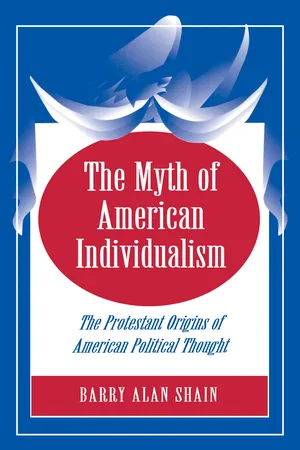
The Myth of American Individualism
The Protestant Origins of American Political Thought
- 418 pages
- English
- PDF
- Available on iOS & Android
eBook - PDF
The Myth of American Individualism
The Protestant Origins of American Political Thought
About this book
Information
Publisher
Princeton University PressYear
2021Print ISBN
9780691029122
9780691033822
eBook ISBN
9780691224992
Topic
HistoriaSubtopic
Historia americana tempranaTable of contents
- Cover Page
- Title Page
- Copyright Page
- Dedication
- Contents
- Acknowledgments
- Preface
- Introduction
- Part One: Standing: The Public Good, The Individual, and the Community
- Part Two: The Meaning of Liberty in the Revolutionary Era
- Afterword
- Bibliography
- Index
Trusted by 375,005 students
Access to over 1.5 million titles for a fair monthly price.
Study more efficiently using our study tools.
Frequently asked questions
Yes, you can cancel anytime from the Subscription tab in your account settings on the Perlego website. Your subscription will stay active until the end of your current billing period. Learn how to cancel your subscription
No, books cannot be downloaded as external files, such as PDFs, for use outside of Perlego. However, you can download books within the Perlego app for offline reading on mobile or tablet. Learn how to download books offline
Perlego offers two plans: Essential and Complete
- Essential is ideal for learners and professionals who enjoy exploring a wide range of subjects. Access the Essential Library with 800,000+ trusted titles and best-sellers across business, personal growth, and the humanities. Includes unlimited reading time and Standard Read Aloud voice.
- Complete: Perfect for advanced learners and researchers needing full, unrestricted access. Unlock 1.5M+ books across hundreds of subjects, including academic and specialized titles. The Complete Plan also includes advanced features like Premium Read Aloud and Research Assistant.
We are an online textbook subscription service, where you can get access to an entire online library for less than the price of a single book per month. With over 1.5 million books across 990+ topics, we’ve got you covered! Learn about our mission
Look out for the read-aloud symbol on your next book to see if you can listen to it. The read-aloud tool reads text aloud for you, highlighting the text as it is being read. You can pause it, speed it up and slow it down. Learn more about Read Aloud
Yes! You can use the Perlego app on both iOS and Android devices to read anytime, anywhere — even offline. Perfect for commutes or when you’re on the go.
Please note we cannot support devices running on iOS 13 and Android 7 or earlier. Learn more about using the app
Please note we cannot support devices running on iOS 13 and Android 7 or earlier. Learn more about using the app
Yes, you can access The Myth of American Individualism by Barry Alan Shain in PDF and/or ePUB format, as well as other popular books in Historia & Historia americana temprana. We have over 1.5 million books available in our catalogue for you to explore.