Here, for the first time, two of Russia's leading economists provide an authoritative analysis of the transition to a democratic market economy that has taken place in Russia since 1990. Serguey Braguinsky, a Russian economist with extensive international experience, and Grigory Yavlinsky, leader of the liberal "Yabloko" party and a major public figure in Russia, focus on the institutions that are critical to a successful transition and the economic incentives needed to make these institutions work. Finally, they discuss in detail the specific components of the economic processes that are necessary for economic transition in general and they draw lessons that can be applied to other nations dealing with similar transitions.
In 1989, Grigory Yavlinsky became a member of the Commission for Economic Reform and wrote the groundbreaking "500 Day Plan," which outlined the first program of transition to a market economy. Two years later, he co-wrote the program of strategic cooperation between the Soviet government and the West (known as the "Grand Bargain"). Here he and Serguey Braguinsky examine what went wrong with the Russian plan--and what is needed to put the economy back on the road to becoming a fully functioning market economy.
The first section of the book presents a new interpretation of the political economy of the socialist state and the incentives and institutions that underpin it, with an emphasis on the present Russian situation. The second part deals with the political economy of "spontaneous transition" and the inefficiencies inherent in economies that lack the organizations and institutions that inhere in established Western democratic economies. In the final section, the authors present a program of actions to put the economic transition in Russia back on track, based on their assessment of the actual current state of both the economy and the government. Their approach is unique in emphasizing organizational evolution at the microeconomic level instead of stressing macroeconomic issues such as money and inflation that are at the heart of most arguments.
This is a thoughtful and thought-provoking book and one that will be widely discussed and debated.
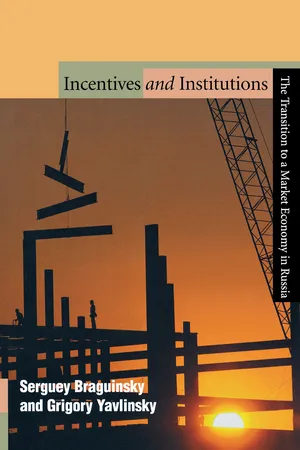
eBook - PDF
Incentives and Institutions
The Transition to a Market Economy in Russia
- 298 pages
- English
- PDF
- Available on iOS & Android
eBook - PDF
Incentives and Institutions
The Transition to a Market Economy in Russia
About this book
Information
Table of contents
- Cover
- Title Page
- Copyright Page
- Contents
- Preface
- Introduction
- Part I: The Political Economy of the Socialist State: Concept, Implementation, Decay
- Part II: The Political Economy of Spontaneous Transition: Insiders’ Markets and the Problem of Economic Efficiency
- Part III: The Political Economy of a New Social Contract: Measures to Promote Democracy, Competition, and Economic Growth
- Conclusion. Can We Do Better?
- References
- Index
Trusted by 375,005 students
Access to over 1.5 million titles for a fair monthly price.
Study more efficiently using our study tools.
Frequently asked questions
Yes, you can cancel anytime from the Subscription tab in your account settings on the Perlego website. Your subscription will stay active until the end of your current billing period. Learn how to cancel your subscription
No, books cannot be downloaded as external files, such as PDFs, for use outside of Perlego. However, you can download books within the Perlego app for offline reading on mobile or tablet. Learn how to download books offline
Perlego offers two plans: Essential and Complete
- Essential is ideal for learners and professionals who enjoy exploring a wide range of subjects. Access the Essential Library with 800,000+ trusted titles and best-sellers across business, personal growth, and the humanities. Includes unlimited reading time and Standard Read Aloud voice.
- Complete: Perfect for advanced learners and researchers needing full, unrestricted access. Unlock 1.5M+ books across hundreds of subjects, including academic and specialized titles. The Complete Plan also includes advanced features like Premium Read Aloud and Research Assistant.
We are an online textbook subscription service, where you can get access to an entire online library for less than the price of a single book per month. With over 1.5 million books across 990+ topics, we’ve got you covered! Learn about our mission
Look out for the read-aloud symbol on your next book to see if you can listen to it. The read-aloud tool reads text aloud for you, highlighting the text as it is being read. You can pause it, speed it up and slow it down. Learn more about Read Aloud
Yes! You can use the Perlego app on both iOS and Android devices to read anytime, anywhere — even offline. Perfect for commutes or when you’re on the go.
Please note we cannot support devices running on iOS 13 and Android 7 or earlier. Learn more about using the app
Please note we cannot support devices running on iOS 13 and Android 7 or earlier. Learn more about using the app
Yes, you can access Incentives and Institutions by Serguey Braguinsky,Grigory Yavlinsky in PDF and/or ePUB format, as well as other popular books in Economics & Development Economics. We have over 1.5 million books available in our catalogue for you to explore.