Contrary to what news reports might suggest, the majority of politicians behave ethically and are never subject to investigations. Is this because of the elaborate system of rules Congress has constructed to regulate the conduct of its members as well as the fear of electoral reprisal? Drawing on economic literature on the behavior of firms, Glenn Parker answers no. He argues that members of Congress behave ethnically not because of the fear of punishment but because of their concern for their reputations. He draws parallels between politicians and businesses, since both stand to suffer significantly when accused of wrongdoing.
Just as business' poor behavior can cause brand names to be tarnished, prices to plummet, and future business to disappear, dishonest politicians stand to sacrifice the human capital invested in their careers, and premiums for honesty, such as electoral security and prestigious post-elective employment. Parker explores public attitudes toward the behavior of members of Congress and shows how those attitudes shape the way members conduct their professional lives. Written from the perspective of public choice, this book offers a novel approach to the question of how to keep politicians honest.
eBook - PDF
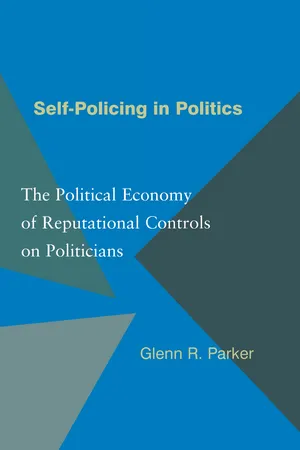
Self-Policing in Politics
The Political Economy of Reputational Controls on Politicians
- 198 pages
- English
- PDF
- Available on iOS & Android
eBook - PDF
Self-Policing in Politics
The Political Economy of Reputational Controls on Politicians
About this book
Information
Table of contents
- Cover Page
- Half-title Page
- Title Page
- Copyright Page
- Dedication Page
- Contents
- List of Figures and Tables
- Acknowledgments
- Introduction
- Chapter 1: What is Opportunism and How Do We Control It?
- Chapter 2: How Reputations Control Cheating in Economics and Politics
- Chapter 3: Problems in the Market for Legislators
- Chapter 4: Hypotheses, Measurement, and Data
- Chapter 5: Constraining Opportunism through Self-Policing
- Chapter 6: Reputational Capital and Job Security; or, If Trustworthy Legislators Are at a Premium, Are They Paid One?
- Chapter 7: Weaknesses in Reputational Controls
- Conclusion
- Appendix 1: Most Important Characteristic for Legislator to Possess: Examples of Category Content
- Appendix 2: Examples of Categories of Employment
- Appendix 3: Codes for Identifying Faithful Agents
- Appendix 4: Lifetime Judicial Appointments: 1965–1996
- Appendix 5: Examples of Prestigious Post-Elective Employment Positions
- Appendix 6: Electoral Defeat and Post-Elective Employment for Senators in the Analysis
- Notes
- References
- Name Index
- Subject Index
Trusted by 375,005 students
Access to over 1.5 million titles for a fair monthly price.
Study more efficiently using our study tools.
Frequently asked questions
Yes, you can cancel anytime from the Subscription tab in your account settings on the Perlego website. Your subscription will stay active until the end of your current billing period. Learn how to cancel your subscription
No, books cannot be downloaded as external files, such as PDFs, for use outside of Perlego. However, you can download books within the Perlego app for offline reading on mobile or tablet. Learn how to download books offline
Perlego offers two plans: Essential and Complete
- Essential is ideal for learners and professionals who enjoy exploring a wide range of subjects. Access the Essential Library with 800,000+ trusted titles and best-sellers across business, personal growth, and the humanities. Includes unlimited reading time and Standard Read Aloud voice.
- Complete: Perfect for advanced learners and researchers needing full, unrestricted access. Unlock 1.5M+ books across hundreds of subjects, including academic and specialized titles. The Complete Plan also includes advanced features like Premium Read Aloud and Research Assistant.
We are an online textbook subscription service, where you can get access to an entire online library for less than the price of a single book per month. With over 1.5 million books across 990+ topics, we’ve got you covered! Learn about our mission
Look out for the read-aloud symbol on your next book to see if you can listen to it. The read-aloud tool reads text aloud for you, highlighting the text as it is being read. You can pause it, speed it up and slow it down. Learn more about Read Aloud
Yes! You can use the Perlego app on both iOS and Android devices to read anytime, anywhere — even offline. Perfect for commutes or when you’re on the go.
Please note we cannot support devices running on iOS 13 and Android 7 or earlier. Learn more about using the app
Please note we cannot support devices running on iOS 13 and Android 7 or earlier. Learn more about using the app
Yes, you can access Self-Policing in Politics by Glenn R. Parker in PDF and/or ePUB format, as well as other popular books in Politics & International Relations & American Government. We have over 1.5 million books available in our catalogue for you to explore.