eBook - ePub
Available until 7 Mar |Learn more
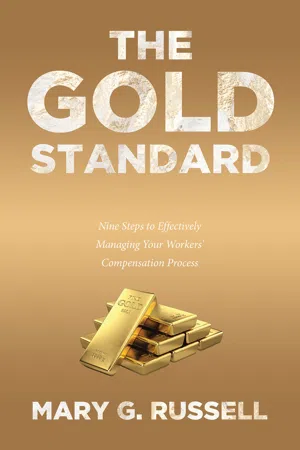
The Gold Standard
Nine Steps to Effectively Managing Your Workers' Compensation Process
This book is available to read until 7th March, 2026
- 68 pages
- English
- ePUB (mobile friendly)
- Available on iOS & Android
eBook - ePub
Available until 7 Mar |Learn more
The Gold Standard
Nine Steps to Effectively Managing Your Workers' Compensation Process
About this book
Workers' compensation is an all-too-often abused, misunderstood, complex, and sometimes poorly managed process that is very costly to an organization. This book is designed to aid HR administrators to effectively manage this process to lower recordable claims, reduce the number of litigated claims, and garner employee support. All with the intent to lower experience modification rate and premiums.
Frequently asked questions
Yes, you can cancel anytime from the Subscription tab in your account settings on the Perlego website. Your subscription will stay active until the end of your current billing period. Learn how to cancel your subscription.
No, books cannot be downloaded as external files, such as PDFs, for use outside of Perlego. However, you can download books within the Perlego app for offline reading on mobile or tablet. Learn more here.
Perlego offers two plans: Essential and Complete
- Essential is ideal for learners and professionals who enjoy exploring a wide range of subjects. Access the Essential Library with 800,000+ trusted titles and best-sellers across business, personal growth, and the humanities. Includes unlimited reading time and Standard Read Aloud voice.
- Complete: Perfect for advanced learners and researchers needing full, unrestricted access. Unlock 1.4M+ books across hundreds of subjects, including academic and specialized titles. The Complete Plan also includes advanced features like Premium Read Aloud and Research Assistant.
We are an online textbook subscription service, where you can get access to an entire online library for less than the price of a single book per month. With over 1 million books across 1000+ topics, we’ve got you covered! Learn more here.
Look out for the read-aloud symbol on your next book to see if you can listen to it. The read-aloud tool reads text aloud for you, highlighting the text as it is being read. You can pause it, speed it up and slow it down. Learn more here.
Yes! You can use the Perlego app on both iOS or Android devices to read anytime, anywhere — even offline. Perfect for commutes or when you’re on the go.
Please note we cannot support devices running on iOS 13 and Android 7 or earlier. Learn more about using the app.
Please note we cannot support devices running on iOS 13 and Android 7 or earlier. Learn more about using the app.
Yes, you can access The Gold Standard by Mary G. Russell,Mary G. G. Russell in PDF and/or ePUB format, as well as other popular books in Business & Human Resource Management. We have over one million books available in our catalogue for you to explore.
Information
Chapter 1
Step 1
Educate Staff on the Importance of Being Safe on the Job
Let’s face it, having a safety program that employees are not aware of will be a flop. Correction, will flop! It is one thing to broadcast, or even post your company’s think-safety-first paraphernalia, but it is an entirely different approach to have a well-thought-out program, which includes a commitment from management, employees, brokers, insurance providers, and industrial clinic staff. It’s also important to have regular, upbeat meetings that engage all workers.
When I consulted for a large personal care manufacturer, with over 250 employees, they discussed safety, but there were no real protocols in place to support it. After some discussions with senior management, they held regular safety meetings. Attendance was mandatory, and signing in was required. The sessions were done in both English and Spanish to ensure everyone was aware that their safety was a primary concern, and they were to follow specific safety guidelines. The employees were also asked to not only look out for themselves but to watch out for each other. If they saw an unsafe condition, and their fellow employee was at risk of being injured, they were to alert that staff. If they couldn’t correct the hazard on the spot, they were to contact someone who could. Common sense, right? Well, you would be surprised at the number of employers who don’t practice common sense, nor do they have regular safety meetings, post safety memos/banners, or even discuss safety. The personal care manufacturer had systems in place, but more could be done.
As business professionals and human resources practitioners, your first priority should be the people you employ. Without them, who will run the business? Management? I don’t think so! It’s that hourly worker, the entry-level, lower-paid staff who keeps that business operating. Therefore, their safety should be your number one concern. While making safety your focus, make sure you have buy-in from the employees to make safety their priority.
In California, employers are to maintain an injury and illness prevention program (IIPP). Every employer has a legal obligation to maintain a safe and healthy work environment for their staff. The IIPP outlines the employer’s responsibility in establishing, implementing, and maintaining such a program. If used correctly, a well-written IIPP has proven, time and time again, to be a very invaluable tool.
The IIPP identifies committee members, who are subject to change, responsible for the safety program, so keep it updated. It explains how to investigate accidents, safety planning, management’s commitment, and so much more. I’ve reviewed and developed IIPP manuals for manufacturing companies that had nothing in place. Title 8 of the California Code of Regulations (T8CCR) section 3203,1 requires every employer to develop, implement and maintain an effective program. Do not wait until a serious incident occurs before putting something in place. Be proactive, not reactive. Failing to have an established program in place could subject your company to significant fines. Know what your state regulations are regarding having a safety program. Let’s be real people, having cute monthly games to play does not “a safety program make.”
Assuming you have a safety program, and you have taken it off the shelf, dusted it off, read it, and updated it, now share that program with your employees. Make that discussion a part of your monthly meetings. Documenting the details of the meetings is a must, and everyone present should sign an attendance sheet. That sheet may come in handy later as explained below.
Years back, I conducted a safety meeting at a manufacturing facility. At that meeting, all employees were advised not to climb the rafters to reach an item on the top shelf, but instead to use a ladder, even if it meant going to the back of the building to retrieve it. They were also advised to have a certified forklift driver to retrieve the item if it was very heavy. The meeting was conducted in both English and Spanish, so the point was made very clear and emphasized repeatedly. A few weeks later, a male employee decided to climb those rafters because in his own words, “it was quicker than getting a ladder,” and he fell backward hitting his back, dead center, on a cart below. He was rushed to the industrial clinic and placed on a WC leave for several weeks with severe back pain. Upon his return the company disciplined him. When he asked why, we reminded him that it was explained to staff, during a safety meeting, not to climb the rafters. He suddenly had amnesia and didn’t remember. Then we showed him the minutes of that meeting and his signature on the sign in sheet. Remember when I said that attendance sheet would come in handy? Having the sign-in sheet available was the perfect “gotcha” moment. Some employees will misrepresent the truth (okay, lie). Having the sign-in sheet available when you question a staff will help your case. He could not refute what was in front of him. He signed the disciplinary action.
Employees have a choice. They can instinctively practice safe methods (which is preferred), or they can undermine authority and do it their way resulting in injury or death. Our role is to continue to educate staff on the importance of being safe on the job. They should want to be safe and not lose time from work. Unfortunately, that is not the case with those who have made it a career to be accident prone. How do you combat that issue? Make safety a part of their job description and performance review. Employees should understand that in their respective roles, they are to practice working safely at all times. Have them sign a new job description. Each time they change roles, or their current position changes, they should sign a job description. Take it a step further by making safety a part of their annual performance review. There is a risk in doing so, however. You risk employees not reporting injuries for fear of getting a poor rating or smaller pay increases. You decide if putting safety on the review makes sense for your organization. Talk with, discipline, and if necessary, terminate those employees who are repeat safety offenders. Seek legal counsel prior to terminating. There should be no issues if discussions are accurately documented.
Years ago, when I consulted for a furniture manufacturer, I participated in an unemployment hearing, as a witness, on behalf of the client. We terminated an employee who violated the same safety rule more than once. You might think that violating a rule twice is not a big deal. Well, that would depend on the safety rule. The employee worked as a carpenter, building furniture. Though he was aware that company policy required that his hand be a certain distance from the blade while cutting, he wasn’t following the guidelines. When we spoke with him about it, he casually stated that he was more comfortable holding his hand closer to the blade to ensure a proper cut. Well, Mr. I-prefer-it-my-way was using that power saw and severely cut his finger and had to be placed on a WC leave. Upon his return, I was walking by his station and noticed him cutting. He had not changed his practices and yet again, held his hand closer to the blade. I waited until he turned off the machine to remind him of the procedure. He acknowledged he understood. I then informed his supervisor. Two days later, I visited his workstation where, once again, I saw him using “his” cutting technique. His hand was closer to the blade. I waited until he stopped the machine and escorted him to his supervisor’s office where the company terminated him for violating a company safety procedure. During the unemployment hearing, we were able to show he was aware of the safety procedure via meetings and sign-in sheets. He was observed on numerous occasions disregarding instructions to follow those procedures. The administrative law judge agreed. His attempt to collect unemployment wages was denied.
Educating employees about your safety program is essential to the program’s success and important for their well-being. When you discuss safety, be cautious not to present it as a set of legal rules or requirements. Employees seem not to like rules or someone being the hall monitor. Make the learning process engaging, informative, and fun. The late Dr. Ralph Smedley, founder of Toastmasters International, once said, “We learn best in moments of enjoyment.”2 Make the meetings about the employee; make the sessions enjoyable. I have found that people listen more when you provide them with statistical data and facts about their work environment. So share!
Over the years, I’ve participated in many safety meetings, and I heard the same old song, just with a different singer. Their talking points were similar. My side comments to these paralyzing (boring) meetings are italicized. Those meetings would go something like this:
Thank you for coming to the safety meeting. As you know, participation is mandatory.
Be sure to sign in before you leave. I want to remind everyone of the importance of being safe on the job. I recognize that we have covered many of these items, but we should review them again because we had several accidents. Accidents are unacceptable! Did you all get a copy of the list of safety rules? Good. Let’s review (blah, blah, blah). As your supervisor (or safety/risk manager), I want you to know we must not have these same repeated accidents. It only hurts you and the company. And the company doesn’t want you hurt! We want you here, and I’m sure you want to be working as well. Are there any questions? (Did they expect questions du...
Table of contents
- Chapter 1
- Chapter 2
- Chapter 3
- Chapter 4
- Chapter 5
- Chapter 6
- Chapter 7
- Chapter 8
- Chapter 9
- Chapter 10