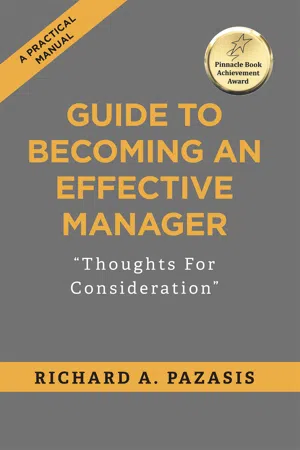
Guide to Becoming an Effective Manager: Thoughts for Consideration is a very focused, succinct, and easy-to-read book for those wishing to develop and perfect leadership and management skills and for employees to understand what type of leadership they should expect to help them successfully meet the mission and goals of their employer while at the same time being fulfilled in their jobs. Its format also provides proven theory with practical applications to be immediately applied while on the
- 124 pages
- English
- ePUB (mobile friendly)
- Available on iOS & Android
eBook - ePub
About this book
Information
Leadership
Leadership means having ultimate responsibility and accountability for successfully carrying out the purpose (i.e., mission) and expectations (i.e., goals) of an organization by selecting, training, supporting, motivating, and steering employees in a direction that creates and sustains a successful organization.
These [successful] organizations had magnetic leaders, a compelling legacy, and held bold, impossible dreams. Their leaders provided an inspiring vision, made all employees feel valued, and worked hard at selecting the right people. (2:8)
Leadership deals with the top line: What are the things I want to accomplish? In the words of both Peter Drucker and Warren Bennis, “Management is doing things Right; leadership is doing the right things.” (3:101)
Leadership is a part of management…but all we ask of leaders is that they influence others to follow. Without leadership, an organization is only a confusion of people and machines. Leadership is the ability to persuade others to seek defined objectives enthusiastically. It is the human factor that binds a group together and motivates it towards goals. (4, para:124)
I am, after all, running a business here. I’m a boss. I’ve got responsibilities—both to the gift-getters and the gift-makers. There are workers to lead, letters to read, orders to fill, processes to manage, stuff to buy, stuff to make, standards to maintain, new technologies to adopt, skills to develop, elf problems to solve, and reindeer droppings to scoop (although I delegate that one). Trust me, I’ve got some big and not-always-easy boots to fill. (5:7)
Leadership is the privilege to have the responsibility to direct the actions of others in carrying out the purpose of the organization, at varying levels of authority and with accountability for both successful and failed endeavors. (10-xiv)
Being a leader is a privilege, and effective leadership requires not only having special attitudes, knowledge, and skills but the ability to get things done through others by using encouragement and praise (i.e., motivation) and without always being the center of attention and constantly “stealing the limelight.” The most effective leaders often work quietly behind the scenes to ensure the success of their organization and bestow such success on their employees. “At times the appropriate leadership action is to stay in the background keeping pressure off the group, to keep quiet so that others may talk, to be calm in times of uproar, to hesitate, and to delay decisions” (4:125). During my career as a CEO, I have been very fortunate to have worked for talented board members, including outstanding board chairpersons. They have always been extremely caring, intelligent, and focused on our organization’s mission. Recently, I received a telephone call from one of my former board chairs. She travels most of the year around the country as a nationally recognized consultant and workshop presenter for the arts. She informed me that she was back in town and would love to meet for breakfast, just to catch up. Well, it turned out to be a wonderful breakfast get-together! And the very next day, I received the following e-mail from her: “You coming to our organization certainly paid off for us. You brought to it a very special kind of leadership. Quiet, but strong. Able to listen and open to ideas. You fostered excellence and community simultaneously. They really were the good old days!”
Senior executives in the good-to-great companies invest in building the company and not themselves. (2:13)
Managers represent the administrative system or management system, and their role is to use organizational behavior to improve people-organization relationships… Managers try to build a climate in which people are motivated, work together, and become more effective persons. (4:5)
You can’t possibly focus on your mission without also focusing on the folks that make your mission happen. The two go hand-in-hand… And besides, since you manage things and lead people, common sense suggests that it’s people who are at the core of all leadership activities. (5:14)
Both a concern for performance and a concern for people are essential. A highly adaptive organization is characterized by managers who serve, equally well, both the corporate and collegial functions. (7:20)
A leader is best when he is neither seen nor heard… (7:98)
Important components to consider when developing an initial implementation plan for the motivation of employees should include the following: (1) Make your business a pleasant, functional, and well-kept place to be. (2) Be a respectful, honest, and supportive manager. (3) Offer rewards such as incentive programs, bonuses, profit sharing, paying for special training, and special job titles. (4) Allow room for growth through advancement opportunities. (5) Share positive and encouraging feedback regarding their input both one-on-one and at group meetings. (6) Be transparent by sharing information about the organization on a regular basis and soliciting, accepting, and using feedback for improvements. (7) When possible, implement flexible work schedules such as flextime, partial work hours from home, and other creative scheduling options. (8) Provide free food and beverages during work hours as a daily appreciation offering. (9) Use recognition and praise for a job well done when deserved, including when they work extra hours or help a coworker. 10) Ask, from time to time, what they feel is most important to help make the organization successful (para, Victor Lipman, Author of Research Study on Employee Motivation: “What Motivates Employees to ‘Go the Extra Mile,’” Mind of the Manager Publication, December 5, 2014).
Leadership can be very exciting and rewarding, but it can also cause much stress and be very draining at times. Leadership needs to result in visible achievements, sometimes against challenging and sometimes insurmountable odds, that are recognized by employees. Therefore, it is not easy being a leader.
Work stress clearly qualifies as a significant organizational challenge for workers, for their leaders, and for their executives. (2:84)
Executives need special support for their work-related well-being. A major reason for this is that these persons are called upon in open-ended ways to serve other employees and the organization. (2:87)
Believe you me, having to smile and be jolly every day when you’re wearing the same thick, red-wool suit that itches like crazy is no picnic. (5:6)
It is soon after a new chieftain is appointed that he will either grow or diminish in the eyes of his subordinates, peers, and superiors. If he is prudent in the application of his authority, demonstrates a spirit of commitment and sees that all obligations are met, the chieftain will enlarge his stature. Then, he will have gained personal loyalty, trust, confidence and respect from all the Huns under his command, from his peers and superiors. (10:97–98)
Important components to consider when developing an implementation plan for the initial and immediate awareness of the general attributes required to become an effective manager, until being able to develop a more solid and long-lasting knowledge and skill base as the result of studying and practicing management practices based on proven research and theory, should include the following: (1) Know your organization’s vision and major goals and make certain that all employees also know the vision and main goals. 2) Be both physically and mentally accessible to employees. (3) Be considerate of employee needs. (4) Provide employees with the training, tools, resources, and feedback required for success. (5) Keep employees in the “what’s happening” information loop. (6) Help employees maintain an appropriate balance between their professional and personal lives. (7) Demonstrate respect for employees’ time and talents as well as respect for them as individuals. (8) Help employees develop in their jobs and also have opportunities to advance within the organization. (9) Fairly distribute the work and workload. (10) Make certain that all employees understand the behaviors and performance outcomes that are expected to meet the organization’s vision and main goals and implement effective evaluations of all employees based on the vision and main goals (5, para:12–17).
Here are some thoughts for consideration as to what helps make an effective leader:
- To be visible and visibly proud of your organization, both internally and externally, and to be its number one cheerleader Research shows a strong correlation between pride in the organization and the overall satisfaction of workers with that organization. (2:47)I am extremely proud of the workshop that the elves, reindeer, and I have created—and we are more than happy to show it off… Yes, we do run a productive and happy place here. And that’s in spite of the intense pressures and challenges we face… (5:12)Attila’s presence was felt wherever he rode or rested. He was not only a Hun, he was the most distinguished Hun of all… He was, after all, their leader… (10:50)I, Attila, King of the Huns, have called this assembly of chieftains and mighty warriors together for the purpose of encouragement. Further, my aim is to kindle the fires of your emotional stamina so that you may not become hopeless in the face of disappointment. (10:87)There’s a lot of pride that business owners have. It’s actually really critical that pride and ownership extends to everyone in the organization. I think of everyone in the same boat is driving the company forward. (Aaron Levie, American entrepreneur and CEO of Box Cloud)Organization pride is stronger for employees if they believe management listens to them and if their co-workers respect them. (Bruce L. Katcher, industrial/organizational psychologist)Organizational pride is a win-win for everyone. Pride is a catalyst for focusing on task, effort, and persistence. And it spurs us on to help others, creating powerful and uplifting feelings of connectedness and belonging, all of which build happiness at work. (Jessica Pryce-Jones, author of Happiness at Work)Important components to consider when developing an implementation plan for being visible and being the organization’s number one cheerleader should include the following: (1) Publish both internal and external publications regarding the accomplishments of the organization on a periodic basis. (2) Provide regular press releases containing the organization’s successes. (3) Develop videos for both external and internal use that highlight the organization’s successes. (4) When in public, always stress the positives (i.e., any negatives should always be kept in-house where they are best resolved). (5) Schedule periodic group and one-on-one meetings to convey your appreciation for and pride in all employee contributions and accomplishments (Richard A. Pazasis, Retired Executive and Author of Guide to Becoming an Effective Manager: Thoughts for Consideration).
- To consistently convey your organization’s vision, mission, and goals through writings, at meetings, during presentations, and when making decisions Although leaders have many roles in which they must excel, creating a vision and transforming that vision into strategy is central to their position. Vision is important because it is necessary to have a clearly defined ro...
Table of contents
- Who You Are
- Leadership
- Organization
- Goals
- Communication
- Administration
- Management
- Managerial Improvement Chart
Trusted by 375,005 students
Access to over 1.5 million titles for a fair monthly price.
Study more efficiently using our study tools.
Frequently asked questions
Yes, you can cancel anytime from the Subscription tab in your account settings on the Perlego website. Your subscription will stay active until the end of your current billing period. Learn how to cancel your subscription
No, books cannot be downloaded as external files, such as PDFs, for use outside of Perlego. However, you can download books within the Perlego app for offline reading on mobile or tablet. Learn how to download books offline
Perlego offers two plans: Essential and Complete
- Essential is ideal for learners and professionals who enjoy exploring a wide range of subjects. Access the Essential Library with 800,000+ trusted titles and best-sellers across business, personal growth, and the humanities. Includes unlimited reading time and Standard Read Aloud voice.
- Complete: Perfect for advanced learners and researchers needing full, unrestricted access. Unlock 1.5M+ books across hundreds of subjects, including academic and specialized titles. The Complete Plan also includes advanced features like Premium Read Aloud and Research Assistant.
We are an online textbook subscription service, where you can get access to an entire online library for less than the price of a single book per month. With over 1.5 million books across 990+ topics, we’ve got you covered! Learn about our mission
Look out for the read-aloud symbol on your next book to see if you can listen to it. The read-aloud tool reads text aloud for you, highlighting the text as it is being read. You can pause it, speed it up and slow it down. Learn more about Read Aloud
Yes! You can use the Perlego app on both iOS and Android devices to read anytime, anywhere — even offline. Perfect for commutes or when you’re on the go.
Please note we cannot support devices running on iOS 13 and Android 7 or earlier. Learn more about using the app
Please note we cannot support devices running on iOS 13 and Android 7 or earlier. Learn more about using the app
Yes, you can access GUIDE TO BECOMING AN EFFECTIVE MANAGER by Richard Pazasis in PDF and/or ePUB format, as well as other popular books in Business & Leadership. We have over 1.5 million books available in our catalogue for you to explore.