What war on drugs? Is our government complicit in the continued proliferation of the illegal drug trade in our nation? This supposed war on drugs has been ongoing for better than one hundred years with no apparent conclusion in sight. Perhaps we should entertain a new strategy to achieve ultimate victory in this never-ending conflict.Our criminal court system provides numerous avenues for offenders to eschew responsibility for their misdeeds. Overburdened criminal courts rely heavily u
- 130 pages
- English
- ePUB (mobile friendly)
- Available on iOS & Android
eBook - ePub
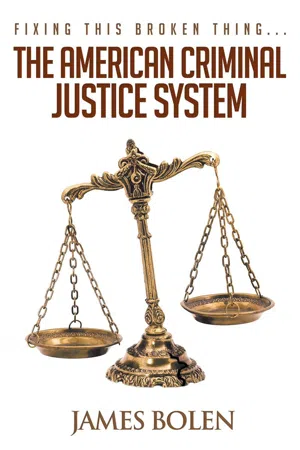
Fixing This Broken Thing...The American Criminal Justice System
About this book
Information
Chapter 1
Criminal Court
And Justice for All, the 1979 film written by Barry Levinson, produced and directed by Norman Jewison. It stars Al Pacino as attorney Arthur Kirkland. Following is part of Attorney Kirkland’s opening remarks to a jury in the film’s final scene: “These proceedings are here to see that justice is done. And justice as any reasonable person will tell you is the finding of the truth…Let’s go back to justice. What is justice? What is the intention of justice? The intention of justice is to see the guilty people are punished, and the innocent people are freed. Simple, isn’t it? Only it’s not that simple. However, it is the defense counsel’s duty to protect the rights of the individual, as it is the prosecution’s duty to uphold and defend the laws of the state. Justice for all. Only we have a problem here. And you know what it is? Both sides want to win. We want to win. We want to win regardless of the truth. Regardless of who’s guilty or innocent. Winning is everything!” As opposed to an arena for competition our criminal courts system should be a fact finding exercise in pursuit of the truth. However, you get the justice for which you can pay. That axiom has been commonly accepted for more years than I can count. We have come to accept that high-priced mouthpieces, sharks or shyster lawyers can be the difference between a verdict of guilty or not guilty. In our current system, not guilty does not always mean innocent. There is “guilty” and “guilty under the law.” Public defenders are often viewed as substandard lawyers that could not make it to the big name private law firms. The “heavy hitters” command the big bucks and can manipulate the system in any manner necessary to ensure an acquittal or substantially reduced penalty for their clients. If the accused has enough money, he or she can buy their way into more desirable outcomes. The disparity of the resources available to the Public Defender’s Office and the offices of large private law firms can be as wide as the Grand Canyon. Equally wide can be the disparity of resources between the prosecutor’s office and those of private law firms. The attorneys may be equally talented, but the playing field is decidedly bent in favor of the side with the most resources—money. Additionally, the case load for the government attorneys, public defenders and prosecutors is clearly more demanding. Socioeconomic status can be a more determinant factor in criminal cases than the truth. In my opinion, this represents “separate but equal” justice. And of course, that weighs heavily in favor of the more affluent be it victim or offender, and this has become acceptable in our society. How can we be so accepting, so comfortable with this reality? Taxation without representation was not acceptable; separate but equal public accommodations are not acceptable; voting rights for male whites only is not acceptable; separate but equal justice is equally not acceptable. Our criminal courts have often been described as an adversarial system. Whichever side has the best presentation wins. Johnnie Cochran said, “If it doesn’t fit, you must acquit.” My assertion is that the criminal court system should be a fact-finding exercise in pursuit of the truth. Justice is attained only after the truth is revealed.
In 1982, James Ealy was convicted of the murders of Christine Parker and her three children. One of the three children, a three-year-old boy was sexually assaulted by Ealy. At the time of this incident, Ealy was on bond for a criminal sexual assault. Ealy’s convictions were overturned by an appellate court, citing the police had no probable cause for his arrest. According to the police report, Ealy was briefly interviewed in his apartment and then invited to voluntarily come into a police facility for questioning. The officers did not draw their weapons, handcuff him or announce that he was under arrest. Ealy was advised his Miranda rights before questioning.
During the appellate hearing, the defense argued that Ealy was held for eighteen hours and given little opportunity to relieve himself; therefore, he was under arrest. Ealy signed a “consent to search” form for his bedroom, and the police recovered incriminating evidence therein. Ealy confessed to the crimes. With one dissenting justice, the panel of three judges overturned Ealy’s convictions. Judge Thomas Maloney, who presided over Ealy’s original trial, made this statement: “When this dangerous man is released from the penitentiary, the state should rent every billboard in the county and state to announce that he has been turned loose.”
In December 2006, James Ealy was arrested for the murder of Mary Hutchinson. Mrs. Hutchinson was the manager of the Burger King at which Ealy worked. There is no amount of public outcry that can right this wrong. There is no way to hold culpable the police officers that arrested Ealy for the four murders in the Rockwell Gardens housing project in Chicago. We cannot formally assign blame to the appellate court judges that freed Ealy for what they interpreted as a violation of his constitutional rights. As a society, we have to swallow this outcome; we have to settle upon the fact that the family of Christine Parker received no justice for their losses. We have to grin and bear the fact that this “dangerous man” was free among us, and while free, he lawlessly took the life of Mary Hutchinson. We have to accept this because in our system of justice, following the rules is more important than justice for the victims of wrongdoing. We are encumbered with a system that fosters concealment of the truth as an acceptable strategy in criminal court proceedings. It appears that our criminal court system is more concerned with supporting its competitive nature as opposed to uncovering the truth and meting out justice.
In no way do I support a system that tolerates violating constitutionally protected rights. My concern is that our system provides opportunities for guilty persons to avoid the consequences of their crimes. We must call upon our Supreme Court to reverse Mapp v Ohio and eviscerate, dissolve, throw out the exclusionary rule. I understand its intent; it is critically important that law enforcement officials do not violate our constitutional rights. Police officers must be restrained; they must not be allowed to adopt a “by any means necessary” approach to enforcing the law. At present, when the officer makes a mistake, only the victim and his/her family suffer any consequence. The offender is freed of any responsibility, and at worse, the officer gets embarrassed in court. Law enforcement is more than a job, it is a sacred profession. The men and women that don those uniforms and report for duty every day have sworn an oath to perform some of the most difficult tasks required by our society. They must and should be appreciated. And they must and should be held accountable for every aspect of the service they provide. If/when a police officer makes a mistake while enforcing a violation of the law, that officer should be mandatorily disciplined by his/her agency for that mistake. Each man and woman that dons the uniform of a police department has attended a training academy and successfully completed the training. Each police officer has satisfactorily completed the required testing of that training academy AND passed a mandatory licensing exam required from the state in which they shall police. Many police agencies conduct roll call training daily. And in some police agencies, there is mandatory annual in-service training. Given these facts, there is no acceptable excuse for an officer to operate outside of department policy and state law. I recognize that each officer is human, and that there are NO perfect people. However, as police officers, we are held to a different standard given the awesome responsibility of that office. A matrix should be established with clear and determinate consequences for the various missteps an officer can make. There should be absolutely no variance for making these mistakes. However, there should never be any mistake that excuses the offender of the consequences of his/her deeds.
There have been occasions when law enforcement officials have committed crimes against the offenders they have arrested. There have been offenders that were physically abused as punishment for their crimes. Some confessions have been beaten and/or tortured out of arrestees. There is absolutely no excuse for this treatment, and the officers guilty of such should be prosecuted to the fullest extent of the law. But again, the crimes committed against the guilty persons should not excuse them from the legal punishment they should receive.
Utilizing the Criminal Justice System to address crimes committed against our citizenry is part of the bedrock of our society. Citizens are consistently urged to summon the police when they have been victimized. However, far too often, the victims do not attain the justice they seek and deserve. There exists jargon that states there is “guilty,” and there is “guilty under the law.” I submit guilty is ALWAYS guilty regardless of circumstances. There is absolutely no logical reason to excuse the crimes of any person because of actions or inactions by others. Everyone of sound mind must be held accountable for his/her actions. When the system fails to punish the offender, the victim is left feeling twice victimized. Victims are encouraged to utilize the system as opposed to seeking justice on their own. It is incumbent upon the system to adequately provide the justice the victim deserves.
720 ILCS 5/12-3.05 (ILCS…Illinois Compiled Statutes…The Criminal Code)
A person commits aggravated battery when, in committing a battery, other than by the discharge of a firearm, he or she knowingly does any of the following:
(1) Causes great bodily harm or permanent disability or disfigurement
One of the cases I handled as a Chicago police officer involved a woman being struck at the top of her head and down the right side of her face with a heavy glass ashtray. She suffered seventy-six stitches and lost use of her right eyelid. I made an arrest and attempted to secure the appropriate felony charge, aggravated battery. The assistant state’s attorney in felony review rejected the felony charge which left me with no alternative but charging the offender with a misdemeanor offense. The details of this case are as follows:
Mary is a middle-aged homeowner and has been in her home for twenty-two years. She is a widow, and her children have moved out and are living their own lives. Her slightly younger brother Fred has fallen upon some difficult times, and Mary has allowed him to move in with her until he can do better. Pam lives on the same block and has been there at least fifteen years. Pam and Mary do not get along at all; they barely speak to one another and never visit with one another. Unbeknownst to Mary, Pam develops an interest in pursuing a personal relationship with Fred—she thinks he’s really handsome. One summer evening, Pam decides to visit Fred as she wants to make her interest known to Fred. As it is summer, Mary’s front door is open; the storm door is closed but unlocked. Pam brazenly opens the door and enters Mary’s house. When Mary came to the door to question why she entered her home without at least the courtesy of ringing the bell, Pam responded, “I didn’t come here to see you, I came to see Fred.” In response, Mary told Pam that this was her house, and that Fred was just visiting. She instructed her to leave her home immediately and not to return. Pam responded that since she was there to see Fred that only Fred could make her leave. The two ladies began a verbal altercation during which Mary complained of spittle hitting her. Pam disregarded her complaint and continued yelling; Mary threw a half cup of water at Pam. Pam responded by grabbing a large glass ashtray from the inn table and striking Mary at the top of her head above her right eye and down her face to her cheek. As previously stated, it took seventy-six stitches to treat Mary’s wound, and her right eyelid will never again close completely. When I questioned the assistant state’s attorney about refusing the felony charges, he responded that since the victim was not admitted into a hospital, he could not justify approving felony charges. As I reread the law, 720 ILCS 5/12-3.05, I failed to find any language that required the victim be hospitalized. That requirement completely escaped me, but it was offered as justification for this assistant state’s attorney’s refusal of felony charges.
720 ILCS 5/18-1
According to 720 ILCS 5/18-1, a person commits robbery when he or she takes property, except a motor vehicle from the person or presence of another by the use of force or by threatening the imminent use of force. According to the Illinois Compiled Statutes, this offense is a felony.
I responded to a call of a “battery in progress” and found a sixty-three-year-old male, black, five feet eight and approximately 160 lbs. It was approximately 10:30 a.m., and the victim had been forced into an alley, beaten and robbed. It was the first of the month and the victim, George, had just left the currency exchange where he had cashed his social security check. The victim was able to give me a fairly good description of the assailant, and I issued a BOLO (be on the lookout) over the radio. Several minutes later, an officer responded that he had detained an individual that fit the general description. I drove George to that location, and he positively identified the man as the person who robbed. The assailant had the exact dollar amount of George’s check in his pocket. The assailant, Ted, was taken into custody and transported to our district station for processing. The assistant state’s attorney on duty approved the felony charges, and Ted was officially charged accordingly.
Thirteen months later, this case proceeded to trial as Ted refused the plea bargain. Ted had a lengthy criminal history, and he was advised that this charge would result in some serious time in prison. On the day the trial was to take place, I reported to the courtroom and observed that George was present and awaiting trial. The assistant state’s attorney that was to try the case summoned us into the rear of the courtroom for pretrial interviews. After interviewing George, she interviewed me. Midway through the interview with me, she stated that I was lucky that she was not in felony review the day this arrest was made. She went on to say that she would have never approved the felony charges as the victim doesn’t speak well. It is extremely difficult to understand what he is saying, and he seems to have difficulty understanding simple questions. She concluded by saying that I should not expect much; she probably would not be able to win this case. I reframed from comment and went to the jury room to collect myself. Yes, she had REALLY angered me as I just could not understand her defeatist attitude. George was not a scholar, but George IS just as human as any other person. I feared this prosecutor would not make a sincere effort to secure this conviction. I could not conceive why given the evidence we had, securing a conviction in this matter would be extraordinarily difficult.
Ted opted for a bench trial, and an hour later, he was found guilty of strong armed robbery. After the proceedings were complete, I could not completely restrain myself. I approached this assistant state’s attorney and told her that I was oh so very happy that she was not in felony review the day of this arrest. Had she been there, George would have been denied the justice he so richly deserved strictly because he was not very well educated and/or articulate enough to satisfy her.
I am not going to attempt to excuse the insensitivity demonstrated by the assistant state’s attorneys in the scenarios I just described. However, I’d like to offer some insight. Many of us have developed an image of our Criminal Justice System based upon stellar television dramas like NBC’s Law & Order. During my policing career, I cannot tell you how many times I heard, “I know my rights, I watch Law & Order every week.” I would then have to explain there’s television, and then there’s real life. Welcome to reality. The assistant state’s attorneys in television dramas are assigned a case, one case and spend hours investigating this case and preparing for the impending trial. They leave the office and go out into the field and conduct their own private investigations and have time enough to bring charges against the actual offender as oftentimes the police arrested the wrong person. This makes for good fictionalized drama, emphasis on fictionalized.
In criminal courts all over this country, every Monday thru Friday, the prosecutors and public defenders enter courtrooms at approximately 8:30 a.m. Pushing a cart carrying at least thirty files, those files represent the morning call—the cases that will be heard that morning. After lunch, the prosecutors and public defenders will enter the courtroom with the same cart bearing the same number of files. Only these are thirty different files than the thirty they had that morning. That is the afternoon call. Of course, this will vary from jurisdiction to jurisdiction, but the general idea is the same. These offices, public defender and prosecutor do not have the manpower and/or resources to investigate each individual case in the manner portrayed in our popular television dramas and movies. The harsh reality is for the most part, the criminal court system is operated like an assembly line. Due to the sheer volume of cases, there is an extraordinary emphasis on ensuring that cases do not come to trial. Attorneys on both sides of the aisle work diligently to reach plea agreements and keep the trial calendar at bare minimum. These same attorneys are evaluated by the number of cases that do not reach trial. Prosecutors must consistently secure a high conviction rate in order to maintain employment. It is critically important that their politician bosses are in position to report to their constituencies they have convicted a high volume of offenders. The politician boss must be in position to report that he/she has supervised a staff that has won convictions for the vast majority of the cases they’ve handled.
Our criminal court system is commonly described as an adversarial system, a competition. It is a system where opposing counsel is supposed to argue matters of fact before an unbiased magistrate in order to attain justice. More simply expressed, defense lawyers and prosecutors are pitted against one another in the presence of a neutral judge to determine the guilt or innocence of the accused. I invite you to pause for a moment and consider w...
Table of contents
- Chapter 1
- Chapter 2
- Chapter 3
- Chapter 4
- Chapter 5
- Chapter 6
Trusted by 375,005 students
Access to over 1.5 million titles for a fair monthly price.
Study more efficiently using our study tools.
Frequently asked questions
Yes, you can cancel anytime from the Subscription tab in your account settings on the Perlego website. Your subscription will stay active until the end of your current billing period. Learn how to cancel your subscription
No, books cannot be downloaded as external files, such as PDFs, for use outside of Perlego. However, you can download books within the Perlego app for offline reading on mobile or tablet. Learn how to download books offline
Perlego offers two plans: Essential and Complete
- Essential is ideal for learners and professionals who enjoy exploring a wide range of subjects. Access the Essential Library with 800,000+ trusted titles and best-sellers across business, personal growth, and the humanities. Includes unlimited reading time and Standard Read Aloud voice.
- Complete: Perfect for advanced learners and researchers needing full, unrestricted access. Unlock 1.5M+ books across hundreds of subjects, including academic and specialized titles. The Complete Plan also includes advanced features like Premium Read Aloud and Research Assistant.
We are an online textbook subscription service, where you can get access to an entire online library for less than the price of a single book per month. With over 1.5 million books across 990+ topics, we’ve got you covered! Learn about our mission
Look out for the read-aloud symbol on your next book to see if you can listen to it. The read-aloud tool reads text aloud for you, highlighting the text as it is being read. You can pause it, speed it up and slow it down. Learn more about Read Aloud
Yes! You can use the Perlego app on both iOS and Android devices to read anytime, anywhere — even offline. Perfect for commutes or when you’re on the go.
Please note we cannot support devices running on iOS 13 and Android 7 or earlier. Learn more about using the app
Please note we cannot support devices running on iOS 13 and Android 7 or earlier. Learn more about using the app
Yes, you can access Fixing This Broken Thing...The American Criminal Justice System by James B Bolen PhD in PDF and/or ePUB format, as well as other popular books in Politics & International Relations & American Government. We have over 1.5 million books available in our catalogue for you to explore.