During the dark days of World War II, forty-one individuals from Ganson Street in the industrialized Western New York city of North Tonawanda left all that was dear to battle the domination of the Axis forces. The Ganson Street Tigers bonded on the streets of an immigrant neighborhood during the Great Depression and their camaraderie was cemented forever on the ball diamonds and sandlots of their youth. This is their story, from the heart of Little Italy to the raging battlefields
eBook - ePub
The Ganson Street Tigers Go to War
A Western New York Community's Commitment to Winning World War II
- 556 pages
- English
- ePUB (mobile friendly)
- Available on iOS & Android
eBook - ePub
The Ganson Street Tigers Go to War
A Western New York Community's Commitment to Winning World War II
About this book
Information
The Early Years
One generation passeth away,
and another generation cometh:
but the earth abideth for ever.
Ecclesiastes 1:4
In the realm of human memory the murky creek had always existed eleven miles above the raging cataract of Niagara Falls. Two hundred years ago a mosquito-infested wilderness dominated this narrow ribbon of water where it ebbs into the mighty Niagara River. At this junction the unwavering current of the great river sweeps the curved banks of its eastern shoreline and rushes through a channel that separates a small isle from the mainland. The Native Americans identified this area in their ancient tongue as “tonawanda”, meaning swift running water. The white men who traversed the region lent the name to the near stagnant creek that stretches ninety meandering miles into a vast tract of land known as Western New York.
The calmness of this virgin forest was disturbed in the year 1801 when soldiers of the young Republic were ordered to cut a road through the dank woodlands. General James Wilkinson commanded the expedition intent on linking the garrison at Fort Niagara on the lower Niagara River with the settlement of New Amsterdam (Buffalo) on the upper reaches of the watercourse. The US Government had entrusted the mission to an officer with a checkered past. General Wilkinson was a flabby, balding Revolutionary War veteran and was later found to be a spy in the service of Spain. Historian Robert Leckie summarized his career as, “a general who never won a battle or lost a court-martial.” But, Wilkinson and his command succeeded with the construction of the military road and a series of bridges needed to traverse numerous tributaries feeding the grand river. A rough-hewn bridge constructed across Tonawanda Creek allowed the uninterrupted passage of military personnel and goods between the isolated settlements. To protect the vital span, the US Army constructed a log blockhouse and stationed a small detachment of blue-coated infantrymen. Among the guard was Lieutenant John Sweeney, a Buffalo businessman, who would become a prominent land speculator along Tonawanda Creek years later. In 1808, Henry Anguish became the first settler along the banks of the creek. He raised a small cabin and cleared some farmland. Anguish’s entrepreneurial spirit led him to build a tavern three years later, and his best, and possibly his only, customers were the soldiers from the blockhouse a short distance away.
Settlers quickly developed the lands near the bridge and along the military road. The dense forests of oak trees disappeared under the swing of broad axes and the cleared land was cultivated. The prosperity of the frontier community was destroyed during the War of 1812 when British soldiers torched nearly every structure along the Niagara River. American militiamen had burned the sturdy bridge over Tonawanda Creek in 1813 to prevent the advance of the British upon the village of Buffalo. This action had only temporarily saved the village. A few days later, British forces crossed the Niagara River and burned Buffalo, leaving only the stone foundations and chimneys in the smoldering ruins. After the peace, the hardy settlers returned to their charred homes to rebuild their lives. Pioneering men such as Colonel John Sweeney, George Goundry, and Stephen Jacobs utilized the wood and water resources of the region to accumulate small fortunes and the settlement along the creek grew and prospered. With the westward expansion of the nation, the need to ease travel and stimulate commerce became an important concern. Businessmen and government officials looked to mimic the canals of Europe as a solution. A backwater politician named DeWitt Clinton spearheaded a bold plan to cut a canal across New York State. The plan was masterminded by a collection of brilliant engineers and the construction of the longest canal in the world was begun. In a few short years, the waters of Tonawanda Creek were incorporated into the Erie Canal system and the area’s population quickly boomed. The canal, which opened in 1825, stretched across New York State bringing commerce and wealth to ports located on the waterway. Settlers traveling westward on overcrowded packet boats flooded Western New York, while other barges carried lumber and produce to large markets in the eastern part of the state. The Erie Canal also carried hundreds of European immigrants into Western New York. These settlers, mainly of German origin, searched for work in the mills and purchased tracts of land to farm.
The area at the confluence of the Niagara River and Tonawanda Creek became synonymous with the lumber trade. Numerous ships carrying timber from nearby Grand Island, America’s midlands, and the wilds of Canada, docked at the local wharfs. More than one hundred businesses related to the lumber industry were located in the Tonawandas over the next 120 years, and the small port on the Niagara River was known as the greatest lumber port in the world.
Eleven years after the opening of the Erie Canal, another technological innovation was introduced to the villages along this waterway. Gangs of Irish laborers laying iron rails worked their way to the area. A short time later, the chugging steam locomotives of the new industrial age began to transform the economic and transportation infrastructure of the fledgling settlements. Despite the coming of the railroad, the presence of sweating draft animals pulling barges on the canal continued for another fifty years. Soon after the arrival of the railroad, steam-powered machinery began to alter the lumber industry. Sooty clouds of black smoke dirtied the skies and massive piles of machine-processed lumber dominated the landscape.
By the autumn of 1861, it was evident the industrial output of the villages huddled against the banks of Tonawanda Creek would be utilized in the war effort against the southern states. Early in the war, local civic leader Lewis S. Payne received permission from the government to raise a company of soldiers for the 100th New York State Volunteer Infantry Regiment, nicknamed the “Board of Trade Regiment”. The unit was organized by the Buffalo Board of Trade, a civic organization that fostered goodwill between merchants in the big port city. The regiment marched off to war in 1862, its ranks deluged with German immigrants. During the Civil War, casualties decimated the 100th Infantry Regiment and Payne was captured by rebel troops. Upon his return from the war, he found the villages that straddled the creek had separated and the community on the north side of the muddy waters had incorporated, naming itself North Tonawanda. The split meant more to the tax collector than the average citizen, and many continued to traverse the wood bridges to labor in the shops and mills located throughout the two towns now located in separate counties. Lumbering and brick-making industries dominated the economic scene until 1870 when the Niagara River Iron Company fired up its blast furnaces on the north side of the creek. The iron company was in need of many new workers and some of the first immigrants from Eastern Europe and Italy relocated to the Lumber City. These unskilled settlers, who had suffered from chronic poverty and oppression in Russia, Sicily, and southern Italy, took on the lowest paying jobs and lived in shacks constructed from discarded wood and packing crates. The new immigrants clustered together on undeveloped parcels of land and found mutual support in a society that did not understand or accept their languages, customs, and superstitions. “The Ku Klux Klan was big in North Tonawanda in the old days,” said Ganson Street resident Patrick DePaolo. “Every bridge leading into the city had a sign on it that said, ‘No Coloreds’. They [the Klan] weren’t fond of Italians either, they called us dagos, wops, and garlic eaters and the Italians suffered a lot of abuse. That’s how the immigrant neighborhoods formed. The Italians had their own church, school, and stores. Everybody knew everybody else in the neighborhood and they looked out for each other.”
Outsiders looked upon the Italians with scorn. The immigrants, especially from southern Italy and Sicily, were very superstitious. Pierced ears were common, even with infants, in the belief that gold near the eyes produced keen eyesight. Bewitching by means of a sordid glance, known as, Malocchio, or “the evil eye”, was greatly feared and a ritual involving olive oil and cold water could only lift the curse. There was also the superstition that mentioning Satan after midnight would bring one face-to-face with the evil devil. The custom of leaving food on the dinner table on November 2, or All Souls Day, in the belief that dead relatives would return to the family was alien to those who were not accustomed to the practices of the Roman Catholic Church.
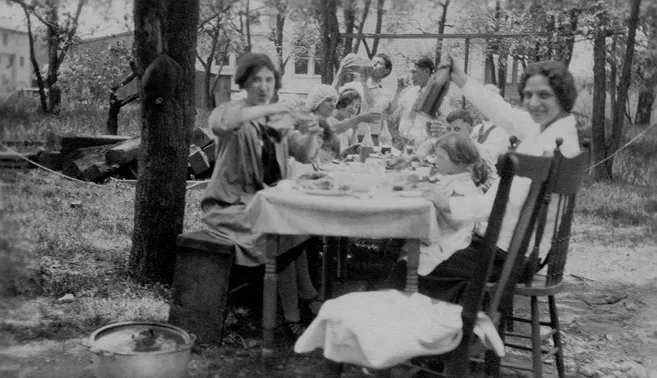
The spirit of Little Italy - A celebration with family, friends, pasta, and red wine. Immigrants in America found support, security, and friendship in ethnic neighborhoods. (Authors’ Collection)
At the turn of the twentieth century, North Tonawanda had been incorporated as a city and industrial based businesses were booming. By this time, nearly one million Italian immigrants had also entered the country and settled mainly in large cities on the East Coast. Seeking to escape city slums and overcrowded tenement houses, many Italians boarded canal boats and worked their way into Central and Western New York seeking employment in port towns located on the vast highway of water. The Tonawandas, with its large industrial base, became an important destination for immigrants searching for work and the “American Dream”. Menial jobs were readily found in factories that produced lumber, bricks, and textiles. Employment could also be obtained in other local companies that manufactured musical instruments, automobiles, carousels, and even chocolate.
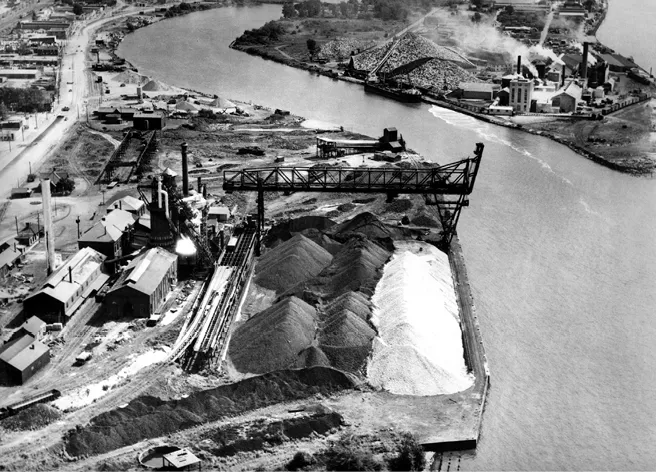
The Twin Cities were old industrial towns known for manufacturing many products including lumber, iron, steel, paper, textile, musical instruments, amusement rides, watercraft, and business and industrial machinery. Thousands of European immigrants labored in the shops and factories in their quest to fulfill the American dream. The ribbon of water that separates Tonawanda Island from the mainland is identified as the “Little River”, a channel for commercial shipping and a favorite swimming area for local boys. Shown in the foreground is Tonawanda Iron Corporation. The mills of the International Paper Company, located on the northern part of the island, are shown in the background. (Courtesy of the Historical Society of the Tonawandas)
By 1910, the Buffalo Bolt Company set up a production facility on the northern reaches of Oliver Street, and wooden boats were sliding down the ways at the Richardson Boat Company on Sweeney Street. Numerous other subsidiary businesses, such as bakeries, taverns, grocers, and retail stores, employed hundreds of others by the onset of the Great War in 1914. The welfare of the citizens was also cared for with the construction of a library with funds donated by wealthy industrialist and philanthropist Andrew Carnegie, and the building of a hospital under the direction of LeGrand S. DeGraff.
The influx of immigrants led to a boom of house construction in both cities. New streets were surveyed and cleared of brush, as rows of simple wood-frame structures rapidly appeared on the dirt byways. Streets named for early settlers or the social prominent were developed a few short blocks from the industrial hub located near the waterfront. The small homes, often constructed by the immigrants themselves, were erected on new streets named Tremont, Bryant, Lincoln, Geneva, and Ganson. Ganson Street was named for Kate Ganson, a socialite who had married local businessman James Sweeney. The first house was built on Ganson Street in 1876 and over the next forty years other lots on the street were sold and developed. The humble street of twenty-eight wood-frame structures became home to many laborers who toiled in local shops and factories. Men like Toni Carere, Michael Belviso, Anthony DePaolo, Peter Malone, Toni Stefanucci, and Anthony Versaci skimped and saved for years to purchase a lot and build a house.
After the Armistice in 1918 ending World War I, the growing industrial base in the Tonawandas needed more workers, and streams of immigrants came from Europe. Germans escaping the economic calamity in their homeland found employment and camaraderie in Gratwick, an immigrant community in the northern environs of North Tonawanda named for William H. Gratwick, a nineteenth century lumber baron...
Table of contents
- Pretext 1
- Pretext 2
- Pretext 3
- Pretext 4
- Pretext 5
- Pretext 6
Trusted by 375,005 students
Access to over 1.5 million titles for a fair monthly price.
Study more efficiently using our study tools.
Frequently asked questions
Yes, you can cancel anytime from the Subscription tab in your account settings on the Perlego website. Your subscription will stay active until the end of your current billing period. Learn how to cancel your subscription
No, books cannot be downloaded as external files, such as PDFs, for use outside of Perlego. However, you can download books within the Perlego app for offline reading on mobile or tablet. Learn how to download books offline
Perlego offers two plans: Essential and Complete
- Essential is ideal for learners and professionals who enjoy exploring a wide range of subjects. Access the Essential Library with 800,000+ trusted titles and best-sellers across business, personal growth, and the humanities. Includes unlimited reading time and Standard Read Aloud voice.
- Complete: Perfect for advanced learners and researchers needing full, unrestricted access. Unlock 1.5M+ books across hundreds of subjects, including academic and specialized titles. The Complete Plan also includes advanced features like Premium Read Aloud and Research Assistant.
We are an online textbook subscription service, where you can get access to an entire online library for less than the price of a single book per month. With over 1.5 million books across 990+ topics, we’ve got you covered! Learn about our mission
Look out for the read-aloud symbol on your next book to see if you can listen to it. The read-aloud tool reads text aloud for you, highlighting the text as it is being read. You can pause it, speed it up and slow it down. Learn more about Read Aloud
Yes! You can use the Perlego app on both iOS and Android devices to read anytime, anywhere — even offline. Perfect for commutes or when you’re on the go.
Please note we cannot support devices running on iOS 13 and Android 7 or earlier. Learn more about using the app
Please note we cannot support devices running on iOS 13 and Android 7 or earlier. Learn more about using the app
Yes, you can access The Ganson Street Tigers Go to War by Frederick T. Adcock in PDF and/or ePUB format, as well as other popular books in History & World War II. We have over 1.5 million books available in our catalogue for you to explore.