This book will help employees at all levels of the company understand how to file effective employee complaints and get successful results! You will learn - The difference between EEO (harassment and discrimination) and Employee Relations or Non EEO. - How to file an effective complaint to get better results - How to avoid filing ineffective complaints that may cause more harm than good - When to use other avenues to resolve your issue before filing a formal complaint Whether you are a leader or individual contributor in an organization, you will find these tools useful in assessing your personal situation, helping you address your employee relations concerns in the best possible manner.
eBook - ePub
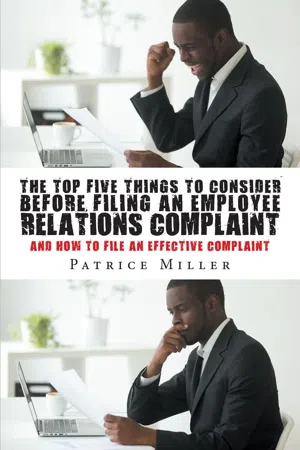
The Top Five Things to Consider before Filing an Employee Relations Complaint
And How to File An Effective Complaint
- 54 pages
- English
- ePUB (mobile friendly)
- Available on iOS & Android
eBook - ePub
The Top Five Things to Consider before Filing an Employee Relations Complaint
And How to File An Effective Complaint
About this book
Information
Chapter 1
Top Five Things to Consider before Filing Your Complaint
- What’s really going on in my situation?
- Does this rise to a policy violation or illegal activity?
- How will filing my complaint affect me and my future career?
- What’s in it for me?
- Is this something I can resolve before making this a formal complaint?
Number 1
What’s really going on in my situation (i.e., long-term conflict with someone, past anger and/or bitterness, etc., or illegal activity or company policy violation)?
In many cases, people file complaints when they are emotionally charged and have had it with their situation. They are no longer in the “take a step back and look at the situation in its entirety” mode.
They are often surprised when the investigator doesn’t look quite as shocked as them when they are explaining their issue. For example, some have looked at me almost as if I could not have possibly heard what they said when I remain calm; the look on their face was as though they were thinking, Didn’t you just hear what I said they did to me?
This calmness is primarily because the investigator has heard very many complaints and not a lot of things shock them or the complainant’s issue has escalated so deeply within them and it feels worse to them than it really is. In general, the longer we focus on something, the larger it grows; hence, the old saying “Making a mountain out of a molehill” sometimes comes in to play. Please keep in mind, I’m not saying this is everyone’s issue, but I’m just saying—take a step back and look at it in its entirety, even if you must write it down and be honest with yourself.
It is not uncommon that once a person is emotionally charged about something or someone—anything that anyone says about it or the person, whether positive or negative, comes across as negative—they sometimes lose sight of the big picture in the moment. In some cases, some will report that their suspect said hello to them and their perception was that there must be some ulterior motive by the suspect leading to something negative against the complainant. Because after all, as far as the complainant is concerned, there is no way the suspect was trying to make amends by saying hello. Surely, they must be up to something.
Finally, ask yourself how you are contributing to this issue and/or if you are the one that is actually behaving as a bully or a chronic complainer. I’ve seen that before too, where the complainant is really the bully and filing a complaint trying to distract from their own behavior, or are displaying behaviors of a chronic complainer. See characteristics of a chronic complainer in chapter 2 and the bullying checklist assessment in chapter 3.
Number 2
Does this rise to a policy violation or illegal activity based on the definitions given earlier?
Again, as mentioned in number 1, take a step back. Does it meet illegal activity or a company policy violation? For example, if the issue is between you and your coworker disagreeing or clashing on some specific issues, at work or personal, especially if it is personal, is this an issue that needs conflict-resolution support (see chapter 5 for tips on handling conflict resolution) or possibly some mediation by your leader or, in some cases, human resources (HR)? Again, many employees end up very disappointed and sometimes very upset because their complaint is not substantiated because it does not rise to a policy violation or illegal activity and feel that they have no options for resolutions. Typically, conflict resolution or employee disputes do not rise to illegal activity or policy violations around harassment or discrimination. It is also important to understand that unequal treatment in the workplace does not always mean unlawful treatment. Recognize that the employer’s actions may be, or at least feel, totally unfair, but it is not necessarily unlawful. A summary of EEO laws is in chapter 4.
Keep in mind that, if it is a conflict or clash, it will take both parties to resolve the dispute, and most importantly, be mindful that one’s unwillingness to participate in resolving the issues versus having someone else resolve it for them can actually begin to move them toward formal coaching plans, performance improvement plans, and ultimately, a disciplinary situation leading to termination because they have now refused to cooperate or have become insubordinate to work direction. Try not to let your pride get the best of you.
Number 3
How will filing your complaint affect you and your future career?
This is an important question. As you know, retaliation for filing complaints is prohibited by law (federal, state, and local) and company policies (see chapter 4). However, many consider the rudimentary definition of retaliation like an eye for an eye versus how the law and policies define retaliation as an adverse term or condition of employment based on nonbusiness reasons occurring subsequent to them filing their complaint.
For example, an employee filed a complaint of harassment against their leader, and subsequently, their performance rating was lowered even though this employee had always received good ratings. This would be investigated as a retaliation complaint. However, if this employee got the same rating before and after filing a complaint, there is no obvious adverse action that occurred, because nothing changed.
Additionally, keep in mind, before filing your complaint, leaders above your leader are notified of the complaint, which, in most cases, is a positive. However, if you are constantly filing multiple complaints that are not merited, remember, you’re dealing with human beings, and it is human nature to become defensive when constantly having to respond to complaints against them. Additionally, I have yet to see in my many years of experience anyone’s career moves in an upward direction after filing numerous complaints that are not substantiated and are mostly around unresolved conflicts. Also, I’ll tell you a little secret: this person is likely very well-known by their peers, HR, the law department, and higher-level leaders in your area and, possibly, enterprise-wide.
Finally, being one who has responded to numerous complaints and having raised complaints on behalf of myself and others, it can be very emotionally draining with the interviews, questioning, and responding to others’ allegations of your conduct. Because believe me, whatever you have done even close to inappropriate, the suspect or a witness will be bringing it up, whether accurate or twisted. So be warned: if you do have any skeletons in the closet, are you okay with having them come out of the closet? I’m just saying; just know it is...
Table of contents
- Chapter 1
- Chapter 2
- Chapter 3
- Chapter 4
- Chapter 5
- Chapter 6
- Chapter 7
Trusted by 375,005 students
Access to over 1.5 million titles for a fair monthly price.
Study more efficiently using our study tools.
Frequently asked questions
Yes, you can cancel anytime from the Subscription tab in your account settings on the Perlego website. Your subscription will stay active until the end of your current billing period. Learn how to cancel your subscription
No, books cannot be downloaded as external files, such as PDFs, for use outside of Perlego. However, you can download books within the Perlego app for offline reading on mobile or tablet. Learn how to download books offline
Perlego offers two plans: Essential and Complete
- Essential is ideal for learners and professionals who enjoy exploring a wide range of subjects. Access the Essential Library with 800,000+ trusted titles and best-sellers across business, personal growth, and the humanities. Includes unlimited reading time and Standard Read Aloud voice.
- Complete: Perfect for advanced learners and researchers needing full, unrestricted access. Unlock 1.5M+ books across hundreds of subjects, including academic and specialized titles. The Complete Plan also includes advanced features like Premium Read Aloud and Research Assistant.
We are an online textbook subscription service, where you can get access to an entire online library for less than the price of a single book per month. With over 1.5 million books across 990+ topics, we’ve got you covered! Learn about our mission
Look out for the read-aloud symbol on your next book to see if you can listen to it. The read-aloud tool reads text aloud for you, highlighting the text as it is being read. You can pause it, speed it up and slow it down. Learn more about Read Aloud
Yes! You can use the Perlego app on both iOS and Android devices to read anytime, anywhere — even offline. Perfect for commutes or when you’re on the go.
Please note we cannot support devices running on iOS 13 and Android 7 or earlier. Learn more about using the app
Please note we cannot support devices running on iOS 13 and Android 7 or earlier. Learn more about using the app
Yes, you can access The Top Five Things to Consider before Filing an Employee Relations Complaint by Patrice Miller in PDF and/or ePUB format, as well as other popular books in Business & Human Resource Management. We have over 1.5 million books available in our catalogue for you to explore.