eBook - ePub
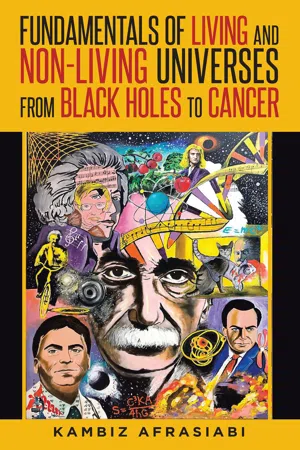
Fundamentals of Living and Non-Living Universes from Black Holes To Cancer
- 292 pages
- English
- ePUB (mobile friendly)
- Available on iOS & Android
eBook - ePub
Fundamentals of Living and Non-Living Universes from Black Holes To Cancer
Information
Topic
Physical SciencesSubtopic
Astronomy & AstrophysicsChapter 1
Introduction and Basic Concepts
True understanding of cancer cell necessitates deep understanding of normal cell. This in turn demands underpinning the birth and evolution of life.
As life itself came into existence in the vast ocean of known universe, this makes understanding the basic principles that govern the birth and homeostasis of universe a prerequisite to all.
The known universe is said to have originated in big bang. Throughout that process, massive amount of energy has come into existence which has also converted to matter.
We are born out of 4 or so percent of the whole matter in the known universe. Ninety-six or so percent of the matter spread in the known universe is dark matter.
The most fundamental law governing the known universe at all levels is the second law of thermodynamics.
By the virtue of this law, the index of disorderliness which correlates with entropy incessantly increases following the birth of the known universe.
The total amount of regular energy in the known universe is said to be zero, which is reasoned by positive energy (force of expansion) counteracting negative energy (force of attraction).
These two exactly cancel each other out. So is the case with the total regular mass in the known universe, simply because E = mc2.
Life is the only machinery on the face of the known universe in which the speed of rise in entropy is the lowest as set by the limits of the second law.
The barrier generated by the cell membrane in the primordial ocean on earth to create the first unit of life some thirty-eight hundred million years ago demanded an energy source to maintain its integrity as well as that of its constituents.
The birth of this unit could be considered the first move against the fast pace of increase in entropy in the surrounding environment.
Glycolysis in the anaerobic prokaryotes and oxidative metabolism of nonoxidative phosphorylation subtype in the aerobic prokaryotes seem to have served that purpose.
With the birth of eukaryotes, oxidative phosphorylation became the dominant source of energy supply.
Eukaryotes not only existed as unicellular organisms but also had the bioenergetics sophistication and advantage to evolve into multicellular organisms.
The simultaneous birth of multicellular era and transmembrane proteins such as G-protein coupled receptors as well as the dominance of oxidative phosphorylation seem to be more than a mere coincidence.
With the convergence of this triad, a more efficient energetics machinery started to handle the energy demands of a much more organized biosystem.
Transmembrane proteins connected extracellular and intracellular compartments. This connection offered the eukaryotes the opportunity of constant surveillance of environmental cues.
GPCRs took over the task of fine and efficient distribution of available energy through their downstream pathways, namely C-AMP and PI3 Kinase.
This could secure transition into a more complex biosystem with significantly less entropy as compared with the prokaryote and unicellular eukaryote era.
In unicellular and multicellular eukaryotes, oxidative phosphorylation of one molecule of glucose could generate thirty-six molecules of ATP. This is an eighteenfold increase in bioenergetics efficiency.
Transformation of a normal cell into a cancer cell is associated with a metabolic shift from oxidative phosphorylation to aerobic glycolysis, which generates four molecules of ATP from one molecule of glucose. This has been well described as Warburg’s effect.
Currently, cancer is defined as uncontrolled proliferation of cells associated with disorderly maturation. This is more of a description than a definition.
The new definition of cancer should reemphasize the metabolic derangement of cancer cell as the central event.
One of the hallmarks of cancer is a shift back in time as far as dominance of bioenergetics machinery is concerned.
Cancer cell relies on glycolysis, which is the hallmark of prokaryotes as the main source of energy.
As mentioned earlier, this is also called Warburg effect. In 1956, Warburg discovered that cancer cell relies on aerobic glycolysis as the main means of metabolism.
Consequently, cancer could also be defined as regression in evolution of normal state and its energetics machinery.
With that regression, comes a significant increase in entropy and disrespect to barriers built into the multicellular system
Migration of cancer cell to unchartered territories of other organs could be best defined as an attempt at spreading this regressive energetics move and shift back in time.
Cancer cell becomes blind to its position in its native organ and metastasizes to foreign organs. This is a complex biological process.
It demands sophisticated genetic machinery to penetrate established barriers and the ability to survive in foreign organs and usurping their resources.
In evolutionary biology language, cancer cell obeys the “grow or go” principle. This principle serves the immediate purpose of survival of cancer cell but culminates in demise of the host.
Definition of Energy
Deep understanding of energy and its dynamics in the biouniverse is a prerequisite to the understanding of normal cell homeostasis.
Normal cell depends on fine and well-balanced energy distribution to its critical compartments and maintenance of the highest possible free energy.
This understanding is much needed for underpinning of pathological conditions such as cancer.
Energy is defined differently in different systems. In Albert Einstein’s famous equation, E = mc2.
Thus, energy and mass are interconvertible and that clearly necessitates deeper understanding of the nature of matter as well.
In 1873, the American engineer ...
Table of contents
- Pretext 1
- Pretext 2
- Pretext 3
- Pretext 4
- Pretext 5
- Pretext 6
- Pretext 7
- Pretext 8
- Pretext 9
- Pretext 10
- Pretext 11
- Pretext 12
Trusted by 375,005 students
Access to over 1.5 million titles for a fair monthly price.
Study more efficiently using our study tools.
Frequently asked questions
Yes, you can cancel anytime from the Subscription tab in your account settings on the Perlego website. Your subscription will stay active until the end of your current billing period. Learn how to cancel your subscription
No, books cannot be downloaded as external files, such as PDFs, for use outside of Perlego. However, you can download books within the Perlego app for offline reading on mobile or tablet. Learn how to download books offline
Perlego offers two plans: Essential and Complete
- Essential is ideal for learners and professionals who enjoy exploring a wide range of subjects. Access the Essential Library with 800,000+ trusted titles and best-sellers across business, personal growth, and the humanities. Includes unlimited reading time and Standard Read Aloud voice.
- Complete: Perfect for advanced learners and researchers needing full, unrestricted access. Unlock 1.5M+ books across hundreds of subjects, including academic and specialized titles. The Complete Plan also includes advanced features like Premium Read Aloud and Research Assistant.
We are an online textbook subscription service, where you can get access to an entire online library for less than the price of a single book per month. With over 1.5 million books across 990+ topics, we’ve got you covered! Learn about our mission
Look out for the read-aloud symbol on your next book to see if you can listen to it. The read-aloud tool reads text aloud for you, highlighting the text as it is being read. You can pause it, speed it up and slow it down. Learn more about Read Aloud
Yes! You can use the Perlego app on both iOS and Android devices to read anytime, anywhere — even offline. Perfect for commutes or when you’re on the go.
Please note we cannot support devices running on iOS 13 and Android 7 or earlier. Learn more about using the app
Please note we cannot support devices running on iOS 13 and Android 7 or earlier. Learn more about using the app
Yes, you can access Fundamentals of Living and Non-Living Universes from Black Holes To Cancer by Kambiz Afrasiabi M.D. in PDF and/or ePUB format, as well as other popular books in Physical Sciences & Astronomy & Astrophysics. We have over 1.5 million books available in our catalogue for you to explore.