Standing on God's Promises Not Sitting on His Premises by Michael Rucker and Pamela Rucker
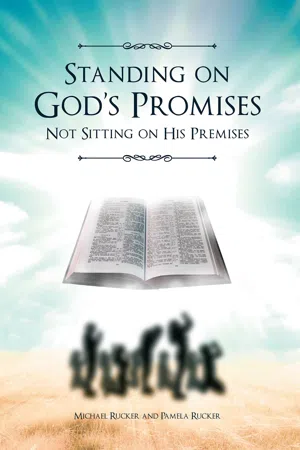
- 62 pages
- English
- ePUB (mobile friendly)
- Available on iOS & Android
eBook - ePub
Standing on God's Promises Not Sitting on His Premises
About this book
Information
Topic
Theology & ReligionSubtopic
ChristianityChapter 1
Sitting on God’s Premises
God’s Premises
God’s premises, as discussed in this book, refers to your statements about your practice and profession of faith as a proposition, principle, or assumption to prove your obligation of obedience and personal commitment to trust in God’s Word, obey His commands, and endeavor to live a righteous life. To that end, sitting on God’s premises points to your lack of discipleship (i.e., failure to go and make disciples of Jesus Christ teaching them all His commandments). Many presuppose that all people who go to church regularly are Christians; all Christians profess faith in Jesus Christ as Savior; and therefore, all Christians trust in God’s Word, obey His commands, and sincerely endeavor to live a righteous life. That presupposition is far from the truth. If you subscribe to this presupposition, you may be sitting on God’s premises instead of standing on His promises. If you don’t seek first the kingdom (i.e., reign, rule, or authority) of God and His righteousness, all the things you need and desire will not be added to you. Simply put, if you receive and believe but don’t become a disciple of Christ, you are sitting on the premises of God.
What it Means to Sit on God’s Premises
Your horizontal relationship with people will mirror your vertical relationship with the Almighty. According to survey results reported by George Barna concerning the state of the Christian Church and how Americans express their faith, “Americans express their faith in a variety of ways. While regular church attendance is a reliable indicator of faithful Christian practice, many Americans choose to experience and express their faith in a variety of other ways, the most common of which is prayer. For instance, three-quarters of Americans (75 percent) claim to have prayed to God in the last week. This represents 73 percent who self-identify as Christian. Following prayer, the next most common activity related to faith practice is attending a church service, with more than one-third of adults (35 percent) having sat in a pew in the last seven days, not including a special event such as a wedding or funeral. About the same proportion (34 percent) claim to have read the Bible on their own, not including when they were at a church or synagogue. About one in six American adults have either volunteered at a nonprofit (19 percent) or at church (18 percent) in the last week. Slightly fewer attended Sunday school (17 percent) or a small group (16 percent).”
What these results fail to show is the horizontal relationship with people. These results fail to show how accountable Christians are with obeying God’s commands in their personal, professional, and social interactions with others. It’s obedience to God’s commands that determine whether Christians experience a life of love, joy, peace, patience, kindness, goodness, faithfulness, gentleness, self-control, protection, rest, prosperity, positive critical thought, increased wisdom, and a deep aggressive desire to know His purpose and will for their life. However, the results do show the religious makeup of the United States and what they believe. Barna uses seven key faith groups in America: (1) born-again Christians, (2) evangelical Christians, (3) those who are Bible-minded, (4) churched/unchurched, (5) practicing Christian, (6) nonpracticing Christian, and (7) post-Christian. He defines born-again Christians as those who have made a personal commitment to Jesus Christ that is still important in their life today and believe that, when they die, they will go to heaven because they have confessed their sins and accepted Jesus Christ as their savior. Evangelical Christians are those who meet the born-again criteria plus seven other conditions. The seven conditions include saying their faith is very important in their life today; believing they have a personal responsibility to share their religious beliefs about Christ with non-Christians; believing that Satan exists; believing that Jesus Christ lived a sinless life on earth; asserting that the Bible is accurate in all that it teaches; believing that eternal salvation is possible only through grace, not works; and describing God as the all-knowing, all-powerful, perfect deity who created the universe and still rules it today. Being classified as an evangelical is not dependent upon church attendance or the denominational affiliation of the church attended. Bible-minded are those who believe the Bible is accurate in all the principles it teaches and have read the scriptures within the past week. Churched/unchurched are those who attended church in the past month or those who have not attended church in the past six months. Practicing Christians are those who attend a religious service at least once a month and who say their faith is very important in their lives and self-identify as a Christian. Nonpracticing Christians are those who self-identify as a Christian but do not qualify as a practicing Christian. Post-Christian are those who do not believe in God or identify as atheist or agnostic, and they do not participate in practices such as Bible reading, prayer, and church attendance. Based on this metric, almost half of all American adults (48 percent) are post-Christian (meet 60 percent or more, or nine or more, of the following factors below). Highly post-Christian individuals meet 80 percent or more of the factors below (12 or more of these 15 criteria):
- Do not believe in God
- Identify as atheist or agnostic
- Disagree that faith is important in their lives
- Have not prayed to God (in the last year)
- Have never made a commitment to Jesus
- Disagree the Bible is accurate
- Have not donated money to a church (in the last year)
- Have not attended a Christian church (in the last year)
- Agree that Jesus committed sins
- Do not feel a responsibility to share their faith
- Have not read the Bible (in the last week)
- Have not volunteered at church (in the last week)
- Have not attended Sunday school (in the last week)
- Have not attended religious small group (in the last week)
- Do not participate in a house church (in the last year)
According to these key faith identifiers, three are critical. Born-again Christians make up one-third of the population (35 percent). They are defined as those who made a personal commitment to Jesus Christ that is still important in their life today and believe that, when they die, they will go to heaven because they have confessed their sins and accepted Jesus Christ as their savior; but not Lord. This suggests a lack of obedience to God’s commands and principles. The next largest group was those considered Bible-minded, who make up about one-quarter of the population (23 percent). They believe the Bible is accurate in all the principles it teaches and have read the scriptures within the past week, but no reception of Jesus Christ as Lord and Savior. Another key factor, according to Barna’s research, is a surprising proportion of churchgoing Christians in the US are generally unaware of the Great Commission (“Research Releases in Faith and Christianity,” March 27, 2018). When asked if they had previously heard of the Great Commission, half of US churchgoers (51 percent) say they do not know this term. Finally, the next significant group, post-Christians made up almost half of the American adult population (48 percent). They do not believe in God or identify as atheist or agnostic, and they do not participate in practices such as Bible reading, prayer, and church attendance. These three factors are critical with regard to whether Americans are standing on the promises of God. In fact, it represents Americans who sit on the premises of God.
What Christians practice and believe significantly impacts their obedience to Christ and His commands and their ability to be and make disciples. For example, Christ’s Sermon on the Mount6 describes what Christian’s attitudes and actions should be (e.g., those who are poor in spirit, those who mourn, those who are meek, those who hunger and thirst for righteousness, those who are merciful, those who are pure in heart, those who are peacemakers, those who are persecuted because of righteousness, and those who are insulted and falsely accused of all kinds of evil because of Christ) and the blessings that come from exhibiting those attitudes and actions. It also describes social or human behaviors that Christians must not exhibit in obedience to Christ (e.g., murder, adultery, fornication, divorce, revenge, etc.). The Sermon on the Mount further teaches the thoughts of man and what is in his heart concerning the identified behaviors can result in one sinning against God and man.
Christian Life When Sitting on God’s Premises
Don’t miss the promises of God for your life by sitting on the premises, allowing secular worldviews and other’s beliefs and opinions to block your blessings. Sitting on God’s premises is when you fail to go and make disciples; fail to believe in the authority of scripture; fail to exhibit a life of love, joy, peace, patience, kindness, goodness, faithfulness, gentleness, self-control, protection, rest, and prosperity; and fail to exhibit positive critical thought, increased wisdom, and a deep aggressive desire to know God’s purpose and will for your life. Most of us get stuck sitting on God’s premises because we keep practicing the same spiritual behaviors and expect different results. We don’t forgive, pray without ceasing, or address our anger before the sun sets. Spiritual behaviors are a crucial part of spiritual growth, but when the same spiritual behaviors become routine, they need to be changed. What got you where you are spiritually may not get you where God wants you to go next. With the inauguration of President Trump, followed by record-setting Women’s Marches; Hurricanes Irma, Harvey, Jose, and Maria battering the Caribbean and the southern United States; Americans witnessed natural disasters; a slew of sexual misconduct allegations launching the #MeToo movement; tragic violence in Las Vegas, New York, Charlottesville, Parkland, Sutherland, and Santa Fe shook the country; and confirmation of Judge Brett Kavanagh to the Supreme Court. In times like these Christian life can be reduced to sitting on God’s premises.
An example of what it looks like to sit on the premises of God is when Christians claim to be spiritual but not religious7 or love Jesus but not the church.8 Those who claim to be spiritual but not religious hold unorthodox views about God, are ambivalent toward religion, and take part in more informal and individual modes of spiritual practice. They do not claim any faith at all. They say they are spiritual, but they identify as either atheist, agnostic, or unaffiliated with a specific religion. Being spiritual but not religious suggests that you fail to agree with the institution of the church or refuse to submit to the authority of the church leadership or church polity. You hold tightly to Christian belief; you just do not find value in the church as a component of that belief. If you fall within this group, you are sitting on God’s premises. Regarding those who love Jesus but not the church, they self-identify as Christian and strongly agree that their religious faith is very important in their life but are de-churched (have attended church in the past but haven’t don...
Table of contents
- Chapter 1
- Chapter 2
- Chapter 3
Trusted by 375,005 students
Access to over 1.5 million titles for a fair monthly price.
Study more efficiently using our study tools.
Frequently asked questions
Yes, you can cancel anytime from the Subscription tab in your account settings on the Perlego website. Your subscription will stay active until the end of your current billing period. Learn how to cancel your subscription
No, books cannot be downloaded as external files, such as PDFs, for use outside of Perlego. However, you can download books within the Perlego app for offline reading on mobile or tablet. Learn how to download books offline
Perlego offers two plans: Essential and Complete
- Essential is ideal for learners and professionals who enjoy exploring a wide range of subjects. Access the Essential Library with 800,000+ trusted titles and best-sellers across business, personal growth, and the humanities. Includes unlimited reading time and Standard Read Aloud voice.
- Complete: Perfect for advanced learners and researchers needing full, unrestricted access. Unlock 1.5M+ books across hundreds of subjects, including academic and specialized titles. The Complete Plan also includes advanced features like Premium Read Aloud and Research Assistant.
We are an online textbook subscription service, where you can get access to an entire online library for less than the price of a single book per month. With over 1.5 million books across 990+ topics, we’ve got you covered! Learn about our mission
Look out for the read-aloud symbol on your next book to see if you can listen to it. The read-aloud tool reads text aloud for you, highlighting the text as it is being read. You can pause it, speed it up and slow it down. Learn more about Read Aloud
Yes! You can use the Perlego app on both iOS and Android devices to read anytime, anywhere — even offline. Perfect for commutes or when you’re on the go.
Please note we cannot support devices running on iOS 13 and Android 7 or earlier. Learn more about using the app
Please note we cannot support devices running on iOS 13 and Android 7 or earlier. Learn more about using the app
Yes, you can access Standing on God's Promises Not Sitting on His Premises by Michael Rucker in PDF and/or ePUB format, as well as other popular books in Theology & Religion & Christianity. We have over 1.5 million books available in our catalogue for you to explore.