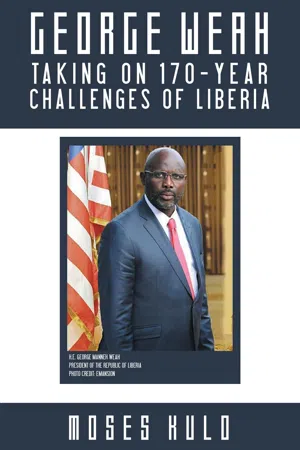
George Weah: Liberia's most celebrated world icon and elected president is on a mission. He positions himself to take on 170-year social inequality, economic, political, corrupt, and other institutional challenges of Liberia. Would Weah accomplishes his vision for Liberia?
- 30 pages
- English
- ePUB (mobile friendly)
- Available on iOS & Android
eBook - ePub
George Weah Taking on 170-Year Challenges of Liberia
About this book
Information
Economic and Political Journeys
Many scholars will agree that Liberia began an independent nation in 1847 with promising economic and political futures than other countries in Africa. Liberia has no colonial master like many African countries. The founding fathers of Liberia were Africans who returned from the United States as free people supported by American Colonization Society (ACS). Roberts Finley of New Jersey, USA, established ACS in 1816 purposely to help the migration of free African-Americans to Africa.
Liberia’s relationship with the United United benefited the Liberian people. Liberia naturally became a democratic nation. English became an official language, and many Liberians converted to Christianity. The ACS and the United States government provided the needed fund to build Liberia’s economy in the 1800s. Also, ACS guided the development of the Liberian political institution. The governing body of ACS led Liberia from 1822–1847 when it turned over the leadership of Libera to the free African-Americans known as Americo-Liberians. Liberia immediately declared independence from ACS and became a sovereign nation in Africa.
In 1869, True Whig Party was founded as a political party by the Americo-Liberians. Unfortunately, the leaders of this new party formed an autocratic government and became, laying the foundation for a self-centered political ideology that destroyed Liberia’s social, economic, and political institutions for many decades. Ideology is a particular set of political practices, ethical ideals, principles, doctrines, or a collection of ideas of any social class. The True Whig Party focused on promoting and protecting the interests of Americo-Liberians and ignored social, economic, infrastructural, and human development in Liberia.
Sadly, in the late 1800s and early 1900s Liberians were divided into two groups namely indigenous and Americo-Liberians. The government of Liberia did nothing to unite the Liberian people. Even the government engaged in practices that encouraged and promoted disunity of the two groups. For example, the indigenous people were not allowed to participate in the political, decision-making process of the country. However, few Americo-Liberians supported the integration of the Liberian people. Some of the Americo-Liberians encouraged and supported indigenous citizens to improve their social and economic statuses. For example, some private Americo-Liberians financially supported the native population to go to school through nongovernmental organizations.
Lessons Learned
In the past two hundred years, no other ideological institution in the Western Hemisphere besides democratic system has survived the human, economic, social, and political challenges of our time. Let us make it clear, many countries in the West claimed to be democratic when in practice, they are not. Liberia is one of those countries. One of the pillars of Western democracy, civilization, equality, economic progress, and moral well-being is making or following fair laws.
The Liberian government, especially under True Whig Party, missed an opportunity to develop and support policies that could reduce illiteracy, improve the community, economic development, strengthen the nation’s infrastructure, and bring the people together. The so-called elite class (Americo-Liberians) only focused on enhancing it...
Table of contents
- Pretext 1
- Pretext 2
- Pretext 3
- Pretext 4
- Pretext 5
- Pretext 6
- Pretext 7
- Pretext 8
- Pretext 9
- Pretext 10
Trusted by 375,005 students
Access to over 1.5 million titles for a fair monthly price.
Study more efficiently using our study tools.
Frequently asked questions
Yes, you can cancel anytime from the Subscription tab in your account settings on the Perlego website. Your subscription will stay active until the end of your current billing period. Learn how to cancel your subscription
No, books cannot be downloaded as external files, such as PDFs, for use outside of Perlego. However, you can download books within the Perlego app for offline reading on mobile or tablet. Learn how to download books offline
Perlego offers two plans: Essential and Complete
- Essential is ideal for learners and professionals who enjoy exploring a wide range of subjects. Access the Essential Library with 800,000+ trusted titles and best-sellers across business, personal growth, and the humanities. Includes unlimited reading time and Standard Read Aloud voice.
- Complete: Perfect for advanced learners and researchers needing full, unrestricted access. Unlock 1.5M+ books across hundreds of subjects, including academic and specialized titles. The Complete Plan also includes advanced features like Premium Read Aloud and Research Assistant.
We are an online textbook subscription service, where you can get access to an entire online library for less than the price of a single book per month. With over 1.5 million books across 990+ topics, we’ve got you covered! Learn about our mission
Look out for the read-aloud symbol on your next book to see if you can listen to it. The read-aloud tool reads text aloud for you, highlighting the text as it is being read. You can pause it, speed it up and slow it down. Learn more about Read Aloud
Yes! You can use the Perlego app on both iOS and Android devices to read anytime, anywhere — even offline. Perfect for commutes or when you’re on the go.
Please note we cannot support devices running on iOS 13 and Android 7 or earlier. Learn more about using the app
Please note we cannot support devices running on iOS 13 and Android 7 or earlier. Learn more about using the app
Yes, you can access George Weah Taking on 170-Year Challenges of Liberia by Moses Kulo in PDF and/or ePUB format, as well as other popular books in Politics & International Relations & Military Policy. We have over 1.5 million books available in our catalogue for you to explore.