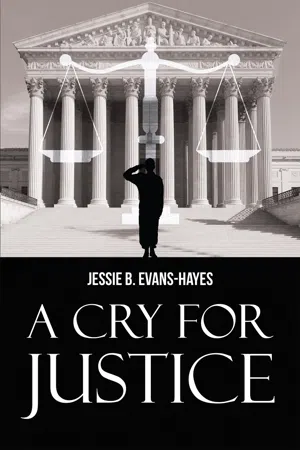
Like the majority of institutions in America, the U.S. Postal Service policy, practice, and/or procedure appear neutral. Truthfully, it has a disproportionately negative impact on members of a racial or ethnic minority group. Dr. Martin Luther King, Jr., once said, "An injustice anywhere is an injustice everywhere!" Inequalities, regardless of their bases should not be swept under the rug. Any discrimination is intolerable, and as citizens, we must all make a serious attempt to do away with it. If we remain docile and inactive, the disparity will continue to grow, and our great nation, no doubt, will diminish to irrelevancy. America is a great nation; however, let's not forget that her strength is built on hope, faith, and all honesty through free labor of slaves. Today, racial disparity affects both the innocent and guilty minority. Our judicial system is in urgent need of reform. Our nation is confronted with serious moral, ethical, constitutional, and economic challenges. We have to work together for systematic changes. This book/documentary validate that as a race of people, we are still plagued with persistent racial disparities—systematic racism which causes serious physical as well as psychological consequences. It discloses judicial tyranny and the corruption of the justice system by way of consistent psychological manipulation and deception, and unconstitutional laws that infringes on minorities and pro se litigants' rights. Like cancer, racism has the potential to destroy!
- 608 pages
- English
- ePUB (mobile friendly)
- Available on iOS & Android
eBook - ePub
A Cry For Justice
About this book
Information
Chapter I
Charleston, South Carolina
My Native Land
South Carolina, known as the Palmetto State encompasses people of all walks of life. It is called the Palmetto State, after the palmetto trees that grow widely.
The palmetto trees and magnificent gardens of luxuriant growth over the years has elevated this state into an art form. In which, most tourists would agree to be one of the prettiest states in the country. Tourists are attracted to its beauty, friendliness, and hospitality.
The South Carolinians has identified South Carolina as having two district areas, the low country and the up country. The east of South Carolina is wide swept by the shore of the Atlantic Ocean in which vacationers enjoy. The low country is near the ocean and surrounded with islands. There are four islands in the low country: Edisto, Wadmalaw, Johns, and James Island. These islands are rich with African-American’s heritage and culture. The west of South Carolina is called the up country.
South Carolina is a Deep South state, mostly rural. Its land consists of small towns, with four major cities: Columbia (the capital), Charleston, North Charleston, and Greenville.
Charleston, SC sits on the East Coast along the Atlantic Ocean between North Carolina and Georgia. It is a busy seaport city and one of the main points of entry for industrial ships entering the states on the East Coast. It was the main point of entry for slaves entering this country during the era of slavery.
The city of Charleston houses today depicts a grand vista of centuries’ old architecture. The Charleston Museum founded in 1773 was the first museum established in the United States. Today, the museum exhibits cover slavery, plantation life, and the Civil War. African-American National Heritage Museum has scattered sites, such as the Slave Mart Museum and McLeod Plantation, which illustrates the lives of slaves in the region.
Prior to the Civil War, more than two hundred years ago, South Carolina was one of the richest of thirteen colonies. After the Civil War, South Carolina entered a period of economic stagnation. In which the people were among the poorest in the nation until the early 1970s when a new generation began to lead, changing many things.
The Civil War lasted four years from 1861 to 1865. A white Southerner said to a visitor from the North, “I’d rather be dead than be a slave on one of those big plantation,” an understandable statement. A slave life was of toil, hunger, and fear. Children were sent to work in the fields at age ten or twelve. Families of up to ten slaves lived in a dirt floor cabins no larger than a modern one-car garage. Their clothes were little more than rags. They went barefoot in the winter. Health was an issue, only four out of one hundred lived to age of sixty.
By the mid-1870s, South Carolina was near internal war. The hooded Ku Klux Klan made its appearance in the state. In the 1900, South Carolina a backward, mostly rural state, in which four out of every five residents lived on a farm. Cotton replaced rice as the major product.
At the beginning of the twentieth century, South Carolina ran one of the worst school systems in the nation. Most rural areas’ classroom was a dilapidated one-room schoolhouses, taught by teachers who did not go to college.
The state maintained separate, most certainly not equal schools for blacks and whites. White teachers were paid four times more than black schoolteachers. As a result, about three out of four black adults were unable to read or write.
In the early 1950s when I was born, African-Americans had no rights. They were treated like garbage. They were called niggers. They were killed and beaten because of their skin color. They were judged by the color of their skin, not by their personality.
Schools were segregated. Segregation was supported by the legal system and police. The Klu Klux Klan and other terrorists murdered thousands of black people. Racial segregation was the separation of different racial groups in daily life facilities, such as eating in a restaurant, drinking fountain, restroom, services, and opportunities such as housing, education, employment, and transportation. They began fighting these laws that kept them out of restaurants and compelled them to sit in the backseats of buses.
Segregation ended in 1954. Although the Freedom Riders, Dr. Martin Luther King, Jr. The NAACP and many others played a huge role in stopping segregation; sadly, it still exist to this date.
The Montgomery Bus Boycott, in which white’s community did not like the protest and tried to stop many times, the U.S. Supreme Court finally ended the bus segregation. After 38l days of boycotting the buses, the U.S. Supreme Court ruled it was unconstitutional to separate people based on their race. Blacks began to challenge other segregation issues.
Although South Carolina has achieved high standards in art, literature, and culture, there is a dark side to the history of Charleston. The ugly experience of slavery and regard to race relations that many whites would rather keep hidden in the past, but the truth remains that discrimination is as prevalent today as it was decades ago, only subtler. This documentary depicts this!
Chapter II
James Island, South Carolina
My Community
James Island is about seven miles west of downtown Charleston. It is surrounded by the Atlantic Ocean, Wappoo River, and the Stono River. In 1899, a one-lane wooden bridge was built across the Wappoo Creek, connecting the island to the peninsula at Charleston. Prior to 1899, the only access to and from James Island was by ferry or boat.
James Island is one of the few places in the U.S. where descendants of slaves can easily trace their roots to one of seventeen slave plantations.
Beginning in the eighteenth century, when more than 40 percent of the slaves to enter the United States arrived at the Port of Charleston, James Island was the destination for hundreds of slaves who were tortured with unimaginable hardships while crossing the Atlantic Ocean then put to work on one of the island’s numerous plantations. There were several slave and sharecropper plantations on James Island.
“The first plantation starting from the Wappoo Cut Bridge was the McLeod and following were the Dill, Grimball, Rivers, Ellis, Seabrook, Clark, Lawton, Hinson, Mikell, Royall, Croskey, Lebby, Legare, Freer, Bee, and Mellechamp Plantations. Some of these plantation owners were relatives and farmed the same properties: father, sons, sons-in-law, brothers, nephew, etc., as the properties were sold or passed down through the generations.”
Hundreds of slave descendants still live on property their ancestors bought from the plantation owners during and after slavery, like my family and many others.
I was born and raised on James Island, known as Grimball Plantation. My siblings and I lived through difficult years of segregation and the frustrations of integration.
“Historical records show that slaves were auctioned at the Old Slave Market located at 6 Chalmers Street in downtown Charleston. The building is still intact, next to the law office of Attorney Gedney Howe III. It is well preserved for historical purposes.”
James Island is rich with African-American heritage and culture. Ever since the 1700s, when blacks were first brought to James Island, the environment resembled more of a village where people depended and relied on one another. This type of environment existed until well into the 1960s.
During and following the slavery and farming eras, James Island was known for the planting and harvesting of rice, cotton, tomatoes, Irish and sweet potatoes, string beans, corn, cucumbers, cabbage, okra, collard greens, eggplants, and many other types of vegetables that were sold nationally, internationally, and locally at the Charleston Market on Meeting Street or at various roadside stands dotting the low country.
Many of the plantations also raised livestock and poultry such as turkey, chicken, geese, and duck.
Due to the unbearable hardship of slavery, sharecropping, and farming on James Island, many former slaves and their descendants migrated north to escape the degradation of their living conditions. Many of them would choose never to return. However, their roots, their memories, and their influence remain.
Today, James Island is a bustling community with families, growing industry and a direct route to the low country’s popular Folly Beach. It has developed into a modern-day community. This small island has left a legacy of both the joy and the pain of living in a time and place wrought with hardship, but somehow still intermingled with the happiness that comes only from a community built on family, love, strength and honor. It is a legacy that is impossible to forget.
Chapter III
Early Childhood
“The outcome of one’s life is based on the
journey he has treaded.”...
journey he has treaded.”...
Table of contents
- Chapter I
- Chapter II
- Chapter III
- Chapter IV
- Chapter V
- Chapter VI
- Chapter VII
- Chapter VIII
- Chapter IX
- Chapter X
- Chapter XI
- Chapter XII
- Chapter XIII
- U.S. Postal Service Ordeal
- Chapter XIV
- Chapter XV
- Chapter XVI
- Chapter XVII
- Chapter XVIII
- Chapter XIX
- Chapter XX
- Chapter XXI
- Chapter XXII
- Chapter XXIII
- Chapter XXIV
- Chapter XXV
- Chapter XXVI
- Chapter XXVII
- Chapter XXVIII
Trusted by 375,005 students
Access to over 1.5 million titles for a fair monthly price.
Study more efficiently using our study tools.
Frequently asked questions
Yes, you can cancel anytime from the Subscription tab in your account settings on the Perlego website. Your subscription will stay active until the end of your current billing period. Learn how to cancel your subscription
No, books cannot be downloaded as external files, such as PDFs, for use outside of Perlego. However, you can download books within the Perlego app for offline reading on mobile or tablet. Learn how to download books offline
Perlego offers two plans: Essential and Complete
- Essential is ideal for learners and professionals who enjoy exploring a wide range of subjects. Access the Essential Library with 800,000+ trusted titles and best-sellers across business, personal growth, and the humanities. Includes unlimited reading time and Standard Read Aloud voice.
- Complete: Perfect for advanced learners and researchers needing full, unrestricted access. Unlock 1.5M+ books across hundreds of subjects, including academic and specialized titles. The Complete Plan also includes advanced features like Premium Read Aloud and Research Assistant.
We are an online textbook subscription service, where you can get access to an entire online library for less than the price of a single book per month. With over 1.5 million books across 990+ topics, we’ve got you covered! Learn about our mission
Look out for the read-aloud symbol on your next book to see if you can listen to it. The read-aloud tool reads text aloud for you, highlighting the text as it is being read. You can pause it, speed it up and slow it down. Learn more about Read Aloud
Yes! You can use the Perlego app on both iOS and Android devices to read anytime, anywhere — even offline. Perfect for commutes or when you’re on the go.
Please note we cannot support devices running on iOS 13 and Android 7 or earlier. Learn more about using the app
Please note we cannot support devices running on iOS 13 and Android 7 or earlier. Learn more about using the app
Yes, you can access A Cry For Justice by Jessie Evans-Hayes,Jessie B. Evans-Hayes in PDF and/or ePUB format, as well as other popular books in Social Sciences & Discrimination & Race Relations. We have over 1.5 million books available in our catalogue for you to explore.