![]()
Did you hear about the rose that grew
from a crack in the concrete?
Proving nature’s law is wrong, it
learned to walk without having feet.
Funny it seems, but by keeping its dreams,
it learned to breathe fresh air.
Long live the rose that grew from concrete
when no one else ever cared.
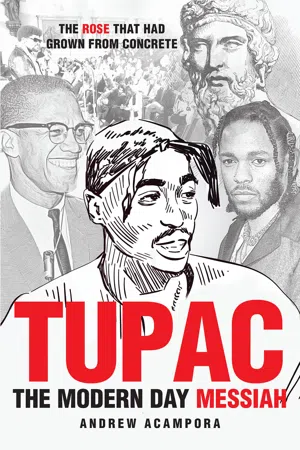
Entrapped in a closed environment with scarce resources and limited potential to flourish in society, Tupac Shakur symbolically represents this rose that had grown out of concrete. Yes, perhaps, the rose had a few petals missing, and was not in its original posture, but nonetheless, a rose had grown from concrete, without receiving sunlight, nurturing, or even hydration!
Maybe the flower was flawed, but it had overcome such immense obstacles. This analogy clearly represents the situation of the poverty-stricken neighborhoods of the United States during much of the twentieth century. The black oppression that was rampant during his lifetime was a driving force for him, allowing him to actually move forward.
However, the average child in an environment filled with poverty, violence, and drugs was left with almost no chance of succeeding in life. Tupac, the revolutionary that shaped a nation, became the rose that grew from concrete, while establishing himself in the minds of many as a modern-day prophet.
One might ask, “How does the flower grow?” The flower grows from love, most notably from his mother, Afeni Shakur, a former Black Panther, who took her son under her wing, and taught him how to fly, using the tools of knowledge and poetry.
Tupac Shakur, a visionary, activist, poet, screenplay writer, actor, and most notably known for his rapping, had established himself as a vital part of our nation’s history, still affecting the lives of millions today despite his death over twenty years ago. His uncanny ability to unlock compartments in our brains and remain righteous toward what he stood for was almost legendary.
Yes, Tupac was demonized by the mass media during his time alive, being viewed for his crimes, rather than what he was persistently preaching, but many revolutionaries were detested and eventually murdered (i.e., Ghandi, Malcolm X, Martin Luther King, Jesus Christ, Abraham Lincoln).
Tupac Shakur was not only a revolutionary, but also a modern-day messiah, who was illustrious for his relatability and vulnerability as an artist, as well as fighting against the United States’ governmental system, police brutality, and black oppression. His biggest contribution toward society was his ability to influence others and carry his words, most notably seen in recording artist Kendrick Lamar in present day, despite his death over twenty years ago now. Tupac Shakur will eventually go down as one of the most influential artists of the twentieth century and a modern-day prophet.
The prophetic power of Tupac the poet would have ceased to exist if it weren’t for those before him, having paved the path for his arrival. So to understand his motives and thought processes, you’d have to be empathetic of his roots, first and foremost.
When identifying his roots, you’d look toward no one else besides his mother, Afeni Shakur. Tupac and Afeni shared a deep, unconditional love for each other as she was forced to raise him on her own. The story of Tupac Shakur is quite magnificent considering the human whom was perceived as a symbol for opposing black oppression and police brutality was a prisoner as an embryo inside of his mother, Afeni Shakur.
Afeni had taken on the leadership role for Tupac during his adolescence and focused on raising his intellect. As Afeni was a former Black Panther, she also ingrained her Black Panther beliefs into Tupac. The panthers had represented knowledge, learning, and speaking your mind when you feel it’s most appropriate. You can easily see this in Tupac’s music.
As Tupac had been on record in his very own documentary “The Resurrection” saying, “If I wasn’t exposed to literature, Shakespeare, and writing poetry growing up, I wouldn’t have been the person I am today.” (Tupac 2003) These principles ultimately guided Tupac toward his ability to work as an activist. However, Tupac Shakur would’ve never had the opportunity to carry the torch if it wasn’t for the civil rights movement sparking the light for it.
In the United States, one can certainly make the argument that the civil rights movement had been the most revolutionary movement in our history. The civil rights movement had effectively planted the seed of equality into our nation. Tupac Shakur took this seed, and tended to it with plenty of water, in order for it to grow.
As Tupac had symbolized the rose that had grown from concrete, he had used water as his main tool toward growing and achieving success.
Wait, water? Well, according to “The Wealth of the Commons,” knowledge is fundamental toward survival, just as H2O is.
Everyone needs them. Water is essential for the existence of all human beings and for life in general. Yet human life also depends on permanent supplies of immaterial goods such as knowledge, information, and culture. In this sense, knowledge is the equivalent of water. This is what I have in mind with the aphorism: Knowledge is the water of the mind. Water for physical survival and knowledge for intellectual development. What is true for water is also true for knowledge. Both can be subject to exclusive private property rights. (Kuhlen 2010)
Of course, knowledge was not easily attainable for blacks in poverty during much of our nation’s history.
Without knowledge, the system has the ability to keep the poor people in an ignorant state of mind. With their ignorance is bliss approach toward society, they are blinded to the mistreatment they are faced with, folding into the system of society. The Wealth of the Commons agrees with this statement:
More accurately, access to knowledge has always, at least in modern western societies, been subject to private appropriation through private intellectual property rights. As the reality of commercial information markets shows, people can very successfully be excluded from open, unrestricted access to knowledge. (Kuhlen 2010)
The civil rights movement had represented a generation dehydrated from knowledge. The Brown vs. Board of Education case of the 1950s had become the straw that stirred the drink in fighting for equal opportunities in acquiring knowledge.
As black and white students were being segregated into separate schools during much of the first half of the twentieth century, the nation that claimed “justice for all” in its anthem was more of an oxymoron, than anything. As the white schools had a better environment in place, their opportunity to reach their potential was naturally greater. Because of this, radicals of the system were beginning to demand equal education. In the 1950s, the radicals were beginning to reign supreme, as the Brown vs. Board case sparked the potential for equality in our government. According to PB...