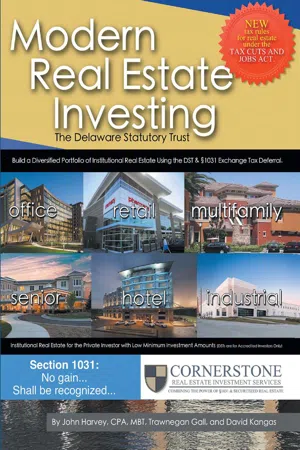
Modern Real Estate Investing introduces the nation to a new concept in real estate investment known as the Delaware Statutory Trust (DST). The DST is a synthesis of one hundred years of real estate, securities, and tax laws that provide an investment entity that allows the modern real estate investor to build a diversified portfolio of institutional grade real estate under protective securities regulations and enjoy the tax advantages of gain nonrecognition using IRC section 1031 like-kind exchanges. The book not only introduces the DST but also guides the reader through the investment process by providing perspective in the choosing of brokers, sponsors, and properties as well as a more in-depth analysis of the DST offering (John Harvey, CPA, MBT, author).The book provides a clear explanation of DST's and how they provide opportunities for smaller investors access to institutional properties otherwise not available to them, because of the large equity requirements and access to reasonable financing. The 1031 exchange is linked very nicely, explaining the DST opportunity for diversification in more than one investment that helps balance overall risk in the 1031 exchange. Trump tax plan is expertly explained and its impact on the DST structure. Book describes clear example of the tax savings of a 1031 exchange and the benefit of compounding on deferred taxes avoided at time sale. Good examples of dos and don'ts in the 1031 exchange (Kosmas G. Toskos, DST investor).
eBook - ePub
Modern Real Estate Investing
The Delaware Statutory Trust
- 330 pages
- English
- ePUB (mobile friendly)
- Available on iOS & Android
eBook - ePub
About this book
Information
Chapter 1
The DST Vision
The dream of building wealth and enjoying financial independence is alive again in America! Over a century of major US legislation has allowed real estate to effectively synthesize with protective securities regulation and beneficial tax law to produce a new investment concept known as the Delaware Statutory Trust, or simply the DST.
A DST is a trust formed under Delaware statutory law that essentially provides for a fractionalized real estate investment, and presents the opportunity, through a securities private placement offering, for an individual to join with other accredited investors to own investment-grade real estate that none of them could own individually. With DST minimum investments as low as $25,000 ($100,000 for exchanges), the private investor may own larger commercial institutional-grade real estate with values up to $100 million. A fractional ownership interest provides the investor with an undivided fractional ownership interest in the entire property or properties, including the projected cash flow, potential appreciation, and tax-deductible depreciation. Thus, a fractional ownership allows for coownership with other similarly qualified investors, but not the right to use or possess the property. Furthermore, the purchase and sale of a DST interest may qualify for capital gain nonrecognition under Section 1031 of the Internal Revenue Code.
Accordingly, what’s new and exciting in real estate investing is not the partnership, the LLC, the S-Corporation, or even the TIC. It’s the Delaware Statutory Trust! The advantages of a DST property offering include, but are not limited to, a low minimum investment amount, access to institutional-grade properties, national credit tenants, stabilized monthly income, greater diversification, full disclosure offering materials, professional due diligence, limited liability protection, more favorable financing terms, lower transaction and administrative costs, and tax-deferred capital gains. The DST vision is the cumulative realization of these numerous advantages.
Background and Perspective
America, with all its diversity and innovation, has traditionally provided the private investor with three core means for passively building wealth. These are commodities, securities, and real estate. Commodities, from gold to soybeans, are purely speculative and do not add value; they are disadvantaged because they provide the investor with no cash flow and no tax shelter. Securities markets have developed over the nation’s history to provide investors with very regulated, highly liquid, and well-diversified markets for stocks, bonds, derivatives, and alternative investments. While marketable securities have a place in every income and growth portfolio, the two major headwinds to building wealth using securities have traditionally been taxation and market volatility. Although both commodities and securities may be held in qualified investment accounts such as an IRA or 401K, tax rules strictly delay any enjoyment of income until the investor’s retirement years, and even then, with certain limitations.
Thankfully, nearly one hundred years of legislative and judicial landmarks have integrated to bring together in the DST some of the best features of these core markets. Chronologically, these legislative and judicial landmarks are:
• The 1921 adoption of Section 1031 into the Internal Revenue Code to allow for nonrecognition of capital gain for real estate,
• The 1933 Securities Act that provided for Regulation D private placement rules applicable to certain real estate offerings,
• The 1946 landmark case of SEC v. W. J. Howey Company, the US Supreme Court defined an investment contract,
• The 1988 Delaware Statutory Trust Act that provided a multi investor structure flexible enough to accommodate the requirements of IRC Section 1031,
• The 2004 IRS Revenue Ruling 2004-86 holding that real estate held in a properly structured Delaware Statutory Trust qualifies for IRC Section 1031 exchange, and
• The 2017 Tax Cuts and Jobs Act that preserved 1031 exchange for real property.
The cumulative effect of these real estate laws, securities laws, and tax laws has formulated a new ownership structure in the Delaware Statutory Trust. The DST has become a means for the private investor to build and preserve wealth within a regulated investment environment using institutional-grade real estate on a tax-deferred basis while enjoying tax sheltered passive income. In short, the modern private investor may now enjoy the best of both worlds—the tax benefits of real estate and the due diligence and full disclosure of securities.
Taxation
We will explore all the advantages of a DST, as well as the disadvantages, in chapter 2, chapter 4, and throughout the book. But first, let’s address the elephant in the room. Why a trust? Aren’t trusts used for estate planning and gifts to charity? Why not a traditional LLC or partnership? The answer is that one thing that is most often paired with death—taxes! As with every other kind of investment, the sale of an asset is met with a short-term or long-term capital gain tax.
With real estate, the tax bite out of an investor’s wealth can be especially substantial, as any allowed or allowable depreciation that was deducted against the rental income over the hold period must first be recaptured at a rate of 25 percent—ouch! Then there is the tax on the long-term capital gain at 20 percent (in most cases), not to mention the Affordable Care Act tax at 3.8 percent, and finally the state and local taxes at 6 percent (on average). These taxes can add up to a third or more of all the gain realized from the investment. Considering this haircut to the investor’s built-up equity, as well as the lost future income that could have been earned on that equity, we quickly realize that taxation, in addition to volatility, can be a major obstacle to building wealth in America.
Thank goodness for Internal Revenue Code Section 1031! About one hundred years ago, our forefathers realized that, unlike selling an investment interest in one business entity (such as the Coca-Cola Corporation) and then reinvesting in another business entity (such as the Pepsi Corporation), selling a real property and then immediately exchanging it for another like-kind real property was not a change in the actual investment at all, and should therefore not be taxed. Over the past decades, this “Cinderella” concept encoded in 1921 into IRS Section 1031 has allowed real estate to excel as a means of building wealth over its comparatively ugly step sisters—commodities and securities (at least from a tax point of view).
The tax advantages of gain nonrecognition with real estate have come at a heavy price—active management. The labor necessary to manage real estate can be time-consuming and exhausting. The private real estate investor knows all too well the burdens and stresses of rent collection, repairs, maintenance, bill payments, and accounting, just to name a few. How about local laws controlling eviction and—should I say it? Rent control! These troubles are often accentuated with smaller and older properties. And it is this menace of active management that has kept most private investors in the commodities and securities markets despite the disadvantage of taxation.
A DST effectively liberates the private real estate investor from the management obligations of individual ownership, commonly referred to as the “three Ts”—tenants, toilets (presumably leaky ones), and troubles—while providing a truly passive investment in institutional-grade properties. DST investments require no active participation on the part of the investor, as they are professionally managed to provide monthly cash distributions and positioned for potential appreciation.
So why a trust, and a Delaware Statutory Trust for that matter? What we need in order to solve the dual problem of taxation and active management is an entity to hold the real estate for us, provide liability protection, and be able to accommodate other coinvestors. The standard LLC, limited partnership, S corporation or trust will not do, as these would all constitute a business entity, and be excluded by the Section 1031 statute, due to the activities of the managing member, general partner, corporate officers, or trustees, respectively. However, the State of Delaware is unique in that it enacted in 1988 its Delaware Statutory Trust Act that provides for extreme flexibility in the trust to limit the powers of the trustee to such an extent that there is no business entity1, but simply a direct interest in the real estate. Accordingly, the Delaware trustee is a mere agent for the holding and transfer of title to real property, and the investor beneficiary retains direct ownership of the real property for federal income tax purposes. Furthermore, to avoid being a business entity for federal tax purposes, the trust may not have the power to vary the investment of the investor beneficial owners for the entire life of the trust.2
Meeting these requirements, federal tax law considers the owner of the DST as the owner of an undivided fractional interest in the trust property.3
Accordingly, an exchange of real property for an interest in the trust is an exchange for the property in the trust and will qualify for nonrecognition of gain under Section 1031.4
The DST for Section 1031 exchange is not a “tax loophole,” but rather a well-thought-out tax policy with the intent by the IRS to provide legitimate tax deferral as defined by Revenue Ruling 2004-86 (a full copy of the Revenue Ruling has been included in the appendices to this book). Accordingly, investors may defer capital gains tax and depreciation recapture on built-up equity in their relinquished properties and reinvest their full equity into DST replacement properties. When the DST investment property is ultimately sold, investors may exchange their gains into yet another DST property, or back into a single-ownership property, with no tax exposure. To date, thousands of DST exchanges have been successfully transacted. Furthermore, in the 2017 Tax Cuts and Jobs Act, Congress has confirmed its continued support for real estate by preserving tax deferral for gains on real property under IRC Section 1031.
Volatility
In addition to taxation, the other major obstacle to building wealth is volatility. This is especially true with the highly liquid securi...
Table of contents
- Chapter 1
- Chapter 2
- Chapter 3
- Chapter 4
- Chapter 5
- Chapter 6
- Chapter 7
- Chapter 8
- Chapter 9
- Chapter 10
- Chapter 11
- Chapter 12
- Chapter 13
- Chapter 14
- Chapter 15
- Chapter 16
- Chapter 17
- Chapter 18
- Chapter 19
- Chapter 20
- Chapter 21
- Chapter 22
- Chapter 23
- Chapter 24
- Chapter 25
- Chapter 26
Trusted by 375,005 students
Access to over 1.5 million titles for a fair monthly price.
Study more efficiently using our study tools.
Frequently asked questions
Yes, you can cancel anytime from the Subscription tab in your account settings on the Perlego website. Your subscription will stay active until the end of your current billing period. Learn how to cancel your subscription
No, books cannot be downloaded as external files, such as PDFs, for use outside of Perlego. However, you can download books within the Perlego app for offline reading on mobile or tablet. Learn how to download books offline
Perlego offers two plans: Essential and Complete
- Essential is ideal for learners and professionals who enjoy exploring a wide range of subjects. Access the Essential Library with 800,000+ trusted titles and best-sellers across business, personal growth, and the humanities. Includes unlimited reading time and Standard Read Aloud voice.
- Complete: Perfect for advanced learners and researchers needing full, unrestricted access. Unlock 1.5M+ books across hundreds of subjects, including academic and specialized titles. The Complete Plan also includes advanced features like Premium Read Aloud and Research Assistant.
We are an online textbook subscription service, where you can get access to an entire online library for less than the price of a single book per month. With over 1.5 million books across 990+ topics, we’ve got you covered! Learn about our mission
Look out for the read-aloud symbol on your next book to see if you can listen to it. The read-aloud tool reads text aloud for you, highlighting the text as it is being read. You can pause it, speed it up and slow it down. Learn more about Read Aloud
Yes! You can use the Perlego app on both iOS and Android devices to read anytime, anywhere — even offline. Perfect for commutes or when you’re on the go.
Please note we cannot support devices running on iOS 13 and Android 7 or earlier. Learn more about using the app
Please note we cannot support devices running on iOS 13 and Android 7 or earlier. Learn more about using the app
Yes, you can access Modern Real Estate Investing by John Harvey CPA, MBT, Trawnegan Gall , in PDF and/or ePUB format, as well as other popular books in Business & Investments & Securities. We have over 1.5 million books available in our catalogue for you to explore.