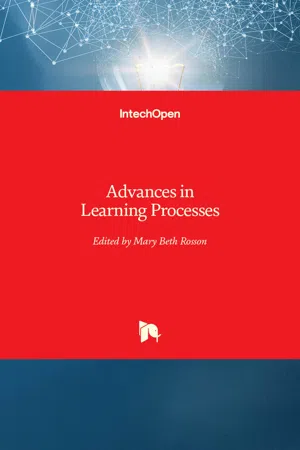
Readers will find several papers that address high-level issues in the use of technology in education, for example architecture and design frameworks for building online education materials or tools. Several other chapters report novel approaches to intelligent tutors or adaptive systems in educational settings. A number of chapters consider many roles for social computing in education, from simple computer-mediated communication support to more extensive community-building frameworks and tools. Finally, several chapters report state-of-the-art results in tools that can be used to assist educators in critical tasks such as content presentation and grading.
- 296 pages
- English
- PDF
- Available on iOS & Android
eBook - PDF
Advances in Learning Processes
About this book
Information
Table of contents
- Advances in Learning Processes
- Contents
- Preface
- A Model of Project-Based Learning to Develop Information Systems Engineers and Managers through “Collaborative Management” App oach
- Educational Modelling Languages and Service-Oriented Learning Process Engines
- Multi-agent Architecture for Retrieving and Tailoring LOs in SCORM Compliant Distance Learning Environments
- E-Testing Construction Support System with some Prediction Tools
- Adaptative Learning Environment for Geometry
- Personalized Learning Path Delivery
- Advances in Artificial Intelligence to Model Student-Centred VLEs
- M-PLAT: Multi-Programming Language Adaptive tutor
- Adaptive and Collaborative Learning Using netUniversity, an interoperable LMS/LCMS
- wConnect: A Developmental Community for Women in Computer and Information Science
- EduWiki: A Knowledge Construction System for Collaborative Learning
- Realization of Swift and Expressive Chat in CSCL: Reach Project
- Network of Schools as a Framework to Support E-Learning within Educational Communities
- Visual analytics to support e-learning
- Informing Instructional Design Using Microgenetic Analysis of ICT-based Collaboration: A Misconceptions Perspective
- An analysis using eye-mark recorder of the effectiveness of presentation methods for e-learning
- Pedagogical use of automatic graders
- An Item Response Theory for Peer Assessment
Trusted by 375,005 students
Access to over 1.5 million titles for a fair monthly price.
Study more efficiently using our study tools.
Frequently asked questions
Yes, you can cancel anytime from the Subscription tab in your account settings on the Perlego website. Your subscription will stay active until the end of your current billing period. Learn how to cancel your subscription
No, books cannot be downloaded as external files, such as PDFs, for use outside of Perlego. However, you can download books within the Perlego app for offline reading on mobile or tablet. Learn how to download books offline
Perlego offers two plans: Essential and Complete
- Essential is ideal for learners and professionals who enjoy exploring a wide range of subjects. Access the Essential Library with 800,000+ trusted titles and best-sellers across business, personal growth, and the humanities. Includes unlimited reading time and Standard Read Aloud voice.
- Complete: Perfect for advanced learners and researchers needing full, unrestricted access. Unlock 1.5M+ books across hundreds of subjects, including academic and specialized titles. The Complete Plan also includes advanced features like Premium Read Aloud and Research Assistant.
We are an online textbook subscription service, where you can get access to an entire online library for less than the price of a single book per month. With over 1.5 million books across 990+ topics, we’ve got you covered! Learn about our mission
Look out for the read-aloud symbol on your next book to see if you can listen to it. The read-aloud tool reads text aloud for you, highlighting the text as it is being read. You can pause it, speed it up and slow it down. Learn more about Read Aloud
Yes! You can use the Perlego app on both iOS and Android devices to read anytime, anywhere — even offline. Perfect for commutes or when you’re on the go.
Please note we cannot support devices running on iOS 13 and Android 7 or earlier. Learn more about using the app
Please note we cannot support devices running on iOS 13 and Android 7 or earlier. Learn more about using the app
Yes, you can access Advances in Learning Processes by Mary Beth Rosson in PDF and/or ePUB format, as well as other popular books in Ciencia de la computación & Ciencias computacionales general. We have over 1.5 million books available in our catalogue for you to explore.