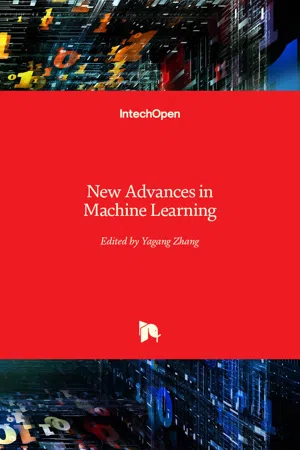
The purpose of this book is to provide an up-to-date and systematical introduction to the principles and algorithms of machine learning. The definition of learning is broad enough to include most tasks that we commonly call "learning" tasks, as we use the word in daily life. It is also broad enough to encompass computers that improve from experience in quite straightforward ways. The book will be of interest to industrial engineers and scientists as well as academics who wish to pursue machine learning. The book is intended for both graduate and postgraduate students in fields such as computer science, cybernetics, system sciences, engineering, statistics, and social sciences, and as a reference for software professionals and practitioners. The wide scope of the book provides a good introduction to many approaches of machine learning, and it is also the source of useful bibliographical information.
- 378 pages
- English
- PDF
- Available on iOS & Android
eBook - PDF
New Advances in Machine Learning
About this book
Information
Table of contents
- New Advances in Machine Learning
- Contents
- Preface
- 1. Introduction to Machine Learning
- 2. Machine Learning Overview
- 3. Types of Machine Learning Algorithms
- 4. Methods for Pattern Classification
- 5. Classification of support vector machine and regression algorithm
- 6. Classifiers Association for High Dimensional Problem: Application to Pedestrian Recognition
- 7. From Feature Space to Primal Space:KPCA and Its Mixture Model
- 8. Machine Learning for Multi-stage Selection of Numerical Methods*
- 9. Hierarchical Reinforcement Learning Using a Modular Fuzzy Model for Multi-Agent Problem
- 10. Random Forest-LNS Architecture and Vision
- 11. An Intelligent System for Container Image Recognition using ART2-based Self-Organizing Supervised Learning Algorithm
- 12. Data mining with skewed data
- 13. Scaling up instance selection algorithms by dividing-and-conquering
- 14. Ant Colony Optimization
- 15. Mahalanobis Support Vector Machines Made Fast and Robust
- 16. On-line learning of fuzzy rule emulated networks for a class of unknown nonlinear discrete-time controllers with estimated linearization
- 17. Knowledge Structures for Visualising Advanced Research and Trends
- 18. Dynamic Visual Motion Estimation
- 19. Concept Mining and Inner Relationship Discovery from Text
- 20. Cognitive Learning for Sentence Understanding
- 21. A Hebbian Learning Approach
- 22. A Novel Credit Assignment to a Rule with Probabilistic State Transition
Trusted by 375,005 students
Access to over 1.5 million titles for a fair monthly price.
Study more efficiently using our study tools.
Frequently asked questions
Yes, you can cancel anytime from the Subscription tab in your account settings on the Perlego website. Your subscription will stay active until the end of your current billing period. Learn how to cancel your subscription
No, books cannot be downloaded as external files, such as PDFs, for use outside of Perlego. However, you can download books within the Perlego app for offline reading on mobile or tablet. Learn how to download books offline
Perlego offers two plans: Essential and Complete
- Essential is ideal for learners and professionals who enjoy exploring a wide range of subjects. Access the Essential Library with 800,000+ trusted titles and best-sellers across business, personal growth, and the humanities. Includes unlimited reading time and Standard Read Aloud voice.
- Complete: Perfect for advanced learners and researchers needing full, unrestricted access. Unlock 1.5M+ books across hundreds of subjects, including academic and specialized titles. The Complete Plan also includes advanced features like Premium Read Aloud and Research Assistant.
We are an online textbook subscription service, where you can get access to an entire online library for less than the price of a single book per month. With over 1.5 million books across 990+ topics, we’ve got you covered! Learn about our mission
Look out for the read-aloud symbol on your next book to see if you can listen to it. The read-aloud tool reads text aloud for you, highlighting the text as it is being read. You can pause it, speed it up and slow it down. Learn more about Read Aloud
Yes! You can use the Perlego app on both iOS and Android devices to read anytime, anywhere — even offline. Perfect for commutes or when you’re on the go.
Please note we cannot support devices running on iOS 13 and Android 7 or earlier. Learn more about using the app
Please note we cannot support devices running on iOS 13 and Android 7 or earlier. Learn more about using the app
Yes, you can access New Advances in Machine Learning by Yagang Zhang in PDF and/or ePUB format, as well as other popular books in Computer Science & Programming Games. We have over 1.5 million books available in our catalogue for you to explore.