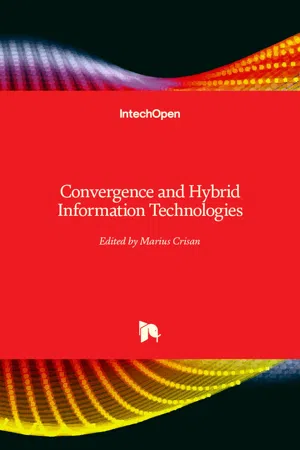
Starting a journey on the new path of converging information technologies is the aim of the present book. Extended on 27 chapters, the book provides the reader with some leading-edge research results regarding algorithms and information models, software frameworks, multimedia, information security, communication networks, and applications. Information technologies are only at the dawn of a massive transformation and adaptation to the complex demands of the new upcoming information society. It is not possible to achieve a thorough view of the field in one book. Nonetheless, the editor hopes that the book can at least offer the first step into the convergence domain of information technologies, and the reader will find it instructive and stimulating.
- 442 pages
- English
- PDF
- Available on iOS & Android
eBook - PDF
Convergence and Hybrid Information Technologies
About this book
Information
Table of contents
- Convergence and Hybrid Information Technologies
- Preface
- Contents
- 1. A New Divide and Conquer Based Classification for OCR
- 2. Parameters Determination for Optimum Design by Evolutionary Algorithm
- 3. Convergence towards a Dynamic Theory of Linguistics and Semantics
- 4. Multiple User-Class Dynamic Stochastic Assignment for a Route Guidance Strategy
- 5. A Framework for Extracting Information from Semi-Structured Web Data Sources
- 6. A Framework for Localizing Integrity Constraints Checking in Distributed Database
- 7. An Agent-Based Software Framework for Robotics and Automation Systems
- 8. Use of e-Science Environmenton CFD Education
- 9. The Analytic Hierarchy and the NetworkProcess in Multicriteria Decision Making:Performance Evaluation and Selecting KeyPerformance Indicators Based on ANP Model
- 10. A Cost-Based Interior Design Decision SupportSystem for Large-Scale Housing Projects
- 11. Multimedia Streaming Service Adaptationin IMS Networks
- 12. Secure and Mobile Multimedia Convergence
- 13. Resource Scheduling Scheme for MultimediaService Provisioning in Ubiquitous Environment
- 14. Promoting Socio-Cultural Values ThroughStorytelling Using Animation and Game-BasedEdutainment Software
- 15. A New Auto Exposure Systemto Detect High Dynamic Range ConditionsUsing CMOS Technology
- 16. Security Architecturefor Sensitive Information Systems
- 17. A Study on Sensor Node Capture DefenceProtocol for Ubiquitous Sensor Network
- 18. Theory and Practice of Program Obfuscation
- 19. Systematic Generation of An IrreduciblePolynomial of An Arbitrary Degree m over FpSuch That p > m
- 20. Efficient Pairings on Twisted Elliptic Curve
- 21. An Improvement of Twisted Ate Pairingwith Barreto-Naehrig Curveby using Frobenius Mapping
- 22. An Improvement of Cyclic VectorMultiplication Algorithm
- 23. A Wireless Sensor Networkfor Field Hockey Performance Analysis
- 24. Application of Game Theoryto Wireless Networks
- 25. Comparison of DP Effectsin MANET AAPs with Link Error
- 26. Design of Optimum Weighting Functionsfor LFM Signals
- 27. Stress and EEG
Trusted by 375,005 students
Access to over 1.5 million titles for a fair monthly price.
Study more efficiently using our study tools.
Frequently asked questions
Yes, you can cancel anytime from the Subscription tab in your account settings on the Perlego website. Your subscription will stay active until the end of your current billing period. Learn how to cancel your subscription
No, books cannot be downloaded as external files, such as PDFs, for use outside of Perlego. However, you can download books within the Perlego app for offline reading on mobile or tablet. Learn how to download books offline
Perlego offers two plans: Essential and Complete
- Essential is ideal for learners and professionals who enjoy exploring a wide range of subjects. Access the Essential Library with 800,000+ trusted titles and best-sellers across business, personal growth, and the humanities. Includes unlimited reading time and Standard Read Aloud voice.
- Complete: Perfect for advanced learners and researchers needing full, unrestricted access. Unlock 1.5M+ books across hundreds of subjects, including academic and specialized titles. The Complete Plan also includes advanced features like Premium Read Aloud and Research Assistant.
We are an online textbook subscription service, where you can get access to an entire online library for less than the price of a single book per month. With over 1.5 million books across 990+ topics, we’ve got you covered! Learn about our mission
Look out for the read-aloud symbol on your next book to see if you can listen to it. The read-aloud tool reads text aloud for you, highlighting the text as it is being read. You can pause it, speed it up and slow it down. Learn more about Read Aloud
Yes! You can use the Perlego app on both iOS and Android devices to read anytime, anywhere — even offline. Perfect for commutes or when you’re on the go.
Please note we cannot support devices running on iOS 13 and Android 7 or earlier. Learn more about using the app
Please note we cannot support devices running on iOS 13 and Android 7 or earlier. Learn more about using the app
Yes, you can access Convergence and Hybrid Information Technologies by Marius Crisan in PDF and/or ePUB format, as well as other popular books in Computer Science & System Administration. We have over 1.5 million books available in our catalogue for you to explore.