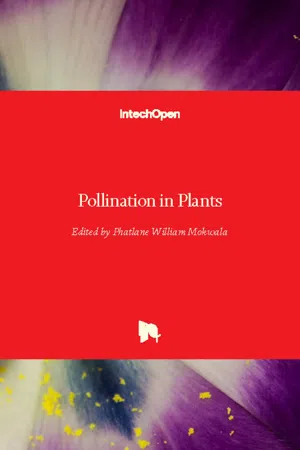
Plants are the basic source of food for both humans and animals. Most of the food is made of fruits and seeds. For these to be formed, pollination must first take place. This process is the transfer of pollen grains from the anther, which is the male structure of the flower, to the sigma on the female structure of the flower. The transfer process requires agents to be carried out. The agents can be either biotic or abiotic. Nature perfected this arrangement between the pollination agents and the plants. As ecosystems and agricultural systems are changing, this balanced arrangement becomes disturbed. This makes it necessary that pollination systems be studied so that necessary measures can be undertaken to ensure productivity. The chapters of this book present results in research undertaken to improve productivity in crops such as Actinidia chinensis (the kiwifruit), Theobroma cacao (cocoa), and Manicaria saccifera (a tropical forest palm). Some results are presented on tests to check the viability of pollen grains and the delivery of sperm cells through pollen tubes to the embryo sac. These results can serve as guidelines to any person seeking to improve pollination and productivity or to check the efficiency on pollination in ecosystems or agricultural production systems.
- 132 pages
- English
- PDF
- Available on iOS & Android
eBook - PDF
Pollination in Plants
About this book
Information
Table of contents
- Pollination in Plants
- Contents
- Preface
- Chapter 1 Introductory Chapter: Pollination
- Chapter 2 The Regulation of Sperm Cells Delivery to the Embryo Sac
- Chapter 3 Pollination Ecology of the Manicaria saccifera (ARECACEAE): A Rare Case of Pollinator Exclusion
- Chapter 4 Challenges in Cocoa Pollination: The Case of Côte d’Ivoire
- Chapter 5 Artificial Pollination in Kiwifruit and Olive Trees
- Chapter 6 Pollen Germination in vitro
- Chapter 7 Comparison of Pollination Graphs
Trusted by 375,005 students
Access to over 1.5 million titles for a fair monthly price.
Study more efficiently using our study tools.
Frequently asked questions
Yes, you can cancel anytime from the Subscription tab in your account settings on the Perlego website. Your subscription will stay active until the end of your current billing period. Learn how to cancel your subscription
No, books cannot be downloaded as external files, such as PDFs, for use outside of Perlego. However, you can download books within the Perlego app for offline reading on mobile or tablet. Learn how to download books offline
Perlego offers two plans: Essential and Complete
- Essential is ideal for learners and professionals who enjoy exploring a wide range of subjects. Access the Essential Library with 800,000+ trusted titles and best-sellers across business, personal growth, and the humanities. Includes unlimited reading time and Standard Read Aloud voice.
- Complete: Perfect for advanced learners and researchers needing full, unrestricted access. Unlock 1.5M+ books across hundreds of subjects, including academic and specialized titles. The Complete Plan also includes advanced features like Premium Read Aloud and Research Assistant.
We are an online textbook subscription service, where you can get access to an entire online library for less than the price of a single book per month. With over 1.5 million books across 990+ topics, we’ve got you covered! Learn about our mission
Look out for the read-aloud symbol on your next book to see if you can listen to it. The read-aloud tool reads text aloud for you, highlighting the text as it is being read. You can pause it, speed it up and slow it down. Learn more about Read Aloud
Yes! You can use the Perlego app on both iOS and Android devices to read anytime, anywhere — even offline. Perfect for commutes or when you’re on the go.
Please note we cannot support devices running on iOS 13 and Android 7 or earlier. Learn more about using the app
Please note we cannot support devices running on iOS 13 and Android 7 or earlier. Learn more about using the app
Yes, you can access Pollination in Plants by Phatlane William Mokwala in PDF and/or ePUB format, as well as other popular books in Biological Sciences & Genetics & Genomics. We have over 1.5 million books available in our catalogue for you to explore.