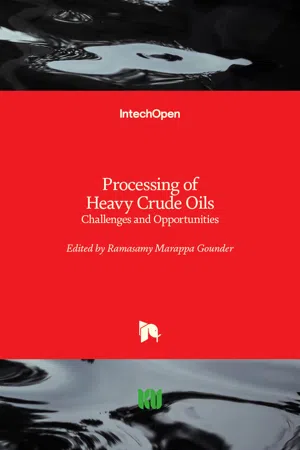
Unconventional heavy crude oils are replacing the conventional light crude oils slowly but steadily as a major energy source. Heavy crude oils are cheaper and present an opportunity to the refiners to process them with higher profit margins. However, the unfavourable characteristics of heavy crude oils such as high viscosity, low API gravity, low H/C ratio, chemical complexity with high asphaltenes content, high acidity, high sulfur and increased level of metal and heteroatom impurities impede extraction, pumping, transportation and processing. Very poor mobility of the heavy oils, due to very high viscosities, significantly affects production and transportation. Techniques for viscosity reduction, drag reduction and in-situ upgrading of the crude oil to improve the flow characteristics in pipelines are presented in this book. The heavier and complex molecules of asphaltenes with low H/C ratios present many technological challenges during the refining of the crude oil, such as heavy coking on catalysts. Hydrogen addition and carbon removal are the two approaches used to improve the recovery of value-added products such as gasoline and diesel. In addition, the heavy crude oil needs pre-treatment to remove the high levels of impurities before the crude oil can be refined. This book introduces the major challenges and some of the methods to overcome them.
- 276 pages
- English
- PDF
- Available on iOS & Android
eBook - PDF
About this book
Information
Table of contents
- Processing of Heavy Crude Oils - Challenges and Opportunities
- Contents
- Preface
- Chapter1 Introductory Chapter: Heavy Crude Oil Processing - An Overview
- Chapter2 Methods for Enhancing Recovery of Heavy Crude Oil
- Chapter3 PVT Properties of Black Crude Oil
- Chapter4 Pumping System of Heavy Oil Production
- Chapter5 Modeling Friction Losses in theWater-Assisted PipelineTransportation of Heavy Oil
- Chapter6 Ablation of Oil-Sand Lumps in Hydrotransport Pipelines
- Chapter7 Evaluation of Asphaltenes Deposition Inhibition Factors in Heavy Crude Oil Pipelines
- Chapter8 Flow of Heavy Oils at LowTemperatures: Potential Challenges and Solutions
- Chapter9 Challenges during Operation and Shutdown of Waxy Crude Pipelines
- Chapter10 Pre-Treatment of Heavy Crude Oils for Refining
- Chapter11 RecentTechniques for the Removal of Naphthenic Acid from Heavy Crude Oils
- Chapter12 Nickel Tetraphenylporphine Extraction from Model Heavy Oil Using Ionic Liquids
- Chapter13 Catalysts for Hydroprocessing of Heavy Oils and Petroleum Residues
- Chapter14 A Model-Based Investment Assessment for Heavy Oil Processing in the Petroleum Refining Industry
- Chapter15 Environmental Challenges Associated with Processing of Heavy Crude Oils
Trusted by 375,005 students
Access to over 1.5 million titles for a fair monthly price.
Study more efficiently using our study tools.
Frequently asked questions
Yes, you can cancel anytime from the Subscription tab in your account settings on the Perlego website. Your subscription will stay active until the end of your current billing period. Learn how to cancel your subscription
No, books cannot be downloaded as external files, such as PDFs, for use outside of Perlego. However, you can download books within the Perlego app for offline reading on mobile or tablet. Learn how to download books offline
Perlego offers two plans: Essential and Complete
- Essential is ideal for learners and professionals who enjoy exploring a wide range of subjects. Access the Essential Library with 800,000+ trusted titles and best-sellers across business, personal growth, and the humanities. Includes unlimited reading time and Standard Read Aloud voice.
- Complete: Perfect for advanced learners and researchers needing full, unrestricted access. Unlock 1.5M+ books across hundreds of subjects, including academic and specialized titles. The Complete Plan also includes advanced features like Premium Read Aloud and Research Assistant.
We are an online textbook subscription service, where you can get access to an entire online library for less than the price of a single book per month. With over 1.5 million books across 990+ topics, we’ve got you covered! Learn about our mission
Look out for the read-aloud symbol on your next book to see if you can listen to it. The read-aloud tool reads text aloud for you, highlighting the text as it is being read. You can pause it, speed it up and slow it down. Learn more about Read Aloud
Yes! You can use the Perlego app on both iOS and Android devices to read anytime, anywhere — even offline. Perfect for commutes or when you’re on the go.
Please note we cannot support devices running on iOS 13 and Android 7 or earlier. Learn more about using the app
Please note we cannot support devices running on iOS 13 and Android 7 or earlier. Learn more about using the app
Yes, you can access Processing of Heavy Crude Oils by Ramasamy Marappa Gounder in PDF and/or ePUB format, as well as other popular books in Technology & Engineering & Fossil Fuels. We have over 1.5 million books available in our catalogue for you to explore.