Wetlands include mangroves, peatlands and marshes, rivers and lakes, deltas, floodplains, rice fields, and even coral reefs. It is known that wetlands are ecologically sensitive systems and the most vulnerable of habitats. Anthropogenic activities (urbanization, water uses, land cover changes, industrial activity, pollution, climatic change, etc.) have direct and indirect effects on wetlands. The evaluation of wetlands with a multidisciplinary perspective in environmental sciences and social sciences provides efficient results. Each chapter takes a crucial look at different approaches to the solution by analyzing wetland problems in the laboratory or in the field and collecting data. The purpose of this book is to help researchers, scientists, and decision-makers utilize a methodology appropriate for a specific problem.
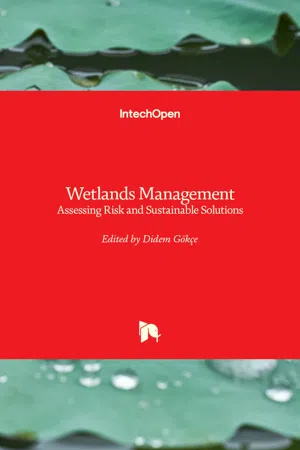
- 198 pages
- English
- PDF
- Available on iOS & Android
eBook - PDF
About this book
Information
Table of contents
- Wetlands Management - Assessing Risk and Sustainable Solutions
- Contents
- Preface
- Section 1 Introduction
- Section 2 Water Quality and Diversity in Wetlands
- Chapter 2 - Isotopic Signatures (δ13C and δ15N) and Characteristics of Two Wetland Soils in Lesotho, Southern Africa
- Chapter 3 - Metals Pollution in Tropical Wetlands
- Chapter 4 - Macroalgae Species as Zonal Indicators of Coral Reef: A Case Study from Bet Shankhodhar Reef, India
- Section 3 - Geographic Information System (GIS) andRemote Sensing Applications
- Chapter 5 - Wetland Monitoring and Mapping Using Synthetic
- Chapter 6 - Mapping and Monitoring Wetland Dynamics Using Thermal, Optical, and SAR Remote Sensing Data
- Chapter 7 - A Collection of Novel Algorithms for Wetland Classification with SAR and Optical Data
- Section 4 - Human-made Structures
- Chapter 8 - Combining the Aesthetic and Ecological Aspects of Man-Made Structures on Coastal Wetlands
- Section 5 - Valuation of Wetlands
- Chapter 9 - A Large-Scale Wetland Conversion Project in Southeastern Missouri: Sustainability of Water and Soil
- Chapter 10 - Assessing the Drivers of Wetland Changes in Areas Associated with Wildlife-Based Tourism Activities inZimbabwe
Trusted by 375,005 students
Access to over 1.5 million titles for a fair monthly price.
Study more efficiently using our study tools.
Frequently asked questions
Yes, you can cancel anytime from the Subscription tab in your account settings on the Perlego website. Your subscription will stay active until the end of your current billing period. Learn how to cancel your subscription
No, books cannot be downloaded as external files, such as PDFs, for use outside of Perlego. However, you can download books within the Perlego app for offline reading on mobile or tablet. Learn how to download books offline
Perlego offers two plans: Essential and Complete
- Essential is ideal for learners and professionals who enjoy exploring a wide range of subjects. Access the Essential Library with 800,000+ trusted titles and best-sellers across business, personal growth, and the humanities. Includes unlimited reading time and Standard Read Aloud voice.
- Complete: Perfect for advanced learners and researchers needing full, unrestricted access. Unlock 1.5M+ books across hundreds of subjects, including academic and specialized titles. The Complete Plan also includes advanced features like Premium Read Aloud and Research Assistant.
We are an online textbook subscription service, where you can get access to an entire online library for less than the price of a single book per month. With over 1.5 million books across 990+ topics, we’ve got you covered! Learn about our mission
Look out for the read-aloud symbol on your next book to see if you can listen to it. The read-aloud tool reads text aloud for you, highlighting the text as it is being read. You can pause it, speed it up and slow it down. Learn more about Read Aloud
Yes! You can use the Perlego app on both iOS and Android devices to read anytime, anywhere — even offline. Perfect for commutes or when you’re on the go.
Please note we cannot support devices running on iOS 13 and Android 7 or earlier. Learn more about using the app
Please note we cannot support devices running on iOS 13 and Android 7 or earlier. Learn more about using the app
Yes, you can access Wetlands Management by Didem Gökçe in PDF and/or ePUB format, as well as other popular books in Biological Sciences & Ecology. We have over 1.5 million books available in our catalogue for you to explore.