The most comprehensive and up-to-date volume on environmental chemistry available today, this is the standard reference for any chemical or environmental engineer.
This book is a very comprehensive project designed to provide complete information about environmental chemistry, including air, water, soil and all life forms on earth. The complete chemical composition and all the essential components of the atmosphere, hydrosphere, geosphere, lithosphere and biosphere are discussed in detail. Numerous forms of pollutants and their toxic effects along with sustainable solutions are provided.
Not just covering the basics of environmental chemistry, the authors discuss many specific areas and issues, and they provide practical solutions. The problems of non-renewable energy processes and the merits of renewable energy processes along with future fuels are discussed in detail, making this volume a comprehensive collaboration of many other relevant fields which tries to fill the knowledge gap of all previously available books on the market. It also thoroughly covers all environment-related issues, internationally recognized standard values, and the socioeconomic impacts on society for the short and long term.
A valuable reference for engineers, scientists, chemists, and students, this volume is applicable to many different fields, across many different industries, at all levels. It is a must-have for any library.
About 13.7 billion years ago, markedly condensed neutron collection led to the beginning of the universe as a distinctive massive fireball known as the “Big Bang”. As a result of this explosion, hydrogen and some helium nuclei were produced, which further produced galaxies and stars eventually. However, there are some misconceptions regarding this theory. Some experts believe that it was not an explosion but an expansion. Due to extreme density and pressure, at a finite time in the past, the expansion of the universe began. With the passage of time, this fireball cooled down and different physical processes came into play which formed the stars and galaxies we see around. Another misapprehension regarding the Big Bang is “singularity”, according to which our universe came into existence as a little fireball emerging somewhere in space. But according to some experts, space didn’t exist before the Big Bang. Back in the late 1960s and early 1970s, three British astrophysicists, Stephen Hawking, George Ellis and Roger Penrose put their attention on the theory of relativity and its consequences regarding our concepts of time. In 1968 and 1970, they prolonged Einstein’s Theory of General Relativity to include measurements of time and space. Their calculations showed that time and space had finite beginning, corresponding to the origin of mass and energy. Thus, it is believed that singularity didn’t appear in space; rather space arose inside of singularity, and prior to singularity, nothing existed, neither space, time, mass or energy – nothing.
Approximately 4.6 billion years ago, gravitational collapse of a gigantic molecular cloud resulted in the formation of our solar system; this is generally known as the “nebular hypothesis”. Various stars, planets, galaxies and sun formed within crumpling clouds and maximum mass of solar system was gathered in the sun while the rest was flattened into a protoplanetary disc. The sun, the red giant, expanded many times before casting off its external layer, which is misleadingly called a “planetary nebula”. However, this hypothesis is contradicted by a large number of alternative theories. In the 1920s, Edwin P. Hubble discovered a relationship that is now known as “Hubble’s law”. This law states that velocity of a galaxy is proportional to its distance from us. Hubble’s law is used to determine the age of the universe by its velocity and its current distance. The time is distance divided by velocity which turns out to be one divided by Hubble’s constant for all galaxies. By using the appropriate cosmological model, the calculated value is 13.73 billion years; that is quite close to the estimated answer of 14 billion years. According to Hubble’s law, v = H × d where Ho = 1/t and “v” is velocity of the galaxy (in km/s), “d” is its distance (in megaparsecs,0 Mpc; 1Mpc = 3.086×10¹⁹ km), H0 is Hubble’s constant and “t” is time. Background cosmic radiations were discovered in 1967 that were the strong advocate of Big Bang, and thus are considered as the second pillar of the Big Bang theory.
However, hydrogen and helium comprise only a small percentage of the total observed density of the universe and maximum mass of the universe is other than atomic matter. Due to interaction between light and matter, background cosmic radiations originated. Radiance is produced by the metals when heated at elevated temperatures. The radiations that are emitted by this material are known as “black body radiations” (BBR). The third pillar of the Big Bang theory (abundance of hydrogen and helium) states that about 90% of the universe is made of hydrogen atom and the other 10% of helium atom. In the beginning, the temperature of the universe was so hot that neutral atoms and atomic nuclei were unable to exist. The universe was a blend of particles and radiations at that time. But immediately, after two minutes, the temperature was lowered by 1 billion Kelvin (still hotter than the middle of the sun). The density of the universe was half of the density of air. At this reduced temperature, deuterium was able to hold together. The reason for this is that, at such a high temperature collision of proton with deuterium had adequate energy to break it apart. Thus from the above discussions, it has been concluded that at low temperature, matter exists in combined form while at elevated temperatures, matter is found in individual particle forms.
Plasma is the gaseous mixture of freely charged particles like electrons, protons and various other sub-atomic particles and ions that can respond to strong electromagnetic radiations. Plasma is a strong conductor of electricity due to the presence of free charges that carry electric current thereby generating a huge amount of magnetic field. This process may cause plasma to constrict into filaments, produce beam of particles, emit wide range of radiations including radio waves, light waves (including infrared, ultraviolet and visible region of electromagnetic spectrum), microwave, x-ray, gamma rays and synchrotron radiation, and form cellular regions of plasma with characteristics similar to magnetosphere and interplanetary medium. Plasma is a distinctive fourth state of matter other than pure solids, liquids and gases and known because of its unique characteristic properties. It is sometimes even referred as “first state of matter”. Plasma usually appears as a cloud of natural gas or ion beam of charges that may also include grains and dust particles thereby generating “dusty plasma”. Plasma is formed by heating the ionized gas by stripping electrons quite away from the atom and enabling the positive and negative charges to move freely. Plasma was first identified in a discharge tube, also known as Crookes tube, and was so described by Sir William Crookes in 1879, who called it “radiant matter”.
1.2 Plank’s Time
Plank’s time is the time taken by a photon in travelling with the speed of light to cover the distance equal to Planck length. Plank’s time is most significant in cosmology (a branch of astronomy involving the origin and evolution of the universe, from the Big Bang to today and on into the future). This extremely small time period is only about 10-43 seconds. The interaction between radiations and matter with space is described by general relativity. No theory was able to explain the universe before Planck time. In 0 to10-43 seconds: shifting of Big Bang upto Plank time occurred and no physical theory was able to explain the behaviour of matter at the beginning of the universe while looking at the history of the universe. In 10−43 to 10−35 seconds: antimatter was produced with little spare of matter during this period of time, and only a minute amount of mater was left over when matter and antimatter was annihilated. In the present time, only one baryon per billion photons is present in universe. From 10−35 to 10−6 seconds: four identifiable forces were separated from fundamental forces and Hadron and Mesons were combined at the end of that era. In between 10−6 to 10−4 seconds: a short period ranging from 10−6 to 10−4 seconds after the Big Bang when heavy weight atomic particles like protons, neutrons, pions and kaons were formed is known as the Hadron Era. Extra baryons were left over, which led to the formation of stars and galaxies after annihilation of baryons and antibaryons.
In 10−4 to 10 seconds: following the Hadron Era is the time period during which photons; neutrons, positrons and electrons were present in almost equal numbers; this is called Lepton Era. Leptons felt the weak interactions just like electrons. At about 0.1 second, n/p ratio started to slant in favor of proton. Neutrinos stopped interacting with each other and matter at about 1 second and n/p ratio was fixed, which in turn determined helium and deuterium abundance in the universe. After three to twenty minutes: nuclear fusion produced helium, deuterium and lithium. The elaboration of helium abundance was a big achievement of Big Bang theory. Furthermore, abundance of deuterium and lithium was also explained by Big Bang theory. In between 10 to 1011 seconds (approximately 3000 years (equavalent to the time on earth)), the energy density of the universe was dominated by radiations during the period called the Radiation Era. At 1013 second (400,000 years (equavalent to the time on earth)): At this time period, the temperature was very low, enabling the neutral atoms to survive individually thus becoming transparent. Then, radiations were able to cross them freely without being absorbed or scattered. From 1013 second to present: with the passage of time, the temperature of the universe decreased, eventually leading to the formation of stars, galaxies and constellations. Nuclear fusion reactions led to the formation of the first star within the first few minutes of the formation of the universe.
1.3 Components of Solar System
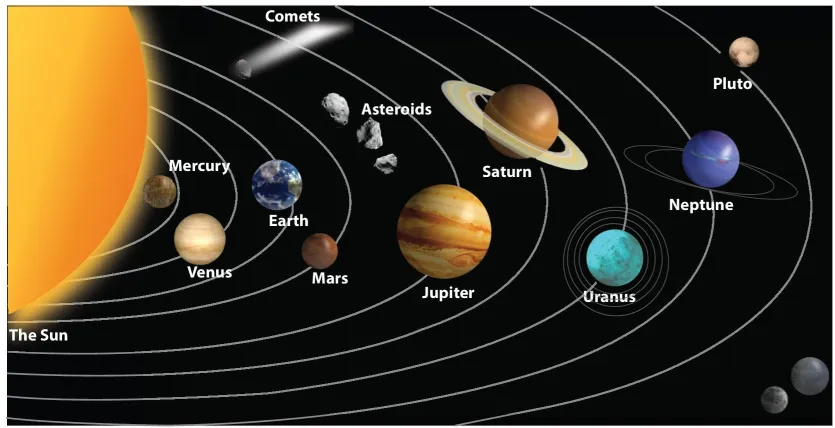
The aggregation of eight planets (excluding Pluto) and their moons in ellipsoidal orbits around the sun, along with smaller bodies like asteroids, meteoroids and comets is called “solar system” (Figure 1.1). Atoms, molecules and particles of cosmic dust from interplanetary clouds got attracted towards each other due to the gravitational field about 6×10⁹ years ago and began to fall together into what is known as the “solar system”. The sun is the principal source of energy for existence of life on earth. It is the nearest star to the earth, about 150 million kilometers from earth. The temperature of the sun’s visible surface (photosphere is a star’s outer shell from which light is radiated) is about 6000 °C. However, the outer layer of the sun’s atmosphere that is known as the “corona” is on an average, about 2 million °C. The core of the sun is the center and is about 15 million degrees °C. The sun is made up of 73% hydrogen and 25% helium. It also has trace amounts of oxygen, carbon, iron and other elements.
There are total eight planets in the solar system, excluding Pluto, that are divided into two groups: inner planets and outer planets. The inner planets include Mercury, Venus, earth and Mars, which are also known as “terrestrial planets” or “rocky planets”. These planets are denser and have shorter periods of revolution. The outer planets contain Jupiter, Saturn, Uranus and Neptune. They are also known as “gas giants” or “gaseous planets”. They are big in size and have longer periods of revolution. Jupiter is the biggest planet in the solar system while Mercury is the smallest. Mercury is a planet closest to the sun, thus orbits the sun quickly and has no significant atmosphere. Its rotation period is longer than its orbital (revolution) period. It has no natural satellites (moons). Venus is known as earth’s twin. It has the longest rotation period of any planet. Its rotation period is longer than its orbital (revolution) period. It is the hottest planet in the solar system. Its atmosphere includes dense gases and clouds of chemicals like H2SO4. It revolves around the sun in a clockwise manner while most of the others revolve in an anti-clockwise direction. It is the second-brightest natural object in the night sky (after the moon).
Figure 1.1 Solar system: sun, planets, asteroids and comets.
Earth is the only planet in the solar system to be known to support life. It has water in all these states, liquid, solid/ice supercritical fluid and gas/steam. Nitrogen, hydrogen, oxygen and carbon dioxide are gases abundantly found in earth’s atmosphere. It takes 23 hours 56 minutes 46 seconds to rotate around its axis. It takes 365.26 days to revolve around the sun. The ozone layer present in the earth’s atmosphere protects it from ultraviolet radiations. The moon is the only natural satellite of earth. Mars is known as the “red planet” due to the presence of iron-rich red soil. Despite its red colour, it is cold because it has lost most of its atmosphere. “Phobos” and “Deimos” are the two moons of Mars. It has polar ice caps and traces of sub-terrestrial liquid water. Jupiter is the largest planet of the solar system. It has two and a half times the mass of all other planets put together. It has the shortest rotation period. It is a gas giant, primarily composed of hydrogen and helium with no discernible solid surface. It has a giant storm (three times the diameter of earth) since 1831 called the “great red spot”. It has a faint ring around it. It has 67 moons. Saturn is the second-largest planet in the solar system. Its density is less than the water. It has a band of concentric rings revolving around it made up of tiny rocks and pieces of ice. It has 62 moons. Moons of Saturn ...
Table of contents
Cover
Table of Contents
Title Page
Copyright Page
Dedication Page
Acknowledgments
1 Introduction to Environmental Chemistry
2 Atmosphere
3 Air Pollution and Control Strategies
4 Hydrosphere
5 Water Pollution and Treatment Technologies
6 Lithosphere/Geosphere
7 Soil Pollution and Remediation Processes
8 Biosphere
9 Noise Pollution
10 Toxicological Chemistry
11 Environmental Disasters
12 Hazardous Wastes
13 Non-Renewable Energy Resources
14 Renewable Energy Resources
15 Biofuels
About the Authors
Index
End User License Agreement
Trusted by 375,005 students
Access to over 1.5 million titles for a fair monthly price.
Study more efficiently using our study tools.
Frequently asked questions
Yes, you can cancel anytime from the Subscription tab in your account settings on the Perlego website. Your subscription will stay active until the end of your current billing period. Learn how to cancel your subscription
No, books cannot be downloaded as external files, such as PDFs, for use outside of Perlego. However, you can download books within the Perlego app for offline reading on mobile or tablet. Learn how to download books offline
Perlego offers two plans: Essential and Complete
Essential is ideal for learners and professionals who enjoy exploring a wide range of subjects. Access the Essential Library with 800,000+ trusted titles and best-sellers across business, personal growth, and the humanities. Includes unlimited reading time and Standard Read Aloud voice.
Complete: Perfect for advanced learners and researchers needing full, unrestricted access. Unlock 1.5M+ books across hundreds of subjects, including academic and specialized titles. The Complete Plan also includes advanced features like Premium Read Aloud and Research Assistant.
Both plans are available with monthly, semester, or annual billing cycles.
We are an online textbook subscription service, where you can get access to an entire online library for less than the price of a single book per month. With over 1.5 million books across 990+ topics, we’ve got you covered! Learn about our mission
Look out for the read-aloud symbol on your next book to see if you can listen to it. The read-aloud tool reads text aloud for you, highlighting the text as it is being read. You can pause it, speed it up and slow it down. Learn more about Read Aloud
Yes! You can use the Perlego app on both iOS and Android devices to read anytime, anywhere — even offline. Perfect for commutes or when you’re on the go. Please note we cannot support devices running on iOS 13 and Android 7 or earlier. Learn more about using the app
Yes, you can access Environmental Chemistry by Muhammad A. Hanif,Farwa Nadeem,Ijaz Ahmad Bhatti,Hafiz Muhammad Tauqeer in PDF and/or ePUB format, as well as other popular books in Physical Sciences & Organic Chemistry. We have over 1.5 million books available in our catalogue for you to explore.