eBook - ePub
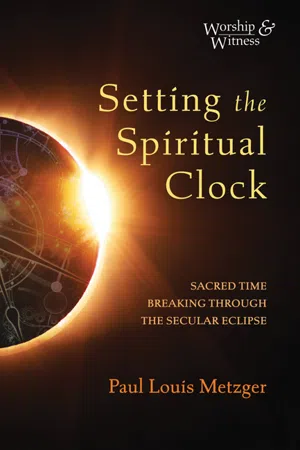
Setting the Spiritual Clock
Sacred Time Breaking Through the Secular Eclipse
- 306 pages
- English
- ePUB (mobile friendly)
- Available on iOS & Android
eBook - ePub
About this book
Various Christian traditions mark their calendars to reflect the biblical and ecclesial narrative and enhance public worship. Such efforts safeguard against secularization's encroachment in the church's life. Setting the Spiritual Clock serves as a guide and traveling companion for the liturgical year, which circles the glorious Son as he breaks through the secular eclipse.
Information
Topic
Theology & ReligionSubtopic
Christian TheologyI
Advent: Jesus Is Coming!
Advent is about Jesus coming to earth. Ultimately, Advent is about Jesus moving history forward—not backward—toward its climax when he comes again. And yet, ironically, the contemporary version of the “Christmas season” has creeped backward into the autumn, not because of an attraction to Christ but because it is good for business.
It is little wonder that business sensibilities shape people’s senses during the Christmas holiday season. Gordon Bigelow argues that the market ideology is the dominant narrative that shapes our psyche today, thereby eclipsing the biblical story in the minds of many. He writes:
Economics, as channeled by its popular avatars in media and politics, is the cosmology and the theodicy of our contemporary culture. More than religion itself, more than literature, more than cable television, it is economics that offers the dominant creation narrative of our society, depicting the relation of each of us to the universe we inhabit, the relation of human beings to God. And the story it tells is a marvelous one. In it an enormous multitude of strangers, all individuals, all striving alone, are nevertheless all bound together in a beautiful and natural pattern of existence: the market. This understanding of markets—not as artifacts of human civilization but as phenomena of nature—now serves as the unquestioned foundation of nearly all political and social debate.27
The Christian calendar instructs us that the market does not dictate value. Advent is not ultimately about futuristic projections of Christmas sales that require extending the season backward into the autumn to grow the profits. Rather Advent is about the prophecies concerning the Messiah’s emergence or visitation on the stage of history.
Nor is Advent about our visiting nostalgic white Christmas scenes reminiscent of a Thomas Kinkade painting and Hallmark card, or binge watching cherished classic Christmas season films. No, Advent is about traveling to Bethlehem with Mary and Joseph to experience the uncommon joy and peace wrapped in swaddling clothes. His joyful and peaceful presence blankets and shelters us so that we do not succumb to the fleeting happiness of holiday good cheer or falter under the heavy-handed and violent order that political establishments so often enforce. Thus, it is no surprise or coincidence that the four Advent candles are “Prophecy” for hope, “Bethlehem” for faith, “Shepherd” for joy, and “Angel” for peace. To these four lighted themes, we now turn.
Jesus Is Coming! Are We Waiting for Him?
The Christian calendar year begins today with the first Sunday of Advent. Advent’s Latin root means “coming” or “arrival,” and signifies Jesus’ coming to earth. In addition to celebrating Jesus’ appearance at his first advent, we await his second advent, when he will judge the nations and reconcile all things to God.
Often, the first week of Advent draws attention to the prophetic expectation of the Messiah’s appearance. The first candle of the Advent wreath is often referred to as the Prophecy Candle or Prophet’s Candle. It symbolizes hope related to those who first spoke of the Messiah’s coming into the world.
Matthew’s Gospel references various texts from the Hebrew Scriptures that the New Testament community believed were prophetic utterances fulfilled in Jesus (read Matt 1:23 and 2:6). From the Gospel of Matthew’s perspective, the New Testament community is not alone in anticipating Jesus’ coming. The saints of old also longed for his appearance, a point that 1 Peter also makes (read 1 Pet 1:10–12).
The prophets did not see with their own eyes what they prophesied, nor did other saints who longed for the coming of the promised Messiah. Hebrews 11:39–40 reads of the saints of old who longed for the fulfillment of the promised inheritance in Christ, “And all these, though commended through their faith, did not receive what was promised, since God had provided something better for us, that apart from us they should not be made perfect.”
I marvel at these Old Testament saints for their tenacity, resilience, and patience. The same goes for the New Testament saints who were undergoing extreme suffering, even persecution. Such was the context of 1 Peter and Hebrews. Like the saints of old, they were awaiting the fulfillment of the ages, when the Messiah will make all things new.
We wait for Jesus’ appearing today. Or do we? In view of the seemingly eternal delay, have we moved on to entertain other “messiahs,” other plans, and other hopes? The times in which we live make it increasingly difficult to wait. In our quick fix and instant gratification culture, it is getting increasingly taxing by the day to wait. High-speed Internet can easily lead to high-speed spirituality, where everything is now. Thus, it is even more important that we slow down and reframe our imaginations in honor of Jesus’ story. We should ask ourselves, no matter our background or context: When Jesus returns to earth, will he find long-suffering faith, or only casual religious browsers surfing the web at a high speed?
The Advent season helps us reframe our imaginations and expectations. As with the church throughout the centuries, as well as with the Hebrew saints of old who longed for the Messiah’s appearance, we anticipate the long-awaited deliverer and live now in view of his coming.
The author of Hebrews would tell us the best is yet to come, as he encourages his readers to wait patiently and encourage one another—and all the more—in the communion of the saints as the day of Jesus’ reappearing advances (Heb 10:24–25). But can we wait? Moreover, if we do wait rather than look elsewhere for satisfaction, how will we make the most of our time?28
We wait by being industrious and active in participating in Jesus’ mission through his Spirit. Jesus will consummate his kingdom when he returns, but we are participants in that kingdom which he inaugurated during his first advent. Thus, the Lord is already here, as we actively wait by living out his will here and now to love God with all our hearts and our neighbors as ourselves, just as he taught and modeled for us. So, we await his coming by living for him, even by living for others. Advent is a time to remember and reenact Jesus’ story. Come, Lord Jesus, come!
Looking for Jesus in the Least Likely of Places—Bethlehem
Today marks the second Sunday of Advent. As with all four Sundays of Advent, today celebrates Jesus’ arrival in the world. Many churches use Advent wreaths to mark the occasion. Often, the candle marking the second Sunday is called the “Bethlehem Candle.” The emphasis is on faith and notes Mary and Joseph’s sojourn to Bethlehem.
No doubt, people who casually engaged the Scriptures would have expected the Messiah to come from Jerusalem. After all, Jerusalem was the capital city. But those who knew their Scriptures well would have realized that the Messiah was destined to come from Bethlehem. Matthew 2:6 points this out, as the Gospel quotes a portion of Micah 5:2. Micah 5:2 reads, “But you, O Bethlehem Ephrathah, who are too little to be among the clans of Judah, from you shall come forth for me one who is to be ruler in Israel, whose coming forth is from of old, from ancient days” (Mic 5:2).
Bethlehem had a special place in Israel’s history. King David was born and raised there. However, it was an ordinary place lacking great significance by all other accounts. It’s just like God to bring significance to otherwise insignificant places or people.
God often shows up in unexpected places. Who would have thought that God would have had Samuel journey to Bethlehem to anoint a king from the line of Jesse—in fact, the youngest of Jesse’s sons, David? Even the prophet Samuel, whom God sent to Jesse’s household to anoint one of his sons as the king to replace Saul, was not looking with God’s eye point-of-view. When he sees the eldest of Jesse’s sons, he assumes immediately that this young man is the person God has chosen as king. But God speaks to Samuel and says, “Do not look on his appearance or on the height of his stature, because I have rejected him. For the Lord sees not as man sees: man looks on the outward appearance, but the Lord looks on the heart” (1 Sam 16:7).
God’s surprising choice of king did not begin there. Judah’s line was chosen over Reuben’s (Jacob or Israel’s firstborn) and God’s presumed favorite Joseph and his children, Ephraim and Manasseh. When Israel blessed his sons, he said of Judah: “The scepter shall not depart from Judah, nor the ruler’s staff from between his feet, until tribute comes to him; and to him shall be the obedience of the peoples” (Gen 49:10). Later in the story, we find that God chooses Ruth, a refugee from Moab, and Boaz of Bethlehem (see Ruth ...
Table of contents
- Title Page
- Timely Acknowledgments
- Introduction: Checkbooks, Calendars, and What We Cherish
- Chapter I: ADVENT: JESUS IS COMING!
- Chapter II: CHRISTMASTIDE: JESUS IS BORN!
- Chapter III: EPIPHANYTIDE: GOD IS WITH US!
- Chapter IV: LENT: DIE TO SELF TO GAIN JESUS!
- Chapter V: HOLY WEEK: JESUS DIES TO BRING NEW LIFE!
- Chapter VI: EASTERTIDE: JESUS IS RISEN!
- Chapter VII: ORDINARY TIME: FOLLOW JESUS IN THE SPIRIT TO THE END!
- Conclusion: Out of Joint and Time? Reset the Spiritual Clock
- Appendix
- Bibliography
Trusted by 375,005 students
Access to over 1.5 million titles for a fair monthly price.
Study more efficiently using our study tools.
Frequently asked questions
Yes, you can cancel anytime from the Subscription tab in your account settings on the Perlego website. Your subscription will stay active until the end of your current billing period. Learn how to cancel your subscription
No, books cannot be downloaded as external files, such as PDFs, for use outside of Perlego. However, you can download books within the Perlego app for offline reading on mobile or tablet. Learn how to download books offline
Perlego offers two plans: Essential and Complete
- Essential is ideal for learners and professionals who enjoy exploring a wide range of subjects. Access the Essential Library with 800,000+ trusted titles and best-sellers across business, personal growth, and the humanities. Includes unlimited reading time and Standard Read Aloud voice.
- Complete: Perfect for advanced learners and researchers needing full, unrestricted access. Unlock 1.5M+ books across hundreds of subjects, including academic and specialized titles. The Complete Plan also includes advanced features like Premium Read Aloud and Research Assistant.
We are an online textbook subscription service, where you can get access to an entire online library for less than the price of a single book per month. With over 1.5 million books across 990+ topics, we’ve got you covered! Learn about our mission
Look out for the read-aloud symbol on your next book to see if you can listen to it. The read-aloud tool reads text aloud for you, highlighting the text as it is being read. You can pause it, speed it up and slow it down. Learn more about Read Aloud
Yes! You can use the Perlego app on both iOS and Android devices to read anytime, anywhere — even offline. Perfect for commutes or when you’re on the go.
Please note we cannot support devices running on iOS 13 and Android 7 or earlier. Learn more about using the app
Please note we cannot support devices running on iOS 13 and Android 7 or earlier. Learn more about using the app
Yes, you can access Setting the Spiritual Clock by Paul Louis Metzger in PDF and/or ePUB format, as well as other popular books in Theology & Religion & Christian Theology. We have over 1.5 million books available in our catalogue for you to explore.