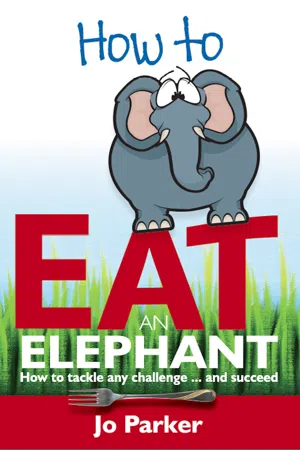
Have you ever wanted to tackle a task but just didn't know where to start? Have you ever wanted to achieve something but felt it was too big a challenge? Have you ever wondered how you would manage to complete everything you need to by the critical date or with the money you have available? This book will tell you the secrets of professional project managers who manage huge projects of amazing complexity, along with tricks of the best managers. Learn how to plan for the worst and achieve the best so that you can build the life you want with greater confidence and success.
- 91 pages
- English
- ePUB (mobile friendly)
- Available on iOS & Android
eBook - ePub
About this book
Trusted by 375,005 students
Access to over 1.5 million titles for a fair monthly price.
Study more efficiently using our study tools.
Information
Subtopic
Gestion de projetCHAPTER ONE

Why bother?

Do some challenges seem daunting?
Have you ever read in newspapers or magazines about people who tackled huge tasks, like launching a new business or organising a grand event, and thought to yourself ‘I’d love to try something like that but I just wouldn’t know where to start’? Or perhaps there’s something you’d like to do but it just seems too big a task – changing job, moving house, organising a big charity event. Some challenges may put you off because something will take such a long time. How will you keep going, maintain momentum, keep track of what you need to do?
Something quite straightforward, such as having a good clear-out, can seem like a huge and challenging task on top of everything else. Even quite small tasks can leave you wondering how on earth you’ll manage to get everything done and often you can feel like a juggler, desperately trying to keep all the balls in the air and wondering what will happen if you drop one.
You are not alone
Shall I let you into a secret? You are not alone. There are lots of people who would love to have a go at something but don’t give it a try because they feel overwhelmed by the task or just don’t know where to start.
In order to raise money for charity, I do lot of speaking at Women’s Institutes. I talk about my wedding which was held on the edge of Antarctica on the island of South Georgia, the year I worked in Afghanistan and how I compete in triathlons. After the talks I get all sorts of women who come up to me and say ‘I’d love to have a go at a triathlon but I just wouldn’t know where to start’ or ‘I’d love to work abroad but I just don’t know how to go about it’. Some of them even tell me about the wedding they have volunteered to organise for their daughter and how they half-wish the selfsame daughter would go off to Antarctica to get married like I did so they wouldn’t have the huge challenge of organising their wedding.
If you talk to these people, it turns out that they do organise all sorts of other things – Women’s Institute meetings, village events, outings for friends and family. However, trying something rather different worries them and they just don’t know what to do.
Others don’t even own up to it. At most, they talk about their ‘friend’ who doesn’t know what to do, but with such a close knowledge that I can’t help speculating whether that friend is actually them. That leaves me wondering if there are others out there who don’t even own up to having a daydream. They keep it close in their heart but never realise it as they feel the challenge is too big.
Not everyone admits to their dreams
There are all sorts of reasons why people don’t own up to having a dream. Some feel they have no right to want something as grand or as ambitious. Sadly, in the UK many people still feel they should not have ‘ideas above their station’. Often they are afraid that people will ridicule their ambitions. I remember when I had my annual appraisal with one boss; he asked what my ambition was. I replied honestly that I’d love to be a director of a company. He laughed at me and told me that was rather ambitious. That was in 1992. In 2000 I was made director of North Surrey Water Company. Admittedly, I was director for less than a year as it was decided at my first board meeting to merge with my old company. Still, it gave me huge satisfaction to know that I’d proved the sceptical boss from my past wrong (although he had retired by that time).
Some people don’t own up to an ambition because they are worried that their colleagues or friends may try to put them off it. Someone wanting to lose weight may be told ‘but you’re nice the way you are’. Someone wanting to change jobs may well not tell their colleagues at work – and certainly not their boss! Someone thinking of taking up a new hobby might be asked ‘Why do you want to do that?’
There can be pressure from family and friends to stay as you are. They may not want to venture into unfamiliar territory even if you are up for it. Some people may have spent so much of their life putting family first that actually tackling something for themselves may feel wrong. However, doing anything differently will feel strange at first; it’s only after a while that it becomes habitual. Try this little exercise: clasp your hands in front of you; notice whether your right or your left little finger is at the back; now change your fingers over so that the other little finger is at the back. Does that feel strange? Leave it for a while and it will start to feel ‘normal’. Any change can be like that and feels strange when you first do it, but if you keep on doing it for long enough it will become normal for you.
Sometimes people don’t own up to a grand plan because they are worried that, by voicing what they want, they will be expected to do something about it. They might quite like the humdrum rut they are trundling along and, although they have daydreams, realising those dreams could actually be quite frightening. It would take them away from the familiar and safe existence they have now.
I can understand that fear as I suffered from it myself. When I was younger, I had the opportunity to be sponsored by a local rotary club to study overseas for a year. Although I was short-listed for theaward, I later pulled out as I had a nice flat and was worried that I might not find another place as nice to live in when I returned. When it was too late, I was really sorry I’d thrown away such an opportunity. I also decided against applying for some jobs as I wasn’t sure what they would bring and wasn’t even sure I could do the job. It wasn’t until I started admitting these things to my friends that I found out that quite a few of them had done similar things.
Why a comfortable rut is not such a good thing
One could ask ‘Why shouldn’t I stay in a rut if it’s comfortable?’ The problem is that nothing in this world stays still; everything is growing or diminishing. Even the most solid-looking stones are being eroded slowly and seemingly still water will be flowing or evaporating. The same applies to us. We may think we are standing still, but if we don’t stretch ourselves, then in fact we tend to gradually retreat into a smaller and smaller comfort zone. Maybe there’s something we used to do but we haven’t done it for weeks, then months and then years. Before you know it, it’s been such a long time that it becomes too much effort.
I’m sure lots of people have found this with friends. If you don’t get in touch with them, it can become more and more difficult to contact them until sometimes you just lose touch and never see them again. That might not be a problem, but if you don’t make new friends your circle of friends may gradually get smaller and smaller.
Cope with the unexpected challenges
In the same way, our ability to tackle new challenges may decrease if we don’t keep exercising that ability. When we are young everything is novel but, as we get older, we have fewer and fewer new experiences. That can mean that when you have no choice about tackling something new it can be really tough. Even if you think that doesn’t matter, you can’t assume that life will stay the same. Life doesn’t always go the way you expect. Divorce, bereavement and redundancy can hit unexpectedly and the more one is used to dealingwith new circumstances and taking on new challenges, the easier it is to cope when something comes along you hadn’t foreseen.
A friend of mine is great at tackling projects. She’s gained all sorts of qualifications through studying part-time which has helped her grow her business. It also made her a stronger person and, when her husband was offered a job in the Middle East, although it was a daunting task to pack up the house and move herself and her two teenage sons to join him, her strength kept her going through the toughest challenge she’d ever had to meet.
Taking on a challenge
As I mentioned, I had always tended to stay with what I knew. However, I grew increasingly frustrated when a certain job I wanted kept eluding me. I kept being told I didn’t have the experience, but that left me in a Catch 22 situation as I needed the job to get the experience. Eventually, I had an opportunity to gain the experience but it would have meant working overseas for a year – and not just anywhere but in Afghanistan during the height of the civil war there. It was a tough decision and I had no idea how I would get on. However, this time I decided I wouldn’t take the ‘safe’ route and I said yes to the opportunity. I had a wonderful time in Afghanistan. Even though there were times when I found it really tough, I weathered the storms and as I did so I gained more strength and understanding about myself. I felt like a completely different person when I returned. Back in the UK I got the long sought-after job and took on fresh challenges. I found that as I did so I grew stronger and stronger.
One of my toughest challenges came when my company restructured. I had the choice of transferring to a job in Folkestone or redundancy. As I had just met a wonderful man who lived in Bedfordshire, Folkestone would have made maintaining that relationship difficult. I therefore accepted the redundancy offer and decided to start my own business after 28 years as an employee. Thatwas one of the most difficult things I had ever tackled, particularly as I then decided to move house as well. However, my earlier challenges stood me in good stead and when I had moved house and set up my new office and was finding that work was coming in steadily, I also realised that again I had reached an even higher level of confidence.
Challenges can get easier
It’s surprising how something which can seem too daunting can, over time and with repetition, get easier and easier. Before you know it, what seemed an impossible hill to climb is behind you and you’re relishing the next ascent. Besides equipping you to cope with life’s knocks, you can acquire new skills which may help with your work, introduce you to new friends or even start a lifetime interest. I found this when writing this book. It was tough at first; I wanted to say so much but didn’t know where to start and never found the time. With some help, I managed to order my thoughts and, once I started, it got easier and easier to write.
Create the life you want
Another benefit of taking on the big challenges is that you are able to create for yourself the life you want. I’ve already explained how taking the job overseas gave me the experience I needed for the job I wanted back in the UK. I had started to turn my life into what I really wanted it to be.
I also decided to study for a further qualification through distance learning. That was another huge challenge, but I came to find the new subjects fascinating and I found exercising my brain really rewarding. Initially, finding the time and the discipline was really difficult but gradually I got into a routine and I found it easier and easier. The course equipped me for some new jobs and helped me gain promotion.
Couch potato to triathlete
One thing I’d always wanted was to feel fitter and to be slimmer. I’d always been hopeless at games – the sort of person who didn’t make it into the form team and ended up pushing a ball around at the back of the hockey nets or throwing it against the wall of the gym. A few years ago, a friend suggested that I have a go at a triathlon. This required swimming 400m – I could barely swim a length. I had to cycle 25km – probably the easiest of the three tasks. Finally I had to run 5km. Running was something I found really tough; I had tried jogging a few times, but found it hard to keep going. However, with help and encouragement from my friend, I had a go. Competing in that first triathlon has transformed my life. I am now fitter and slimmer than I’ve ever been in my life. At long last I can choose clothes that I like, rather than because they fit. I have more energy and don’t get ill. Finally I really have created the life I wanted. In the same way, you can transform your life in lots of ways. You do not have to stick with the same job in the same location with the same activities when you get back home.
You will see in this book that I use the example of competing in my first triathlon quite a few times. It was something I didn’t feel capable of initially but which really did transform my life. However, to finish my first triathlon required me to use all my skills as a project manager – only this time I was the project!
Never stop learning
Even now, taking on new ‘big tasks’ stretches and toughens me. Recently I was asked to act as an expert witness in a major planning enquiry. This was something I had never done before. I had to analyse the performance of another company and write a report which would be considered in detail by the other side’s legal experts. I would have to justify all my statements and explain why I had made them. I would even be cross-examined by a senior member of the legal profession – and all this in front of former colleagues as well as the national press. It was without doubt the toughest thing I’d had to cope withyet. I had three days of questioning by a top London lawyer, during which time I was not allowed to speak to any of the team I had worked with. However, when it was finished I really did feel I could tackle anything. The confidence boost has helped me as a person and helped my business.
It is possible to change
I hope that from my examples you can see that it is possible to change the way you feel about life or even about yourself. Lots of people go through life feeling scared, unworthy, inadequate or stuck in a rut. A life coach I knew said that one of the most common problems she came up against was ‘the impostor syndrome’, w...
Table of contents
- Cover
- Dedication
- Title Page
- Copyright
- Contents
- CHAPTER ONE - Why bother?
- CHAPTER TWO - Anyone can do it
- CHAPTER THREE - Develop a Big Picture
- CHAPTER FOUR - Expand the picture
- CHAPTER FIVE - Build a route plan
- CHAPTER SIX - Sort out what you need
- CHAPTER SEVEN - You are not alone
- CHAPTER EIGHT - Getting people to do things
- CHAPTER NINE - Make sure things happen
- CHAPTER TEN - You can make your own luck
- CHAPTER ELEVEN - Celebrate Success
- About the Author
Frequently asked questions
Yes, you can cancel anytime from the Subscription tab in your account settings on the Perlego website. Your subscription will stay active until the end of your current billing period. Learn how to cancel your subscription
No, books cannot be downloaded as external files, such as PDFs, for use outside of Perlego. However, you can download books within the Perlego app for offline reading on mobile or tablet. Learn how to download books offline
Perlego offers two plans: Essential and Complete
- Essential is ideal for learners and professionals who enjoy exploring a wide range of subjects. Access the Essential Library with 800,000+ trusted titles and best-sellers across business, personal growth, and the humanities. Includes unlimited reading time and Standard Read Aloud voice.
- Complete: Perfect for advanced learners and researchers needing full, unrestricted access. Unlock 1.5M+ books across hundreds of subjects, including academic and specialized titles. The Complete Plan also includes advanced features like Premium Read Aloud and Research Assistant.
We are an online textbook subscription service, where you can get access to an entire online library for less than the price of a single book per month. With over 1.5 million books across 990+ topics, we’ve got you covered! Learn about our mission
Look out for the read-aloud symbol on your next book to see if you can listen to it. The read-aloud tool reads text aloud for you, highlighting the text as it is being read. You can pause it, speed it up and slow it down. Learn more about Read Aloud
Yes! You can use the Perlego app on both iOS and Android devices to read anytime, anywhere — even offline. Perfect for commutes or when you’re on the go.
Please note we cannot support devices running on iOS 13 and Android 7 or earlier. Learn more about using the app
Please note we cannot support devices running on iOS 13 and Android 7 or earlier. Learn more about using the app
Yes, you can access How to Eat an Elephant by Jo Parker in PDF and/or ePUB format, as well as other popular books in Développement personnel & Gestion de projet. We have over 1.5 million books available in our catalogue for you to explore.