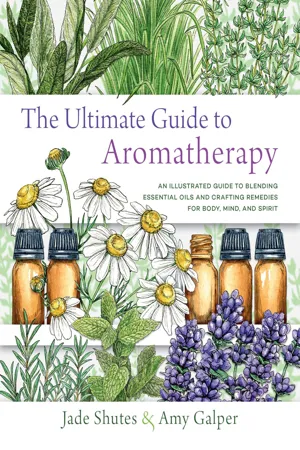
The Ultimate Guide to Aromatherapy
eBook - ePub

The Ultimate Guide to Aromatherapy

An Illustrated guide to blending essential oils and crafting remedies for body, mind, and spirit

  1. 208 pages
  2. English
  3. ePUB (mobile friendly)
  4. Available on iOS & Android
eBook - ePub

The Ultimate Guide to Aromatherapy

An Illustrated guide to blending essential oils and crafting remedies for body, mind, and spirit

About this book

Written by two of the leading voices in aromatherapy, Amy Galper and Jade Shutes, The Ultimate Guide to Aromatherapy is a progressive, comprehensive approach to using aromatherapy and essential oils for healing and wellness.

Essentials oils have been used across all world cultures for thousands of years. While the popularity of aromatherapy has endured, the methods and applications of the craft have evolved. The Ultimate Guide to Aromatherapy is the modern practitioner's guide to working with aromatherapy and essential oils.

Using techniques developed over decades of teaching, you will learn the science of aromatherapy and how essentials oils interact with our sense of smell, brain pathways, and skin. The guide also includes over 50 plant profiles, plus recipes and blends for health and beauty. Included are remedies for digestive health, immunity, women's health concerns, and more, such as Hand & Body Wash for Flu Recovery, Self-Love Botanical Perfume, and Tummy Massage Oil for Indigestion.

Drawing on the authors' unique methodology and expertise as aromatherapists, herbalists, and healers, you will learn the art of blending formulations with great skill and discernment.

The Ultimate Guide to… series offers comprehensive beginner’s guides to discovering a range of mind, body, spirit topics, including tarot, divination, crystal grids, numerology, witchcraft, chakras, and more. Filled with beautiful illustrations and designed to give easy access to the information you’re looking for, each of these references provides simple-to-follow expert guidance as you learn and master your practice.

Frequently asked questions

Yes, you can cancel anytime from the Subscription tab in your account settings on the Perlego website. Your subscription will stay active until the end of your current billing period. Learn how to cancel your subscription.
No, books cannot be downloaded as external files, such as PDFs, for use outside of Perlego. However, you can download books within the Perlego app for offline reading on mobile or tablet. Learn more here.
Perlego offers two plans: Essential and Complete
  • Essential is ideal for learners and professionals who enjoy exploring a wide range of subjects. Access the Essential Library with 800,000+ trusted titles and best-sellers across business, personal growth, and the humanities. Includes unlimited reading time and Standard Read Aloud voice.
  • Complete: Perfect for advanced learners and researchers needing full, unrestricted access. Unlock 1.4M+ books across hundreds of subjects, including academic and specialized titles. The Complete Plan also includes advanced features like Premium Read Aloud and Research Assistant.
Both plans are available with monthly, semester, or annual billing cycles.
We are an online textbook subscription service, where you can get access to an entire online library for less than the price of a single book per month. With over 1 million books across 1000+ topics, we’ve got you covered! Learn more here.
Look out for the read-aloud symbol on your next book to see if you can listen to it. The read-aloud tool reads text aloud for you, highlighting the text as it is being read. You can pause it, speed it up and slow it down. Learn more here.
Yes! You can use the Perlego app on both iOS or Android devices to read anytime, anywhere — even offline. Perfect for commutes or when you’re on the go.
Please note we cannot support devices running on iOS 13 and Android 7 or earlier. Learn more about using the app.
Yes, you can access The Ultimate Guide to Aromatherapy by Jade Shutes,Amy Galper in PDF and/or ePUB format, as well as other popular books in Medicine & Alternative & Complementary Medicine. We have over one million books available in our catalogue for you to explore.

PART I

About Aromatherapy

Image

CHAPTER ONE

THE NEW AROMATHERAPY

WHAT IS AROMATHERAPY? The quick and simple answer—aromatherapy is the study and application of essential oils. It can also be referred to as Essential Oil Therapy, and that’s how we like to think of it. Essential Oil Therapy (i.e., aromatherapy) encompasses the holistic application and use of essential oils to support the health and well-being of the individual. We’ll use both terms in this book.
But if we dig deeper, its true and genuine definition is still a little murky. It’s often misunderstood and undervalued, possibly due to its commercial exploitation, especially in the United States. Think of all the diffusers saturating the market these days, and the thousands of articles and Internet posts touting the magical powers of essential oils. (That’s actually one of the reasons we like calling it Essential Oil Therapy.) And yet, despite the lack of clarity and complexity in its definition, aromatherapy continues to be one of the fastest growing complementary healthcare modalities of the 21st century.
Before we start carving out our approach to Essential Oil Therapy, let’s quickly review the history of the human use of aromatic plants. Understanding it can provide great insight into how we redefine it for the 21st century.
Although humans have been using aromatic plants for thousands of years, aromatherapy as we know it today is a relatively young practice in comparison. Throughout this book you will be introduced to the remarkably dynamic and diverse ways in which essential oils can be used: house-cleaning products, therapeutic inhalers, diffuser blends, body care products to nourish and support the health of skin, and medicinal products that support the body’s own innate healing processes.

A LITTLE HISTORY

Our use of medicinal and aromatic plants is ancient. Many of the ways our ancestors used aromatics are similar to the ways in which we use them today. They date back to the origins of humans, when aromatic plant material was first placed onto a fire. Our sense of smell was more attuned back then, and primitive humans may have found the aromas powerfully affecting them in many ways.
Eventually, through their intuition and observations, people were motivated to start writing down their experiences with plants. We can find written records dating as far back as 5,000 years. Cultures in India, Egypt, and China, for example, have rich histories and evidence of using medicinal and aromatic plants. Plants collected for their aroma and extracts were used for medicine, food preservation, religious ceremonies, and embalming the dead.
During the Middle Ages aromatics were used for defense against the bubonic plague. Doctors would use a variety of aromatic herbs and spices stuffed in a mask to protect themselves from infection. It has been speculated that through their use of aromatics, perfumers and glove makers (those who made gloves would imbue the gloves with aromatics) were immune to the plague due to the aromatics they used in their respective crafts.
GROWING INTEREST
Market research studies, conducted by Grand View Research in April 2019 and Market Reports World in September 2019, report that the global aromatherapy market size was valued at USD $1.3 billion in 2018 and is projected to witness a 10.4 percent CAGR (compound annual growth rate) over the forecast period ending in 2025. Rising awareness about therapeutic uses of essential oils is anticipated to drive the growth. Specifically, Grand View’s Aromatherapy Market Size Analysis reports that revenues are expected to reach $2.35 billion by 2025.
By the 18th century, the use of essential oils was much more widespread. Research on their medicinal properties captivated the curiosity of physicians and druggists, who were the early precursors to modern pharmacists. And in the 19th century, published studies showing the antibacterial and antifungal properties of many essential oils became more accessible.
Let’s take a brief look at how the word Aroma- therapy came into the modern lexicon. It was RenĂ©-Maurice GattefossĂ©, perfumer and chemist, who coined the term in 1937. Probably the most important thing to remember about GattefossĂ© and his impact on what eventually grew into the modern practice of aromatherapy is that he clearly meant to distinguish the medicinal application of essential oils from their perfumery applications. As a perfumer, he had a great love and passion for the aromas of essential oils, but by 1918 he grew more fascinate...

Table of contents

  1. Cover
  2. Title Page
  3. Contents
  4. Essential Oils
  5. Introduction
  6. Part I: About Aromatherapy
  7. Part II: Pathways Into the Body
  8. Part III: The Essential Apothecary
  9. Part IV: Methods of Use (Application)
  10. Part V: Putting it All Together
  11. Resources
  12. About the Authors
  13. Acknowledgments
  14. Endnotes
  15. Index
  16. Copyright