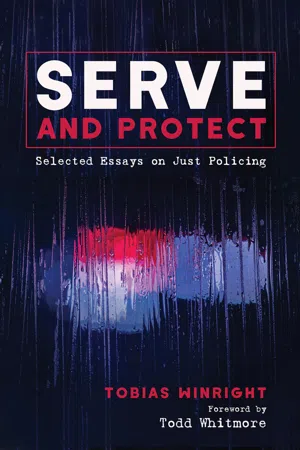
This collection of essays on policing and the use of force, while written over the course of the last twenty-five years, remains relevant and timely. Although issues in policing and questions about excessive force and brutality have been addressed by criminologists, sociologists, philosophers, and criminal justice ethicists, only a handful of theological ethicists treat this pressing matter. While the Christian moral tradition has a voluminous record of theological attention to violence and nonviolence, war and peace, there is a dearth of references to policing. And most considerations of criminal justice issues by Christians and their churches concentrate on prison reform, or abolition, and the death penalty, but not policing. These essays, authored by a theological ethicist possessing professional experience in law enforcement, seek to fill this curious gap. They offer a framework for moral reasoning concerning the justification for police use of force and the just application of such force, and they propose just policing as a model that is consonant with promoting a just peace in communities and society. In addition, they explore the implications of such an approach for wider, international questions about just war, terrorism, the responsibility to protect, and post-war justice.
- 198 pages
- English
- ePUB (mobile friendly)
- Available on iOS & Android
eBook - ePub
About this book
Information
Topic
Theology & ReligionSubtopic
Christian TheologyChapter One
The Perpetrator as Person
Theological Reflections on the Just-War Tradition and the Use of Force by Police1
Since the end of the Cold War, much of the attention of citizens and politicians in the United States has swiveled inward upon other issues of life and death, in particular the crime and violence on their own streets. Cries for action in this domestic arena appear to be growing, as evidenced by the past decade’s call to arms in a so-called war against drugs and by Washington’s recent, torrid advocacy for a crime bill and for more police officers in the “war” against crime. Indeed, such trends have led one observer to remark, “We are a nation at war with ourselves: a civil war. The war of law enforcement against the forces of crime.”2 At the same time, however, several highly publicized incidents have provoked public alarm and scrutiny; therefore, reflection and assessment are called for to consider whether and how this kind of “war” ought to be waged.
One notorious incident involved an African-American male named Rodney King. While driving on the evening of March 3, 1991, King was pulled over by, and had a confrontation with, Los Angeles police officers, who proceeded to arrest him on a number of charges. On the surface this sort of incident occurs frequently and could have been reported as a routine traffic arrest, except for the additional fact that it was filmed by a bystander with a video camera. Indeed, the video showed all who watched the replays on the news media how several of fifteen uniformed officers repeatedly beat, bruised, and lacerated King. Although shocking to many Americans, one criminal-justice expert notes, “That beating was not unique in the history of policing. It probably has kin in every state in the Union, in every country, and indeed in every significant police force as far back as we can trace the police function.”3
To be sure, considering the prevalence of violence in our culture, and given the rote adoption of the “war” model or paradigm for law enforcement by the government, such incidents are likely to be less rare. In fact, researchers estimate that police officers kill about 600 criminal suspects yearly, shoot and wound an additional 1,200, and fire at and miss another 1,800.4 This being the case, the issue of the use of force, especially deadly force, by law enforcement officials in the performance of their duties deserves vigilant scrutiny. How are such uses of force justified and restrained? Is there a uniform approach? What model for restraint would be most appropriate for law enforcement in the United States? If police forces are in a “war” against crime, how do they determine when to use force and when it is excessive? What can prevent another Rodney King incident from happening? Is there a way to restrain the use of force among our police, and if so, what is the ethical basis?
Such questions are certainly formidable and are attracting, in the light of incidents like King’s, burgeoning attention from social scientists, criminologists, and increasingly, philosophers. For example, criminal-justice ethicist Lawrence Sherman proposes that, on the one hand, many issues in police ethics are “in fact clear-cut, and hold little room for serious political analysis,” while on the other hand, the use of force deserves such attention since it is “very complex, with many shades of gray.”5 Furthermore, Sherman asserts, “The most basic question of all criminal justice ethics, of course, is whether and under what conditions one can reconcile doing harm to others with our widespread norms against harm.”6 At this juncture, he muses that the literature on pacifism, nonviolence, and conscientious objection may be relevant, but adds that he has unfortunately not seen such an approach applied to the domestic use of force by police. Moreover, he queries, “Can a pacifist be a police officer or a judge? Can a Christian? Can a Rawlsian? What is the ethical defense for saying that killing is wrong and then urging killing in response to killing?”7 These are profound questions, deserving of sober reflection.
In fact, these are the sort of considerations that usually fall within the purview of ethicists, including moral theologians, except that the latter group has failed to broach seriously this particular topic in relation to law enforcement. Indeed, the history of Christian thought is replete with theological wrestlings with such life-shaking issues as war and peace, abortion and euthanasia; and yet, oddly, the dilemma of the use of force by police officers appears to have been a theological blindspot, which is all the more intriguing given that probably as many persons in recent years have found themselves struggling over precisely this issue, for surely there are many police officers who are also Christians.
Indeed, vividly etched in my memory is a question posed by a panelist during my own oral board interview within the application process for a position with a local law enforcement agency: “Would your Christian faith hinder or prevent you from a performance of duty, such as shooting to kill an alleged perpetrator?” I cannot recall what provoked this query, but I do remember that I was at a loss as to how to respond. Indeed, I had struggled with this question, but the Bible and the official church statements—the usual authoritative sources for Christian ethical guidance—were silent about this concrete issue, although the Bible does discuss the one-on-one situation of turning the other cheek, and the church’s tradition includes just-war theory. What I did, therefore, was to build a bridge from church teaching concerning just-war principles to the context of law enforcement, and I was thereby enabled to respond “no” to the panelist’s question, given that I believed that the agency’s policies were in line with the attitude of restraint which undergirds just-war thinking.
Hence, in view of both the present, general need for further, sustained ethical reflection...
Table of contents
- Title Page
- Foreword
- Acknowledgments
- Introduction
- Chapter 1: The Perpetrator as Person
- Chapter 2: Two Rival Versions of Just-War Theory and the Presumption against Harm in Policing122
- Chapter 3: From Police Officers to Peace Officers203
- Chapter 4: Just Cause and Preemptive Strikes in the War on Terrorism
- Chapter 5: Just Policing and the Responsibility to Protect411
- Chapter 6: The Police in War484
- Chapter 7: Militarized Policing
- Chapter 8: Demilitarize the Police!513
- Chapter 9: Faith, Justice, and Ferguson
- Postscript
- Bibliography
Trusted by 375,005 students
Access to over 1.5 million titles for a fair monthly price.
Study more efficiently using our study tools.
Frequently asked questions
Yes, you can cancel anytime from the Subscription tab in your account settings on the Perlego website. Your subscription will stay active until the end of your current billing period. Learn how to cancel your subscription
No, books cannot be downloaded as external files, such as PDFs, for use outside of Perlego. However, you can download books within the Perlego app for offline reading on mobile or tablet. Learn how to download books offline
Perlego offers two plans: Essential and Complete
- Essential is ideal for learners and professionals who enjoy exploring a wide range of subjects. Access the Essential Library with 800,000+ trusted titles and best-sellers across business, personal growth, and the humanities. Includes unlimited reading time and Standard Read Aloud voice.
- Complete: Perfect for advanced learners and researchers needing full, unrestricted access. Unlock 1.5M+ books across hundreds of subjects, including academic and specialized titles. The Complete Plan also includes advanced features like Premium Read Aloud and Research Assistant.
We are an online textbook subscription service, where you can get access to an entire online library for less than the price of a single book per month. With over 1.5 million books across 990+ topics, we’ve got you covered! Learn about our mission
Look out for the read-aloud symbol on your next book to see if you can listen to it. The read-aloud tool reads text aloud for you, highlighting the text as it is being read. You can pause it, speed it up and slow it down. Learn more about Read Aloud
Yes! You can use the Perlego app on both iOS and Android devices to read anytime, anywhere — even offline. Perfect for commutes or when you’re on the go.
Please note we cannot support devices running on iOS 13 and Android 7 or earlier. Learn more about using the app
Please note we cannot support devices running on iOS 13 and Android 7 or earlier. Learn more about using the app
Yes, you can access Serve and Protect by Tobias Winright in PDF and/or ePUB format, as well as other popular books in Theology & Religion & Christian Theology. We have over 1.5 million books available in our catalogue for you to explore.