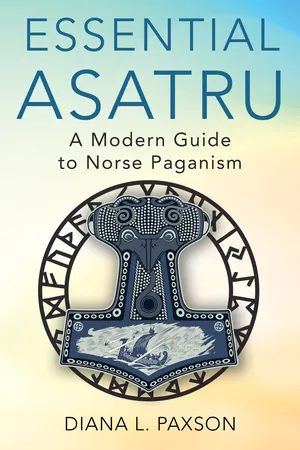
In Essential Asatru, renowned author and priestess Diana Paxson demystifies an ancient, rich, and often misunderstood religion, and offers a practical guide for its modern followers.
A Journey to Fulfillment and Renewal
Filled with clear, concise instructions on living Asatru every day, this truly accessible guide takes you on a journey from Asatru’s origins in Scandinavian and German paganism to its recognition as an official religion in the 1970s and its widespread acceptance today.
Essential Asatru also includes:
· A complete history of Asatru gods and goddesses, including Odin, Thor, and Ostara · The life values, such as honor, truth, fidelity, and hospitality, that shape Asatru’s tenets · Indispensable information on rituals, rune casting, ethics, and divination
Essential Asatru is an elegant and splendid introduction to a centuries-old religion that continues to enrich and fascinate its followers today.
Praise for Essential Asatru
“This mainstreamed book on Asatru offers a thorough grounding in both history and the present and shows how those values—the true heart of any religion—are expressed in the lives of its faithful. This book is recommended for personal education, library shelves, and world religion classes.” —Facing North
“A solid and thorough yet concise introduction to the religion, its history, the gods and goddesses, and the basics of modern practice.” —Idunna
The first round has been completed. Karen brings the horn back to Janet as Thorolf picks up a bottle of mead. This also has been home brewed. After the first bottle was opened five years ago, the kindred swore to put the rest of the batch aside to mature, and with great self-control have kept from tasting it until now. This is a tense moment, since there is always the possibility that the brew has turned to vinegar instead. Thorolf gets the cork out, pours a little into a glass, and tastes. As they watch, he begins to smile.
“Oh yes... ” he sighs. “This one is truly worthy of the gods. ” He turns to Janet and pours the mead into the horn. “I dedicate this mead to the Aesir and the Vanir. Their gifts to us have been great, and a gift demands a gift again!” He draws the rune Gebo over the horn.
Janet turns the horn so that its point is down and a little to the side and lifts it. “I drink to Thor, our protector and friend I want to thank you for sending that tornado across the fields instead of through our town. Keep your hammer between us and the jotnar who would destroy, and teach us how to honor the helpful ones, especially Earth, your mother.” Carefully, she drinks, then hands the horn to Karen to begin the circuit of the room.
Ásatrú is the troth of the gods, and it is the gods and goddesses who are the focus of the religion as it is practiced today. The principal male deities listed by Snorri in the Younger Edda (in Old Norse spelling) are Odhinn, Thórr, Baldr, Njordh and his son Freyr, Tyr, Bragi, Heimdallr, Hodr, Vidar, Vali, Ullr, and Forseti. Another figure who plays an important part in the mythology is Loki. One can also group the Germanic deities by family. The Vanir, who came to Asgard in an exchange of hostages after a war with the Aesir, consist of Njordh and his children Frey and Freyja. We know Nerthus only from a first-century Roman account, but today she is counted among the Vanir as well. The Aesir include all the other male deities, and Frigg, her handmaidens, and probably Idunn. Skadhi, Gerd, Hella, and possibly Sif come from the jotun kin. Nobody really knows about Loki, though it has been suggested that his father was a giant and his mother one of the Aesir.
To completely cover all the gods and goddesses would make up a hefty volume all by itself. In this and the next chapter, I will only be able to cover the deities who seem to be most active in the heathen world today. God names are given in the most common Anglicized spellings. For a more exhaustive presentation, I recommend the first volume of Our Troth. You will also find more information and some fine invocations in Galina Krasskova’s Exploring the Northern Tradition. For a discussion of heathen rituals, see chapter 8. For more poetry in honor of the gods, try Idunna 63 (Spring 2005), which is available as a back issue from the Troth (see the resources section and bibliography for more information). Music for the songs for each deity can be found on my Web site, www.hrafnar.org.
Heimdall
The way to Asgard lies across Bifrost Bridge, the shimmering rainbow that spans the skies. It ends at a hall called Himinbjorg, where the god Heimdall watches with eyes that can see a hundred leagues and listens with ears that can hear the grass growing, needing no sleep in his ceaseless vigil as warder of the gods. He is called the white god, and most people visualize him as being tall and fair. He has a horse called Gulltopp (Golden-Top).
Of all the gods, Heimdall is the one who is most consistently benevolent to humankind. Perhaps this is because in the days before he became the gods’ watchman he visited Midgard and fathered children there. Thus, “Heimdall’s kin” include not only the gods, but humans. In the Poetic Edda, we are told that under the name of Rig, he spent one night each with “great-grandfather” and “great-grandmother,” “grandfather” and “grandmother,” and “father” and “mother,” and nine months later, each wife gave birth to a son. The child of the oldest couple became the ancestor of all thralls, the next was the father of free farmers, and by “mother” he sired the noble class. The youngest son of “Earl” became a runemaster and king, leading some to suspect that Rig may be Odin rather than Heimdall.
According to Snorri, Heimdall himself is the son of Odin by the nine waves of the sea. One of his bynames, Vindhlér, means either “Wind-Sea” or “Wind-Protection.” In folklore, the waves are called sheep, and the last wave in a sequence is the ram. The Old Norse word for ram is heimdali, so the sheep is considered one of his animals. Another of his bynames, Hallinskidhi, is a poetic word for a ram. Another creature with whom he is associated is the seal, whose form he took to fight Loki, who had stolen Freyja’s necklace. He guards the forces of life, and at the end of the age he will summon the gods to battle by blowing the Gjallr horn.
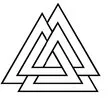
As a god who guards the boundary of Asgard, and an ancestor of humankind, we can call on Heimdall for aid in warding ourselves and our homes. As ancestor of different human groups, he has an interest in helping people to get along. For this reason, the rune I use to represent him is Mannaz,
. Although he will play his part at Ragnarök (he and Loki will slay each other), and he owns a sword, he is generally peaceful in character.
If you live on a seacoast, one way to get close to Heimdall is to sit on the shore and watch the waves rolling in. Visualize the god rising from the frothing surf, shining as the sun gleams on the sea. You may also seek him on mountain tops or bridges. Read the “Lay of Rig” in the Elder Edda, meditate on the tasks performed by each of Rig’s offspring, and identify their equivalents in your own life. Praise him whenever you see a rainbow. The Viking Symposium that I attended in 2000 opened in St. John’s, Newfoundland, the easternmost harbor of North America and gateway to the New World. As I went walking on the heights above the town, I saw a rainbow arching overhead and felt Heimdall very near.
A blót, or blessing, is usually performed for a specific deity. To honor Heimdall, dress the altar in white and gold. You may add pictures of waves, sheep, seals, and so on. Fill the drinking horn with mead or Ramshead beer. For the feast, you may cook seafood or lamb. No day of the week is directly associated with Heimdall, but as guardian of the gate, he can be honored at the beginning of the week, on Monday.
The following is an invocation to Heimdall:
Holy Heimdall, hear thy children, Warden, open wide the way, Bifrost blazes now before us, The Road of Rig we ride today. Friend and father, grant us favor As all things thou dost see and hear. Choose for thy children sight unclouded, Speech and understanding clear.
You may also sing the following chant:
Heimdall, Heimdall, wisest of watchers, Bifrost Bridge now blazes bright. Open wide the way of welcome, The Aesir fare to feast tonight.
Tyr
Tyr is the god who gives his name to Tuesday. The Romans identified him with Mars, their god of war, but Tyr is much more. His name is derived from the same Indo-European root that gave us the Greek Zeus, so he must originally have been a sky god. He is one of the two gods for whom a rune is named: Tiwaz (Anglo-Saxon Tir),
. This element may surivive in the Anglo-Saxon Rune Poem, “Tir is a guiding star, keeps faith well with princes; it is on course over night’s mists, never failing.” His most ancient holy places were on mountain tops, close to the sky.
But an early Germano-Roman dedication to “Mars Thingsus” (Mars of the Assembly) suggests that he was also seen as a god of sovereignty and right order, and this aspect survived in the lore. In the Viking Age, Tyr was invoked for victory in battle, but it seems likely that it was not war that concerned him, but the holmgang—the trial by combat that was the final court of appeal.
By the Viking Age, although Tyr was known to be both wise and brave, only two stories about him survived. In the “Lay of Hymir,” he and Thor go to Jotunheim to seek a cauldron big enough to brew beer for all the gods. His role here is minor, and the poem is important chiefly because it indicates that Tyr comes from giant kin.
The second and only tale in which Tyr plays a major role is the story of the binding of the wolf Fenris, told in the Prose Edda. The wolf was one of Loki’s children by the giantess Angrboda. For a time, the gods kept him in Asgard, and Tyr was the only one with the courage to feed him. But the wolf kept growing and eating, until it became clear that if he were not contained he would destroy them all. The gods attempted to bind Fenris, but he broke every fetter they could create until they got the dwarves to craft the fetter called Gleipnir, which was made from six impossible things: the sound of a cat’s footfall, a woman’s beard, the mountain’s roots, a bear’s sinews, a fish’s breath, and bird’s spittle. When it was done, they called the wolf to try it on him, promising he could break it easily, but this time Fenris suspected a trick and refused to be bound unless one of the gods would set his hand in the wolf’s mouth as insurance.
The only one who dared to do so was Tyr, and when the fetter proved unbreakable, Fenris bit off his hand. Here we see the paradox of the god whose essence is integrity participating in a deception. As a result, the god who aids the warrior has no sword hand. The god who raised the wolf is the one who binds him. Violence controls violence. Following this example of sacrifice, we find the courage to bind the wolves within our own souls.
We have no descriptions of Tyr’s appearance. I usually visualize him as being rather lean, with grizzled dark hair and gray eyes and a somewhat grim or thoughtful expression, wearing a mail shirt and a cloak of dark red wool. Today, although some follow Tyr as a disciplined warrior, others honor him as an example of integrity and self-sacrifice for the common good—he was, after all, the only one of the gods willing to pay the price for deceiving the wolf. He is therefore seen as a god of justice, and those who call on him for help in that area had better be certain they are in the right, because true justice is what they will receive. We call on him for help in understanding and making the hard choices and fulfilling the oaths we have sworn. He is often sought by those involved in law, law enforcement, and the military.
To know Tyr, we must be willing to see ourselves clearly, to recognize our faults and do our best to c...
Table of contents
Also by
Title Page
Copyright Page
Table of Contents
Foreword
Introduction
Acknowledgments
PROLOGUE - Feasting the Gods at Raven Hammer Hall
ROUND ONE - Heroes and Ancestors
ROUND TWO - Gods and Goddesses
ROUND THREE - Toasts, Boasts, and Oaths
Resources
Bibliography
ABOUT THE AUTHOR
Trusted by 375,005 students
Access to over 1.5 million titles for a fair monthly price.
Study more efficiently using our study tools.
Frequently asked questions
Yes, you can cancel anytime from the Subscription tab in your account settings on the Perlego website. Your subscription will stay active until the end of your current billing period. Learn how to cancel your subscription
No, books cannot be downloaded as external files, such as PDFs, for use outside of Perlego. However, you can download books within the Perlego app for offline reading on mobile or tablet. Learn how to download books offline
Perlego offers two plans: Essential and Complete
Essential is ideal for learners and professionals who enjoy exploring a wide range of subjects. Access the Essential Library with 800,000+ trusted titles and best-sellers across business, personal growth, and the humanities. Includes unlimited reading time and Standard Read Aloud voice.
Complete: Perfect for advanced learners and researchers needing full, unrestricted access. Unlock 1.5M+ books across hundreds of subjects, including academic and specialized titles. The Complete Plan also includes advanced features like Premium Read Aloud and Research Assistant.
Both plans are available with monthly, semester, or annual billing cycles.
We are an online textbook subscription service, where you can get access to an entire online library for less than the price of a single book per month. With over 1.5 million books across 990+ topics, we’ve got you covered! Learn about our mission
Look out for the read-aloud symbol on your next book to see if you can listen to it. The read-aloud tool reads text aloud for you, highlighting the text as it is being read. You can pause it, speed it up and slow it down. Learn more about Read Aloud
Yes! You can use the Perlego app on both iOS and Android devices to read anytime, anywhere — even offline. Perfect for commutes or when you’re on the go. Please note we cannot support devices running on iOS 13 and Android 7 or earlier. Learn more about using the app
Yes, you can access Essential Asatru by Diana L. Paxson in PDF and/or ePUB format, as well as other popular books in Theology & Religion & Religion. We have over 1.5 million books available in our catalogue for you to explore.