Quick Reference to Data Structures and Computer Algorithms, A
eBook - ePub

Quick Reference to Data Structures and Computer Algorithms, A

An Insight on the Beauty of Blockchain

  1. English
  2. ePUB (mobile friendly)
  3. Available on iOS & Android
eBook - ePub

Quick Reference to Data Structures and Computer Algorithms, A

An Insight on the Beauty of Blockchain

About this book

For beginners to level up Core Programming Skills Key Features

  • Simple and easy to understand.
  • Useful for any level of students including B.E., BTech, MCA, BCA, B.Sc. (Computer Science), etc.
  • Algorithms used in the book are well explained and illustrated step by step.
  • Help students in understanding how data structures are implemented in programs.
  • Each module contains question bank which includes questions for competitive examinations like UGC-NET, placement drives, and so on.


Description
The book gives full understanding of theoretical topic and easy implementation in programming. The book is going to help students in self-learning of data structures and in understanding how these concepts are implemented in programs. It contains lot of figures, which will help students to visualize the concept effectively. Diagrams help students to understand how the programs involving data structure concepts are implemented within the computer system.
Algorithms are included to clear the concept of data structure. Each algorithm is explained with figures to make student clearer about the concept. Sample data set is taken and step by step execution of algorithm is provided in the book to ensure the in – depth knowledge of students about the concept discussed. What Will You Learn

  • New features and essential of Algorithms and Arrays.
  • Linked List, its type and implementation.
  • Stacks and Queues
  • Trees and Graphs
  • Searching and Sorting
  • Greedy method
  • Beauty of Blockchain


Who This Book Is For
This book is useful for all the students of B. Tech, B.E., MCA, BCA, B.Sc. (Computer Science), and so on. Person with basic knowledge in this field can understand the concept from the beginning of the book itself.
We think our book is one of a kind. We are trying to connect the past and the present here. The last module of our book is focussing on BLOCKCHAIN. It explains the concepts of blockchain through a different dimension, that is, explaining the data structure aspect of blockchain. Table of Contents

  • Algorithm and Arrays
  • Linked Lists
  • Stacks and queues
  • Trees and Graphs
  • Searching and Sorting
  • Greedy Method
  • Beauty of Blockchain
  • About the Author
    Raji Ramakrishnan Nair, has done BCA, MCA and M. Tech (IT) and currently working as an Assistant Professor at the P. G. Department of Computer Applications of Marian College Kuttikkanam (Autonomous). She has 14 years of teaching experience and believes that teaching is all about being 'friend, philosopher and guide' to her students. This book is inspired by her passion to simplify complex subjects for easy understanding; the real contribution of a great teacher. She is a philanthropist as well, actively involved in many social causes, which made her students to engage in relief works in Kerala mega flood and resulted in two houses being built for flood victims. LinkedIn Profile: linkedin.com/in/raji-ramakrishnan-nair-8820b1171 Divya Joseph, is a Teacher by passion and profession. She has done MTech (CSE) and BTech (IT) from Amal Jyothi College of Engineering, Kanjirapally. Presently, she is working as an Assistant Professor in the P.G. Department of Computer Applications, Marian College Kuttikkanam (Autonomous). Alen Joseph, is an Associate Software Developer at UST Global Trivandrum. His great passion for teaching and research motivated him to write this book. He has done MCA from Marian College Kuttikkanam (Autonomous). He is a passionate tech enthusiast and his dream is to become a full-time researcher.
Frequently asked questions

Yes, you can cancel anytime from the Subscription tab in your account settings on the Perlego website. Your subscription will stay active until the end of your current billing period. Learn how to cancel your subscription.
No, books cannot be downloaded as external files, such as PDFs, for use outside of Perlego. However, you can download books within the Perlego app for offline reading on mobile or tablet. Learn more here.
Perlego offers two plans: Essential and Complete
  • Essential is ideal for learners and professionals who enjoy exploring a wide range of subjects. Access the Essential Library with 800,000+ trusted titles and best-sellers across business, personal growth, and the humanities. Includes unlimited reading time and Standard Read Aloud voice.
  • Complete: Perfect for advanced learners and researchers needing full, unrestricted access. Unlock 1.4M+ books across hundreds of subjects, including academic and specialized titles. The Complete Plan also includes advanced features like Premium Read Aloud and Research Assistant.
Both plans are available with monthly, semester, or annual billing cycles.
We are an online textbook subscription service, where you can get access to an entire online library for less than the price of a single book per month. With over 1 million books across 1000+ topics, we’ve got you covered! Learn more here.
Look out for the read-aloud symbol on your next book to see if you can listen to it. The read-aloud tool reads text aloud for you, highlighting the text as it is being read. You can pause it, speed it up and slow it down. Learn more here.
Yes! You can use the Perlego app on both iOS or Android devices to read anytime, anywhere β€” even offline. Perfect for commutes or when you’re on the go.
Please note we cannot support devices running on iOS 13 and Android 7 or earlier. Learn more about using the app.
Yes, you can access Quick Reference to Data Structures and Computer Algorithms, A by Divya Joseph,Raji Ramakrishnan Nair,Divya Joseph,Alen Joseph in PDF and/or ePUB format, as well as other popular books in Computer Science & Programming Algorithms. We have over one million books available in our catalogue for you to explore.

CHAPTER 1

Algorithms and Arrays

1.1 Introduction

An algorithm is defined as a finite set of instructions, which when executed in an order, accomplishes a predefined task. Algorithm is actually the core logic of a problem, rather than the complete code or program. We can express an algorithm, either as an informal high-level description as pseudo code or using a flowchart.
Each algorithm has the following properties:
1. Input: An algorithm must be provided with zero or more inputs externally.
2. Output: At least one output must be obtained.
3. Definiteness: Every step of the algorithm should be unambiguous.
4. Finiteness: The execution of the algorithm must terminate after a finite number of steps.
5. Effectiveness: Every instruction must be very basic, so that any layman can understand the principle, using only pencil and paper.

1.2 Basic Concepts – Data Structures and Types of Data Structure

Data can be organized in many ways and one of the ways is data structures. It is mainly used to represent data in the memory of the computer, so that, data can be retrieved effectively later. The idea behind the concept of data structure is to reduce the space and time complexities of different tasks.

1.2.1 Data Type

There are various types of data available such as integer, string, and so on. To classify these available types of data, we use data type, which determines the values that can be used as well as the type of operations that can be performed on the corresponding type of data. Basically, there are two data types:
  • Built – in Data Type
  • Derived Data Type
Built-in Data Type
When any programming language provides built – in support for any data type, then such type of data types is known as built – in data type. For example, the following built – in data types are provided by most of the programming languages – integers, boolean (TRUE or FALSE), floating (Decimal Numbers), characters, and strings.
Derived Data Type
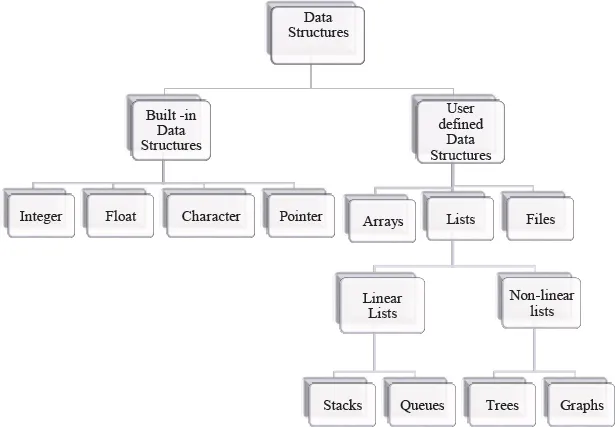
Those data types which are implemented independently in one or the other way, are known as derived data types. These are mainly the combination of primary or built – in data types and associated operations on them. For example, list, array, stack, queue, and so on (figure 1.1).
Figure 1.1 Classification of Data Structure
The data structures can also be classified on the basis of the following characteristics:
Characteristic Description
Linear
Here, the data items are arranged in a linear sequence. For example, array.
Non-Linear
Here, the data types are not in sequence. For example, tree, graph.
Homogeneous
Those data structures, where all the data elements are of same type, are known as homogeneous data structures. For example, array.
Non-homogeneous
Those data structures, where data elements, may or may not be of the same data type, are known as non – homogeneous data structures. For example, structures.
Static
Data structures, whose sizes and structures, associated to memory locations, are fixed during compile time, are known as static data structures. For example, array.
Dynamic
Data structures, whose sizes and structures, associated to memory locations, can be expanded or shrunk, while execution, are known as dynamic data structures. For example, linked list created using pointers.

1.3 Performance Analysis of an Algorithm

If we want to buy a television, there are many brands available in market. But, we have a fixed amount of money in hand as well as fixed amount of space to place this television at home. So, while deciding which television to buy, we have to go through almost all brands available in market, keeping three factors in mind, price, space, and performance. Depending on the availability and convenience, we choose the one which suits us. Similarly, in Computer Science, multiple algorithms are available to solve a particular problem. When we have more than one algorithm to solve a single problem, then we need to select the best one. Thus, performance analysis helps us to select the best algorithm from multiple algorithms to solve a problem.
When there are multiple alternative algorithms to solve a ...

Table of contents

  1. Cover
  2. A Quick Reference to Data Structures and Computer Algorithms
  3. Copyright
  4. Preface
  5. Acknowledgment
  6. About the Author
  7. Table of Contents
  8. MODULE I: Algorithms and Arrays
  9. 1. Algorithm
  10. MODULE II: Linked Lists
  11. 2. Linked Lists
  12. MODULE III: Stacks and Queues
  13. 3. Stacks and Queues
  14. MODULE IV: Trees and Graphs
  15. 4. Trees and Graphs
  16. MODULE V: Searching and Sorting
  17. 5. Searching and Sorting
  18. MODULE VI: Greedy Method
  19. 6. Greedy Method
  20. MODULE VII: Beauty of Blockchain
  21. 7. Beauty of Blockchain