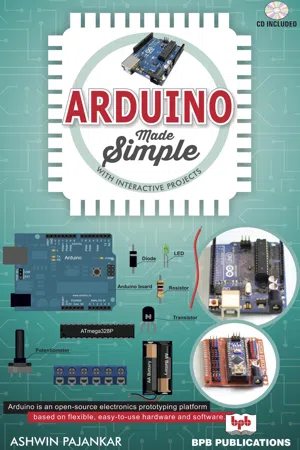
Arduino made simple
eBook - ePub

Arduino made simple

With Interactive Projects

  1. English
  2. ePUB (mobile friendly)
  3. Available on iOS & Android
eBook - ePub

Arduino made simple

With Interactive Projects

About this book

Arduino is an open-source electronic prototyping platform based on flexible, easy-to-use hardware and software Key Features

  • Comprehensive coverage of various aspects of Arduino basics, ecosystem, and Arduino IDE
  • Covers Arduino Uno, Arduino Nano, and introduces to the latest Arduino Tian which runs Linux
  • Simple language, crystal clear approach, and straight forward comprehensible presentation
  • Adopting user-friendly style for explanation of circuit and code examples.
  • Illustrated with circuit diagrams, screenshots, and photographs.

  • Description
    The book is written in such a way that the concepts are explained in detail, giving adequate emphasis on circuits and code examples. To make the topics more comprehensive, circuit diagrams and code snippets are furnished extensively throughout the book. The book is designed in such a way to make it reader-focused and contains latest topics, circuit diagrams, code examples, & reference. The book also features the most current and popular Arduino boards. It teaches novice beginners how to create interesting electronics project with Arduino platform and ecosystem. It also benefits the professional level programmers to get started with Arduino platform and ecosystem. What You Will Learn
  • Arduino, Arduino PWM, Writing Programs for Arduino
  • LED Programming, Programming with Push Buttons
  • Analog Inputs and Various Buses
  • Working With Displays, Sound and Sensors
  • Arrays, strings, and memory
  • Matrix Keypad And Security System
  • SD Card Module, IR Receiver, and Relay
  • Arduino Nano and Arduino Tian


Who This Book is For
Students pursuing BE/BSc/ME/MSc/BTech/MTech in Computer Science, Electronics, Electrical. Table of Contents
1. Introduction to Arduino
2. Getting Started
3. Writing Programs for Arduino
4. LED Programming
5. Programming with Push Buttons
6. Analog Inputs and Various Buses
7. Working With Displays
8. Arrays, strings, and memory
9. Working with Sound and Sensors
10. More Sensors
11. Arduino PWM
12. Matrix Keypad And Security System
13. SD Card Module, IR Receiver, and Relay
14. Arduino Nano and Arduino Tian
15. Miscellaneous Topics
16. Important Questions (Unsolved) About the Author
Ashwin Pajankar is a polymath. He is a Science Popularizer, a Programmer, a Maker, an Author, and a Youtuber. He is passionate about STEM (Science-Technology-Education-Mathematics) education. He is also a freelance software developer and technology trainer. He graduated from IIIT Hyderabad with M.Tech. in Computer Science and Engineering. He has worked in a few multinational corporations including Cisco Systems and Cognizant for more than a decade. LinkedIn Profile: https://www.linkedin.com/in/ashwinpajankar/

Tools to learn more effectively

Saving Books

Saving Books

Keyword Search

Keyword Search

Annotating Text

Annotating Text

Listen to it instead

Listen to it instead

CHAPTER 1

Introduction to Arduino

I hope that all of you have gone through the preface. If not, I would recommend you to read it thoroughly. With this chapter, we are starting our journey into the wonderful and amazing world of Arduino.
Arduino is an open-source electronics prototyping platform and ecosystem. It is based on easy-to-use hardware and software environments. It is intended for students, artists, designers, hobbyists, enthusiasts and anyone interested in creating interactive objects or environments.
In this chapter, we will learn the following concepts:
Microcontrollers
AVR Microcontrollers
Arduino Boards and Arduino Ecosystem
Features of Arduino

Microcontrollers

Before we get started with Arduino, we need to understand what a microcontroller is. This is because, basically, Arduino is a Micontroller platform. A Microcontroller is a small computer on a single Integrated Circuit (IC). It is a complete package with a Microprocessor, onboard memory, and programmable Input/Output peripherals. Microcontrollers are heavily used in embedded applications.

AVR Microcontrollers

AVR is a family of microcontrollers developed by Atmel Corporation. Atmel is America based designer and manufacturer of microcontrollers. Atmel began development of AVR microcontrollers in the beginning in 1996. AVR microcontrollers are modified Harvard architecture 8-bit RISC (Reduced Instruction Set Computer) single-chip microcontrollers.
A special feature of AVR family is that it is one of the first families of micro- controllers which has on chip flash memory. Other competing microcontroller families at that time (late 90s) had ROM, EPROM, or EEPROM for the program and firmware storage.
The reason we discussed AVR microcontrollers in the last couple of paragraphs is that Arduino products prominently use various AVR microcontrollers.
You can find more information about AVR on http://www.atmel.com/products/microcontrollers/avr/

Other Microcontrollers and Processors used by Arduino boards

Apart from AVR microcontrollers, a couple of boards from Arduino family (namely Arduino Zero and MKR1000) use ARM microcontroller units. ARM is yet another family of RISC microprocessors designed and manufactured by ARM.
Few high end Arduino boards support Linux and they have Qualcomm Atheros microprocessors. The examples are Aruino Yun, Arduino Tian, and Arduino Industrial 101.
Arduino 101 uses Intel Curie.
We will get introduced to various Arduino boards and the entire ecosystem in detail in this chapter.

Who can learn Arduino?

The real power of the arduino platform lies in the fact that it is for everyone. Yes! That might sound like an exaggeration. However, it is truly meant for everyone.
Arduino was originally meant for the students. Its purpose was to provide a low- cost and open-source platform and ecosystem to the students to learn electronics and programming. As the time passed, the popularity of Arduino grew and it pervaded in many areas.
Today, Arduino is prominently used as the most preferred microcontroller platform in Education and academic institutions. It is also extensively used in the embedded systems in the areas of Industrial Production, Healthcare, Mining, and Traffic Monitoring. It has also found place in active research in the areas of modeling, simulation, and Human-Computer Interface.
Figure. 1.1: High school students working with Arduino for their school project
As we have seen, the Arduino Platform was meant for students in the beginning. However, now it is actively used by electronics makers, enthusiasts, and hobbyists all around the world to make interactive stuff. It is also used by artists. If you are studying Computer Science or Electronics, there is pretty good chance that you've seen one of the Arduino boards in Action.
We can find more information on the Arduino platform on its website https://www.arduino.cc

Features of Arduino

Arduino is the most preferred platform for the makers now-a-days because of the following features:
Inexpensive - Arduino is inexpensive board. It costs less than the contemporary microcontroller trainer platforms. You can even assemble your own Arduino. The Arduino clones cost even lesser than the Official Arduino boards.
Cross Platform - The official Arduino IDE is supported on Windows, Linux, Mac OSX.
Open Source Hardware - The diagrams of all the Arduino boards are published under Creative Commons License and they are open-source.
Open Source Software - Arduino can be programmed with the official Arduino IDE and AVR C Programming.

Arduino Boards and Ecosystem

Till now, we've learned what microcontroller is and also learned that most of the major Arduino boards use AVR microcontrollers. A few also use ARM microprocessors. In this section, we will understand what Arduino ecosystem is and have a look at few major member boards of the Arduino Ecosystem.
Arduino has got a very vibrant ecosystem with plethora of products. These boards and products are grouped into various categories. Let's have a look at each and every category one by one.

Official Arduino Boards

Official Arduino boards carry Arduino brand on them. They are directly supported by the official Arduino IDE. They are licensed to bear Arduino Logo on them. Also, they are manufactured by authorized manufacturers.
The authorized manufacturers pay a royalty for each board which contributes towards keeping Arduino ...

Table of contents

  1. Cover Page
  2. Title Page
  3. Copyright Page
  4. Dedication
  5. Acknowledgement
  6. Preface
  7. Table of Contents
  8. Chapter 1: Introduction to Arduino
  9. Chapter 2: Getting Started
  10. Chapter 3: Writing Programs for Arduino
  11. Chapter 4: LED Programming
  12. Chapter 5: Programming with Push Buttons
  13. Chapter 6: Analog Inputs and Various Buses
  14. Chapter 7: Working With Displays
  15. Chapter 8: Arrays, strings, and memory
  16. Chapter 9: Working with Sound and Sensors
  17. Chapter 10: More Sensors
  18. Chapter 11: Arduino PWM
  19. Chapter 12: Matrix Keypad And Security System
  20. Chapter 13: SD Card Module, IR Receiver, and Relay
  21. Chapter 14: Arduino Nano and Arduino Tian
  22. Chapter 15: Miscellaneous Topics
  23. Important Questions (Unsolved)

Frequently asked questions

Yes, you can cancel anytime from the Subscription tab in your account settings on the Perlego website. Your subscription will stay active until the end of your current billing period. Learn how to cancel your subscription
No, books cannot be downloaded as external files, such as PDFs, for use outside of Perlego. However, you can download books within the Perlego app for offline reading on mobile or tablet. Learn how to download books offline
Perlego offers two plans: Essential and Complete
  • Essential is ideal for learners and professionals who enjoy exploring a wide range of subjects. Access the Essential Library with 800,000+ trusted titles and best-sellers across business, personal growth, and the humanities. Includes unlimited reading time and Standard Read Aloud voice.
  • Complete: Perfect for advanced learners and researchers needing full, unrestricted access. Unlock 1.4M+ books across hundreds of subjects, including academic and specialized titles. The Complete Plan also includes advanced features like Premium Read Aloud and Research Assistant.
Both plans are available with monthly, semester, or annual billing cycles.
We are an online textbook subscription service, where you can get access to an entire online library for less than the price of a single book per month. With over 1 million books across 990+ topics, we’ve got you covered! Learn about our mission
Look out for the read-aloud symbol on your next book to see if you can listen to it. The read-aloud tool reads text aloud for you, highlighting the text as it is being read. You can pause it, speed it up and slow it down. Learn more about Read Aloud
Yes! You can use the Perlego app on both iOS and Android devices to read anytime, anywhere — even offline. Perfect for commutes or when you’re on the go.
Please note we cannot support devices running on iOS 13 and Android 7 or earlier. Learn more about using the app
Yes, you can access Arduino made simple by Ashwin Pajankar in PDF and/or ePUB format, as well as other popular books in Technology & Engineering & Electrical Engineering & Telecommunications. We have over one million books available in our catalogue for you to explore.