The burgeoning of archaeological research in the Kurdish Autonomous Region of Iraq is one of the great success stories of world archaeology today. For twenty years it was impossible for western archaeologists to work in Iraq, and for most of this time there were also heavy restrictions on the activity of Iraqi archaeologists. In addition to this Kurdistan remains a region never systematically explored. The conference presented the first opportunity for the leading figures in this renaissance of research in the area to gather and present all the key new projects which are revolutionising our understanding of the region. The following papers are available to download in Open Access:
Current Investigations into the Early Neolithic of the Zagros Foothills of Iraqi Kurdistan - Roger Matthews, Wendy Matthews, Kamal Rasheed Raheem and Kamal Rauf Aziz: Download
About Bakr Awa - Peter A. Miglus: Download
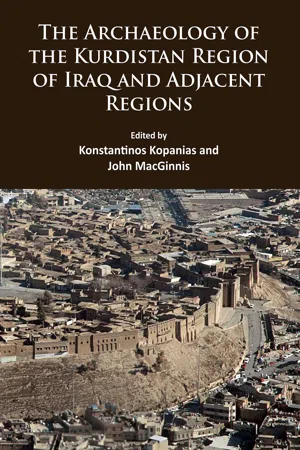
eBook - PDF
The Archaeology of the Kurdistan Region of Iraq and Adjacent Regions
- 477 pages
- English
- PDF
- Available on iOS & Android
eBook - PDF
The Archaeology of the Kurdistan Region of Iraq and Adjacent Regions
About this book
Information
Table of contents
- Cover
- Title Page
- Copyright Page
- Contents
- Authors’ details
- Preface
- Archaeological investigations on the Citadel of Erbil: Background, Framework and Results
- Archaeological investigations on the Citadel of Erbil: Background, Framework and Results
- Figure 1. Erbil Citadel, areas demarcated for archaeological investigation.
- Figure 2. Area E, plan of the excavations.
- Figure 3. Area E, elevation of the fortification wall.
- Figure 1. General view of the site from the west. Source: Author.
- The site of Bazyan: historical and archaeological investigations
- The site of Bazyan: historical and archaeological investigations
- Figure 2. Plan showing the location of soundings. Source: Author.
- Figure 3. The sanctuary and the nave. Source: Author.
- Figure 4. Northern sounding 4. Source: Author.
- Figure 5. Stratigraphy of northern sounding 4. Source: Author.
- Figure 7. Stratigraphy of northern sounding 5. Source: Author.
- Figure 8. Initial northeastern sector. Source: Author.
- Figure 9. Quadruple column. Source: Author.
- Figure 1. Tell Nader, Northern Ubaid: bowls with zigzag lines (predominantly fine clay, less inclusions, wet finish, greenish overfired).
- Short notes on Chalcolithic pottery research: The pottery sequences of Tell Nader (Erbil) and Ashur (Qal’at Sherqat)
- Short notes on Chalcolithic pottery research: The pottery sequences of Tell Nader (Erbil) and Ashur (Qal’at Sherqat)
- Figure 2. Tell Nader, Early Northern Ubaid: a. painted sherds (predominantly fine clay, organic temper, burnish, brownish-buff with reddish-brown painting), b. fragments of lenticular jars with a high spout (?) (fine clay, organic temper and lime inclusio
- Figure 3. Tell Nader, post-Ubaid: a. bowls with a groove on the rim, b. ‘Wide Flower-Pots’, c. conical bowls, d. concave bowls, e. neckless jars with flaring rim, f. double rimmed jar, g. double mouthed jar (predominately fine clay, organic temper, burn
- Figure 4. Ashur, Ubaid: a. painted rim (?) sherd (Bär 2003, 289 Taf. 146); b. incised herring bone pattern (fine clay with mineral inclusions and some coarse organic temper, hand-made, buff-reddish-greenish; Beuger 2007, cat. II pl. 117, 3), c. applicatio
- Figure 5. Ashur, post-Ubaid: neckless jars with flaring rim (predominately fine clay with mineral inclusions and some coarse organic temper, buff; Beuger 2007, cat. II 69.12, 72.14-17; 27.10-11, 32.2-3).
- Figure 6. Ashur, LC3-4: casserole bowls (?) (fine clay with mineral inclusions and some coarse organic temper, buff, Beuger 2007, cat. I pl. 7,4; cat. II pl. 19. 12-13).
- New Evidence of Paleolithic Occupation in the Western Zagros foothills: Preliminary report of cave and rockshelter survey in the Sar Qaleh Plain, West of the Kermanshah Province, Iran
- New Evidence of Paleolithic Occupation in the Western Zagros foothills: Preliminary report of cave and rockshelter survey in the Sar Qaleh Plain, West of the Kermanshah Province, Iran
- Figure. 1. Location of recorded Paleolithic sites recorded in the Kermanshah and Islamabad Plains during the 1980s and 1990s.⤀
- Figure 2. Kal-e Davoud Cave: (a) Plan of the cave drawn in 2007 showing location of the 1961 test pit; (b) General view of the cave; (c) Single side-scraper found during visit of the site in 2007.
- Figure 3. Middle Paleolithic lithic artifacts from Khosrawi, south-west of Ghasr-e Shirin.
- Figure 4. Locations of recorded Paleolithic sites in the lowland regions of Sar Pol-e Zahab, Ghasr-e Shirin and Azgeleh.
- Figure 5. The physical geography of the survey area.
- Figure 6. Geological map of the Azgeleh region showing the location of the Sar Qaleh survey area.
- Figure. 7. Map of the Sar Qaleh Plain showing location of recorded sites in 2010.
- Figure 8. General view of the sites recorded in the Tang-e Janga and other potential sites.
- Figure 9. Plan of Tang-e Janga 3 cave, general view of the pass and location of the cave, and close-up of its entrance.
- Figure 10. The mouth of Tang-e Janga 6 cave.
- Figure 11. General view of the Sewar Hawār showing locations of some of the sites recorded in 2010.
- Figure 12. Sheikh Rozin: (a) Southern end of the Salmaneh Mountain showing location of the Sheikh Rozin site group; (b) Sheikh Rozin sites.
- Figure 13. Sheikh Rozin 3, view looking south from the shelter entrance.
- Figure 14. Plan of Sheikh Rozin 8 cave.
- Figure 15. Two forms of raw material from the study area: (a) tabular chert and (b) nodular chert.
- Figure 16. Upper Paleolithic bladelet core from Sheikh Rozin 7.
- Figure 17. Selected Upper Paleolithic artifacts from Sar Qaleh sites.
- Figure 18. Selected Epipaleolithic artifacts from Sar Qaleh sites.
- Activities of Sapienza-University of Rome in Iraqi Kurdistan: Erbil, Sulaimaniyah and Duhok
- Activities of Sapienza-University of Rome in Iraqi Kurdistan: Erbil, Sulaimaniyah and Duhok
- Figure 1. Erbil Civilization Museum, cataloguing activities of the numismatic collection (photo DiSA).
- Figure 2. Slemani Museum, 3D model of Narseh’s bust from Paikuli monument (photo DiSA, processing Studio 3R).
- Figure 3. Erbil Citadel, topographic map of the Citadel with the position of the geophysical surveys (photo DiSA, processing Studio 3R).
- Figure 4. Erbil Citadel, 2D ERT section of the Main Street and of two crossing streets (photo DiSA, processing TERR.A.IN).
- Figure 5. Erbil Citadel, 2D ERT section of the North Gate area (photo DiSA, processing TERR.A.IN).
- Figure 6. Erbil Citadel, 2D ERT section at the base of the tell slope, in front of the North Gate (photo DiSA, processing TERR.A.IN).
- The Achaemenid Period Occupation at Tell ed-Daim in Iraqi Kurdistan
- The Achaemenid Period Occupation at Tell ed-Daim in Iraqi Kurdistan
- Figure 1. Plan of the building at Tell ed-Daim (from al-Tikriti 1960: pl. 1).
- Figure 2. Pottery vessels from Level 1 at Tell ed-Daim (from al-Tikriti 1960: pl. 5).
- Figure 3. Pottery (nos. 11-12) and stone (nos. 14-16) vessels from Level 1 at Tell ed-Daim (from al-Tikriti 1960: pl. 5).
- Figure 4. Bronze horse-bit from Tell ed-Daim, IM 60180 (from al-Tikriti 1960: pl. 10/4).
- Figure 5. Bronze kohl-jars from rooms 2 (right) and 9 (left) at Tell-ed-Daim, IM 60182-3 (from al-Tikriti 1960: pl. 10/2-3).
- Figure 6. Silver disc with embossed flower design from Tell ed-Daim, IM 60172 (from al-Tikriti 1960: pl. 11/13).
- Figure 7. Bronze wall plaques from Tell ed-Daim, IM 60191 A-B (from al-Tikriti 1960: pl. 9).
- Figure 8. Stone scoops from Tell ed-Daim, IM 60206, 60208 (from al-Tikriti 1960: pl. 5/17-18).
- Figure 9. Bronze horse-bits from Persepolis (left) and Deve Hüyük (right) (from Ivantchik 2001: Fig. 86/1,3).
- Figure 10. Bronze kohl-bottles from Nimrud (left), Tell Jigan (centre) and Khirbet Hatara (right). (From left, drawings by J. E. Curtis, from Ii and Kawamata 1984-5: Fig. 18 on p. 183, and from Fiorina 2007: Fig. 12/53a).
- Figure 11. Bronze wall-plaques from Nimrud (from Curtis 2013: pl. XXIV/399-400).
- Figure 12. Stone scoop from Persepolis (from Curtis and Tallis 2005: pl. 139).
- Figure 13. Silver scoops from Erzincan (British Museum nos. 123263-4).
- ‘Inscription D’ from Sennacherib’s Aqueduct At Jerwān: Further Data and Insights
- ‘Inscription D’ from Sennacherib’s Aqueduct At Jerwān: Further Data and Insights
- Figure 1. Elevation and plan of the SW sector of the Jerwān aqueduct, scale 1:500, from Jacobsen and Lloyd 1935, Fig. 3 (cou tesy of the Oriental Institute of the University of Chicago).
- Figure 2. ‘Inscription D’ on the southern façade of the western sector of the aqueduct. At top (i.e. left), the CAD-generated elevation of the façade with indication of the position of the inscribed blocks; below (center-right), the individual segments
- Figure 3. A view from west of the so-called ‘repaired breach’: to the left of the dotted line is the original structure; to the right of the dotted line are the two rows of the restoration: elaboration after Jacobsen and Lloyd 1935, pl. X B (courtesy of t
- Figure 4. Chisel marks on the outer bands of a block (photo by M. Gatti, © MAIA).
- Figure 5. Rusticated blocks of the original structure to the east of the ‘repaired breach’ (photo by M. Gatti, © MAIA).
- Figure 6. The conjunction between restoration and original structure (photo by M. Gatti, © MAIA).
- Figure 7. Panoramic view of the central recess of the ‘repaired breach’; note the masonry, which is slightly stepped downward (photo by M. Gatti, © MAIA).
- Figure 8. Detail of Fig. 2 with block numbering inserted, and legend on newly visible/partly visible/no longer visible blocks after 2012 fieldwork (R. Del Fabbro, © MAIA).
- Figure 9. Block no. 127b, which was not copied by Jacobsen and not numbered in his diagram (photo by M. Gatti, © MAIA).
- Figure 10. Block no. 93a (not copied by Jacobsen): damages due to exposure to weathering and to vegetative growth (photo by M. Gatti, © MAIA).
- The Land of Nineveh Archaeological Project: A Preliminary Overview on the Pottery and Settlement Patterns of the 3rd Millen ium BC in the Northern Region of Iraqi Kurdistan
- The Land of Nineveh Archaeological Project: A Preliminary Overview on the Pottery and Settlement Patterns of the 3rd Millen ium BC in the Northern Region of Iraqi Kurdistan
- Figure 1. The LoNAP survey area with the surveyed settlements.
- Figure 3. Ninevite 5 painted potsherds.
- Figure 4. Ninevite 5 incised and incised/excised pottery specimens.
- Figure 5. Mid-Late 3rd Millennium potsherds.
- Figure 6. Akkadian and Post-Akkadian potsherds.
- Animal husbandry and other human-animal interactions in Late Ubaid-Early Uruk northern Iraq: the faunal remains from the 202 excavation season at Tell Nader
- Animal husbandry and other human-animal interactions in Late Ubaid-Early Uruk northern Iraq: the faunal remains from the 202 excavation season at Tell Nader
- Figure 1. Species composition of the 2012 faunal assemblage from Tell Nader.
- Figure 2. Anatomical breakdown of cattle remains. Key: H=horncore, AT=atlas, AX=axis, MD=mandible/loose mandibular tooth, SC=scapula, Hp=proximal humerus, Hd=distal humerus, Rp=proximal radius, U=ulna, Rd=distal radius, MCp=proximal metacarpus, MCd=distal
- Figure 3. Anatomical breakdown of pig remains. See Figure 2 for key.
- Figure 4. Anatomical breakdown of sheep/goat remains. See Figure 2 for key.
- Figure 5. Mortality data for sheep/goat based on epiphyseal fusion.
- Figure 6. Mortality data for pig based on epiphyseal fusion.
- Figure 7. Cattle distal metacarpus (palmar view) exhibiting severe broadening of the articular surface, as well as some lipping.
- Figure 8. Mortality data for cattle based on epiphyseal fusion.
- Figure 9. Incidence of butchery and worked bone in for the three most abundant taxa.
- Figure 10. Example of pointy tool manufactured from a sheep/goat distal metacarpus.
- Figure 1. The location of Char-Ghapi in the Sassanian Empire.
- Hawsh-Kori and Char-Ghapi: Why the Sassanids built two monuments in the west of Kermanshah and the south of Iraqi Kurdistan
- Hawsh-Kori and Char-Ghapi: Why the Sassanids built two monuments in the west of Kermanshah and the south of Iraqi Kurdistan
- Figure 2. Corona satellite image of the area of the area of Qasr-e Shirin.
- Figure 3. Sassanian monuments in Qasr-e Shirin (De Morgam, 1896).
- Figure 4. Inside the Char-Ghapi (personal archives: Hossain Azizi).
- Figure 5a-b. The plan of the Char-Ghapi by (a) Hersfeld and (b) Bell.
- Figure 5c. The plan of the Char-Ghapi by (c) De Morgan.
- Figure 7. The façade of the Char-Ghapi (Bell 1905).
- Figure 8. The brick arch of Char-Ghapi.
- Figure 9. The eastern gateway of Char-Ghapi.
- Figure 10. Part of the dome of Char-Ghapi.
- Figure 11. Modern view of Char-Ghapi taken by the author in 2005.
- Figure 13. Close up of platform.
- Figure 14. Close up of platform.
- Figure 15. Architectural models of Sassanian fire temples of the (a) Early, (b) Middle and (c) Late periods.
- Figure 16. Plans of churches in Iraq from the Sasanian period (Okada, 1991: Fig. 1).
- Figure 17. Plans of Basilica Churches in Armenia at (a) Geghart and (b) Ereruk.
- Figure 18a-b. Church with cross plan: (a) St. Stepanos and (b) St. Thaddeus.
- Figure 18c. Church with cross plan: (c) St. Mary.
- Figure 19. Plan of the four-columned churches of (a) St. Herepsime and (b) St. George.
- Figure 20. Plan of the four-columned churches of (a) Saint Mary in Shām Valley (1518), and (b) Saint Mary in Djolfa (1681).
- Figure 21. Plan of four-columned Churches from the Safavid period: (a) the Church of St. Hovans in Djolfa; and (b) the Church of the St. George (in Qarebagh in the Urmia region.
- Figure 22. Plan of four-columned churches from the 18th and 19th centuries: (a) the Nestorian Church of Mār-Georgis (1830); (b) St. Mary in Tabriz (1785).
- Figure 23. Plan of four-columned churches from the late 19th century and 20th centuries: (a) St. Mary Ākhe-Khāne in Salmās (1893), (b) St. Mary in Anzali Harbor (1885), and (c) St. Shughāgāt (1940).
- Figure 24. Plan of Char-Ghapi (Hozhabri, 2005).
- Figure 25. Results of thermoluminescence dating test No. 1 (1350±75).
- Figure 26. Results of thermoluminescence dating test No 2 (1370±70).
- Figure 27. Ceramics from surface survey at Char-Ghapi (Hozhabri 2005).
- Figure 28. Locations of Christian places in the sixth century AD (Walker 2006 map 2).
- Across millennia of occupation: the Land of Nineveh Archaeological project in Iraqi Kurdistan: The prehistory and protohistory of the Upper Tigris rediscovered
- Across millennia of occupation: the Land of Nineveh Archaeological project in Iraqi Kurdistan: The prehistory and protohistory of the Upper Tigris rediscovered
- Figure 1. Map of the LoNAP area with surveyed sites and canals (© LoNAP project).
- Figure 2. Map of the LoNAP survey area with the three different eco-zones characterizing the region: (1) the Tigris river valley; (2) the flat and dry plain of Baidrah; (3) the well-watered and fertile valley of Navkur. Image based on a Google Earth satel
- Figure 3. Map of the LoNAP prehistoric sites (@LoNAP project).
- Figure 4. (a) selection of Neolithic (Hassuna) pottery collected during survey; (b) CORONA satellite image with some Neolithic sites (c) a view from the north of Asingrian.
- The Iraqi Institute: Education for Archaeological Research and Conservation
- The Iraqi Institute: Education for Archaeological Research and Conservation
- Figure 1. Iraqi Institute for the Conservation of Antiquities and Heritage.
- Table 1. Other Programs at the Iraqi Institute.
- Figure 1. Map of the Tanjaro valley.
- Two seasons of excavations at Kunara (Upper Tanjaro): An Early and Middle Bronze Age city
- Two seasons of excavations at Kunara (Upper Tanjaro): An Early and Middle Bronze Age city
- Figure 2. Kunara, general view.
- Figure 3. Kunara, geophysical survey.
- Figure 4. Kunara, areas implantation.
- Figure 5. Kunara, area C.
- Figure 6. Kunara, area B.
- Figure 7. Kunara, area A.
- Figure 8. Kunara, area D1.
- Figure 10. Kunara, cylinder seal.
- Figure 9. Kunara, arrowhead.
- Excavations of the Chalcolithic Occupations at Salat Tepe on the Upper Tigris, Southeastern Anatolia
- Excavations of the Chalcolithic Occupations at Salat Tepe on the Upper Tigris, Southeastern Anatolia
- Figure 1. Location of Salat Tepe.
- Figure 2. Kite photo of excavated trenches on Salat Tepe, viewed from the south.
- Figure 3. Plan of architecture in Trench I12 (the 2010 season).
- Figure 5. Floor 46/T of Room 47/M cut by Pit 26/Ç in Trench I12 (2001).
- Figure 6. Remarkable artefacts from Floor 46/T in Trench I12 (2011): (a) ‘Canaanean blade’; (b) stone axe; (c) ‘Gray Burnished Ware’.
- Figure 8. Floors 81/T and 82/T of Rooms 84/M and 85/M in Trench I12 (2012).
- Figure 9. Kiln 66/F and Pits 67/Ç, 68/Ç on Floor 65/T in Trench I12 (2012).
- Figure 10. Grave 64/G in Trench H12 (2012).
- Figure 11. Plan and Section of Grave 64/G i n Trench H12 (2012).
- Figure 12. Rooms 53/M, 68/M, 69/M, 72/M in Trench H12 (2012), viewed from the south.
- Figure 13. Plan of a tripartite building complex (2012).
- Figure 14. Remarkable artefacts from the tripartite building complex (2012).
- Figure 15. Pavement 89/T in Trench G12N (2012).
- Figure 16. ‘Coba bowl’ from Kiln 20/F in Trench I12 (2008): (left) inside of the vessel; (right) outside of the base.
- Figure 1. A map showing the distribution of sites documented during the 2012-14 field seasons and the extent of four distinguished settlement zones (drawn by J. Mardas and R. Koliński).
- Insights into the settlement history of Iraqi. Kurdistan from the Upper Greater Zab Archaeological Reconnaissance Project
- Insights into the settlement history of Iraqi. Kurdistan from the Upper Greater Zab Archaeological Reconnaissance Project
- Figure 2. The efficiency of various methods of identification of archaeological sites in the UGZAR project seasons 2012-2013 compared with the evidence from the Atlas of the Archaeological Sites in Iraq (Salman 1976).
- Figure 3. Periodization used in chronological determinations of the UGZAR project (Ur 2013: 2).
- Figure 4. The number of settlements per cultural period in each of the environmental zones discussed (sites that yielded a single sherd identified in the Working Ceramic Typology for a period are counted as 0.5, sites which yielded two or more such sher
- Figure 5. A histogram illustrating the distribution of sites per historical period in four environmental zones distinguished in the present paper.
- Figure 6. The aggregate settlement area and the number of sites in the eastern Navkur plain (UGZAR field seasons 2013-14).
- Figure 7. A histogram illustrating settlement development in the eastern part of the Navkur plain, showing the number of settlements and their aggregate area per period.
- Figure 8. Reconstructed position of the two relief fragments of panel 2 at Gunduk recovered by the UGZAR team (drawn by X. Kolińska, based on al-Amin 1948: Fig. 8).
- Figure 9. Panel 3 of the Gunduk relief (photograph: D. Piasecki).
- Figure 10. A view towards the Şaxi Akrê with the Gunduk pass clearly visible from a distance of 25 km. Site S074, Xaraba Kalaşin, in the foreground (photograph: R. Koliński).
- Figure 11. Site S037, Girdi Mikrdan, damaged by leveling and construction of houses (photograph: M. Szabłowski).
- Figure 12. Site S055, Girdi Kalake 3, entirely leveled for construction purposes (photograph: R. Koliński).
- Figure 13. Site S098, Xaraba Çiaskan, with visible damages due to clay digging (photograph: X. Kolińska).
- Figure 14. A man from Daratu digging for clay at S089, Girdi Aşi Gawre, 13 October 2013 (photograph: M. Kostyrko).
- Two Ottoman Trade Buildings (Qaisariya) in the Bazaar of Erbil From Building Archaeology to Refurbishment Planning
- Two Ottoman Trade Buildings (Qaisariya) in the Bazaar of Erbil From Building Archaeology to Refurbishment Planning
- Figure 1. Survey work, executed while the bazaar was in active use, in the background the northern gates to the Western Qaisariya (2013, TU Berlin/DAI, D. Kurapkat).
- Figure 2. Eastern Qaisariya, ground plans of the ground floor and the upper storey (2012, TU Berlin/DAI, original drawings D. Kurapkat, digitisation M. Saleh and O. Zenker).
- Figure 3. Eastern Qaisariya, tailors’ workshops along the eastern hallway under a temporary shelter which replaced the collapsed barrel vault, also the wooden gallery is missing and the upper-floor rooms are not accessible any more (2012, TU Berlin/DAI, D
- Figure 4. Western Qaisariya, ground plan of the ground floor and section drawing (2013, TU Berlin/DAI, original drawings D. Kurapkat and U. Siegel, digitisation A.-M. Arera and O. Zenker).
- Figure 5. Eastern Qaisariya, vertical axis of one shop after the completion of conservation and restoration work (2012, TU Berlin/DAI, D. Kurapkat).
- Figure 6. Design proposal for the refurbishment of the irreversibly altered western hallway of the Western Qaisariya (2013/14, TU Berlin, A.-M. Arera and O. Zenker).
- Ninevite 5 – culture or regional pottery style?
- Ninevite 5 – culture or regional pottery style?
- Figure 1. Distribution of Ninivite 5 pottery, after Rova, E. 1988, pl. II – Map II.
- Figure 2. a – Tell Mohammed ‘Arab, examples of plans of houses from different levels (H, I, C, A), after Roaf, M. 2003: 327, ig. 14: A, C and 328, fig. 15: I, H; b – Tell Kutan, houses, after Forest J. D. 1987: 86, fig. 2 and Roaf M. 2003: 326, fig. 12
- Figure 3. Tulul eth-Thalathat V, grain store: left – superstructure (in gray) on foundations (dotted lines), right – foundations, after Fukai, S. et al. 1974, pl. XLV.
- Back to the Land of Muṣaṣir/Ardini: Preliminary report on fieldwork (2005-2012)
- Back to the Land of Muṣaṣir/Ardini: Preliminary report on fieldwork (2005-2012)
- Figure 1. The land of Muṣaṣir.
- Figure 2. Reused column bases from the village of Mdjeser.
- Figure 3. Incised column bases, (a) from the village of Mdjeser, (b) from the Urartian temple at Altintepe.
- Figure 4. Column bases from the village of Mdjeser.
- Figure 5. Funerary statues recovered from the lands of Muṣaṣir and Kirruri.
- Figure 6. Jars with excised line decoration from the Diyana plain, from (a) Tell Haudian and (b) Dêlizian.
- Figure 7. (a) Jars from Abd-bakra village. (b) Bowl from Tell Haudian.
- Figure 8. Large storage jar from Mdjeser with stamp seal impression.
- New Researches on the Assyrian Heartland: The Bash Tapa Excavation Project
- New Researches on the Assyrian Heartland: The Bash Tapa Excavation Project
- Figure 1. Distribution of principal mounds in the South Erbil Plain.
- Figure 2. The mound of Bash Tapa from the southeast.
- Figure 3. The mound of Bash Tapa from the northeast.
- Figure 4. Bash Tapa survey sectors.
- Fig. 6. Chrono-stratigraphical Sequence of Sounding 1 (2013 campaign).
- Figure 5. Sounding 1, Locus and chrono-stratigraphical phases (west section).
- Fig. 8. Chrono-stratigraphical Sequence of Sounding 2 (2013 campaign).
- Figure 7. Sounding 2, Level 5 plan.
- Figure 9. Obverse of tablet BT96-I-1.
- Current Investigations into the Early Neolithic of the Zagros Foothills of Iraqi Kurdistan
- Current Investigations into the Early Neolithic of the Zagros Foothills of Iraqi Kurdistan
- Figure 1. Map to show location of key CZAP sites.
- Figure 2. Plan of Bestansur to show location of excavated trenches.
- Figure 3. Bestansur, Trench 10 composite plan of architecture.
- Figure 4. Radiocarbon dates from Bestansur and Shimshara.
- Figure 5. Large stone at entrance to Building 5.
- Figure 7. Bestansur, Trenches 12-13 architecture.
- Figure 10. Shimshara, location of Trench 1 (left) and Trench 2 (right), looking north.
- Figure 8. Obsidian Çayönü tool from Shimshara, re-used as blade core.
- Figure 9. View of Shimshara, looking south to the Dokan Dam lake.
- About Bakr Awa
- About Bakr Awa
- Figure 1. Bakr Awa on satellite image (Quickbird 11th October, 2010, Digital Globe Inc.) with marked excavation areas.
- Figure 2. Occupation periods reached in the excavation areas 1 to 6 during seasons 2010-11 and 2013-14.
- Figure 3. Cylinder seals and sealings from the 3rd and 2nd millennium BC: a) BA 2328/9 – Early Dynastic sealed vessel rim, 1.4 cm wide; b) BA 1161/1 – Ur III/Early Isin Larsa chlorite seal, 2.1 x 1.1 cm; c) BA 1291/1 – Ur III/Early Isin Larsa chlorite sea
- Figure 4. Entrance to brick tomb BA 2500.
- Figure 1. Map of sites in the Shahrizor Plain.
- Magnetic investigations in the Shahrizor Plain: Revealing the unseen in survey prospections
- Magnetic investigations in the Shahrizor Plain: Revealing the unseen in survey prospections
- Figure 2. Sites affected by landmine depositions.
- Figure 3. Gird-i Shatwan at Wadi Shamlu (Digital Globe image, 23.11.2013).
- Figure 4. Selection of Parthian pottery from Gird-i Shatwan (SSP-51 & 52).
- Figure 5. Limestone pillar base from Gird-i Shatwan.
- Figure 7. Interpretation of the magnetomer image of Gird-i Shatwan.
- Figure 8. The prospected area on top of the mound of Shatwan.
- The Bazaar of Erbil within the Context of Islamic Trade Routes and Trade Buildings
- The Bazaar of Erbil within the Context of Islamic Trade Routes and Trade Buildings
- Figure 1. Aerial photo of Erbil, 1951 (© Pitt Rivers Museum, University of Oxford).
- Figure 2. The bazaar of Erbil in 1953. The Qaisariya buildings are highlighted (© Constantinos and Emma Doxiades Foundation).
- Figure 3. The bazaar of Erbil in 1927. (© Harding Collection, University College London).
- Figure 4. Erbil, southern facade of the Eastern Qaisariya in1944 (A. Kersting, © Conway Library, Courtauld Institute).
- Figure 5. Virtual reconstruction of the original appearance of the main alley of the Eastern Qaisariya (3D-model: Claas von Bargen).
- Figure 6. Kifri, khan building in the bazaar in September 2013 (photo M. Müller-Wiener).
- Halaf Settlement in the Iraqi Kurdistan: the Shahrizor Survey Project
- Halaf Settlement in the Iraqi Kurdistan: the Shahrizor Survey Project
- Figure 1. Numbers of later prehistoric sites per period in the Shahrizor Plain and estimated average site size according to the Shahrizor Survey (SSP) (after Mühl and Nieuwenhuyse in press).
- Figure 2. Shahrizor Survey Project. Examples of Late Neolithic pottery collected in the survey (Tell Qortas=SSP73) showing examples of Halaf Fine Ware and HUT Fine Ware (Photo S. Mühl, Shahrizor Survey Project).
- Figure 3. Map of the Shahrizor showing the locations of Halaf sites known in the 1980’s. No. 203: Tell Sragon; no. 204; Tell Begom (after Hijara 1997: 90, fig. 99).
- Figure 4. Map of the Shahrizor showing the locations of later prehistoric (Neolithic, Halaf, Ubaid and Late Chalcolithic) sites attested in the Shahrizor Survey Project (after Mühl and Nieuwenhuyse in press).
- Contextualizing Arbīl: Medieval urbanism in Adiabene
- Contextualizing Arbīl: Medieval urbanism in Adiabene
- Figure 1. Map of the region of Adiabene showing urban sites under study and the reconstructed courses of medieval routes (drawing by L. Starková and K. Nováček).
- Figure 2. View of Altun Köprü from the south, 1534, a miniature by Nasúh al-Silahi Matrakçı (after Eroğlu et al. 2008).
- Figure 3. Eski Makhmūr, an Early Islamic castle (qasr No.1), plan of surface remains of the structure in the recent satellite image (drawing by L. Starková and K. Nováček).
- Figure 4. Eski Makhmūr, a pottery collection from surface survey of the qasr No. 1 (drawing by H. Švácha).
- Figure 5. The city of Kušáf in CORONA satellite image (28 February 1967): 1 – citadel, 2 – fortified lower town, 3 – unfortified neighborhoods, 4 – a large rectangular enclosure, 5 – open canals or hollow ways (drawing by L. Starková and K. Nováček).
- Filling the Gap: The Upper Tigris Region from the Fall of Nineveh to the Sasanians. Archaeological and Historical Overview Through the Data of the Land of Nineveh Archaeological Project
- Filling the Gap: The Upper Tigris Region from the Fall of Nineveh to the Sasanians. Archaeological and Historical Overview Through the Data of the Land of Nineveh Archaeological Project
- Figure 1. The area of the Land of Nineveh Archaeological Project within the modern context of North Iraq. (© LoNAP Archives).
- Figure 2. Preliminary histogram of the settlements recovered in the LoNAP 2012 and 2013 season. Bars indicate the number of sites per period, the curved line indicates the number of collected sherds. (© LoNAP Archives).
- Figure 3. Post-Assyrian/Achaemenid period ceramics from the Land of Nineveh Archaeological Project. (© LoNAP Archives).
- Figure 4. A view of Tell Balyuz from the North. The line of trees on the other side of the tell marks the course of the rubar Duhok. (© LoNAP Archives).
- Figure 5. Hellenistic period ceramics from the Land of Nineveh Archaeological Project (1/2). (© LoNAP Archives).
- Figure 6. Hellenistic period ceramics from the Land of Nineveh Archaeological Project (2/2). (© LoNAP Archives).
- Figure 7. Parthian period ceramics from the Land of Nineveh Archaeological Project. (© LoNAP Archives).
- Figure 8. Site 464 and the small cluster of Sasanian sites from the space (© Google Earth, modified). (© LoNAP Archives).
- Figure 9. Sasanian period ceramics from the Land of Nineveh Archaeological Project. (© LoNAP Archives).
- Satu Qala: an Assessment of the Stratigraphy of the Site
- Satu Qala: an Assessment of the Stratigraphy of the Site
- Figure 1. Map of the region. (Copyright: The Satu Qala Project).
- Figure 2. Satellite image of Satu Qala (GeoEye 2005, OrbView-3 scene, Level OrbView Basic Enhanced, GeoEye, Dulles, Virginia, 1/30/2005).
- Figure 3. Occupational levels of operation A.
- Figure 4. Occupational levels of operation B.
- Figure 5. Selection of bowls found in buildings 2 and 3 of Level A7a. (Copyright: The Satu Qala Project).
- Figure 6. Selection of closed shapes found in Level B4. (Copyright: The Satu Qala Project).
- Helawa: A New Northern Ubaid/Late Chalcolithic Site in the Erbil Plain
- Helawa: A New Northern Ubaid/Late Chalcolithic Site in the Erbil Plain
- Figure 1. General view of Helawa from the south.
- Figure 2. General view of Aliawa from the south.
- Figure 3. Georeferenced topographic plan of Helawa with altimetric curves.
- Figure 4. Topographic grid of Collection Areas (A-E) and Collection Units (1-44).
- Figure 5. Samarra, Halaf and Northern Ubaid pottery from Helawa.
- Figure 6. Northern Ubaid and Late Chalcolithic 1-2 pottery from Helawa.
- Figure 7. Late Bronze pottery from Helawa.
- Figure 8. Obsidian blade, bladelets, and flakes from CU A20 and D33.
- Figure 10. Clay nail (TH.13.A20.25) and ring scraper (TH.13.A23.44).
- From the banks of the Upper Tigris River to the Zagros Highlands. The first season (2013) of the Tübingen Eastern Ḫabur Archaeological Survey
- From the banks of the Upper Tigris River to the Zagros Highlands. The first season (2013) of the Tübingen Eastern Ḫabur Archaeological Survey
- Figure 1. Geographical map of the EHAS region (Dohuk province), with indication of the five sampling Zones (A to E).
- Figure 2. Preliminary distribution of predicted archaeological sites (obtained through remote-sensed analysis) and true surveyed sites in the two areas investigated in 2013.
- Figure 3. Site typology of the 2013 trial season: a) Tell with lower town (Bassetki, site B01); b) settlement on natural hillock (Gire Peteh, site C04); c) flat settlement on spur (Bamira, B16); d) shelters (IANES, University of Tübingen / P. Sconzo).
- Figure 4. The site of Bassetki, with indication of the extension of the Early and Middle Bronze Age settlement on the basis of the surface sherd cover (in the background declassified CORONA satellite image).
- Figure 5. Mila Mergi, looking north towards the Synda Plain and the Turkish border (IANES, University of Tübingen / P. Sconzo).
- Figure 6. Rescue operation at the Mila Mergi rock relief (IANES, University of Tübingen / P. Sconzo).
- Figure 1. South-East Turkey, showing the location of Gre Amer in relation to modern settlements. Drawing: Tony Ives/Stuart Blaylock.
- Gre Amer, Batman, on the Upper Tigris: A Rescue Project in the Ilısu Dam Reservoir in Turkey
- Gre Amer, Batman, on the Upper Tigris: A Rescue Project in the Ilısu Dam Reservoir in Turkey
- Figure 2. General site plan of Gre Amer, showing operations (for orientation), and areas excavated 2009-14. Drawing: İluh Haritacılık/Stuart Blaylock.
- Figure 3. Air photograph of Gre Amer from the west, showing Operations 1 and 3/4 (front left and right respectively), the road bisecting the site (centre), and trenches of Operation 5 to the rear. The Garzan river is seen to the right and rear centre, loo
- Figure 4. Group photograph of selected Level 4 pots from Operation 1, including Khabur ware bird-painted waster (left) and Nuzi-type bichrome jar (left centre). Photo: Stuart Blaylock, ref: 2011/6321.
- Figure 5. A second-millennium slipped and bichrome-painted vessel, painted with bird, animal and human figures, and multiple geometric motifs. Photo: Caner Şenyuva, ref: 2014/2863. [
- Figure 6. Five RBWW pithoi in a Level 4 storage room of E49 N42 in Operation 5, looking north-west. Photo: Stuart Blaylock, ref: 2013/5025.
- Figure 7. The Level 3 building in Operation 5, E51 N42, excavated in 2013, showing walls with niches and doorways preserved to lintel height; looking north. Photo: Stuart Blaylock, ref: 2013/3001.
- Figure 8. Plan of Operation 5, Level 3, with montage of key ceramic finds. Drawing: Stuart Blaylock.
- Figure 9. Selected Early Iron Age painted sherds. Photo: Caner Şenyuva, ref: 2014/2076.
- Figure 10. Selected Neo-Assyrian Palace Ware sherds associated with Level 2. Photo: Caner Şenyuva, ref: 2014/2109.
- Figure 11. Plan of Operation 3, Level 1, with montage of key ceramic finds. Drawing: Stuart Blaylock.
- Figure 12. Level 1 Cemetery 2011-2012, plan of burials with key diagnostic finds. Drawing: Ben Claasz Coockson/Stuart Blaylock.
- In the Neo-Assyrian Border March of the Palace Herald: Geophysical Survey and Salvage Excavations at Gird-i Bazar and Qalat-i Dinka (Peshdar Plain Project 2015)
- In the Neo-Assyrian Border March of the Palace Herald: Geophysical Survey and Salvage Excavations at Gird-i Bazar and Qalat-i Dinka (Peshdar Plain Project 2015)
- Figure 1. Map of the Peshdar Plain with its key sites (prepared by Jean-Jacques Herr).
- Figure 2. Map of the provincial borders of the Assyrian Empire during the reign of Sargon II (721-705 BC), indicating the Peshdar Plain and key sites in Central Assyria and Western Iran mentioned in this paper (prepared by Alessio Palmisano and Andrea S
- Figure 3. Satellite image (A) of the Peshdar Plain showing Gird-i Bazar and Qalat-i Dinka, with the areas of the geophysical survey (B-E) and the three off-site trenches (red squares) indicated. QuickBird Image, 24 October 2014. Magnetograms by Jörg Fa
- Figure 4. Drone image (A) of the excavations at Gird-i Bazar (28 September 2015; courtesy Simone Mühl) and detail photographs of the individual excavation areas (B-F).
- Figure 5. A selection of stratified pottery finds from Gird-i Bazar, as mentioned in this paper (prepared by Jean-Jacques He r).
- Figure 6. Calibrated radiocarbon determination for the charcoal sample UGAMS 23561 from the offsite trench G42.
- Figure 7. Calibrated radiocarbon determination for the charcoal sample UGAMS 23213 from Gird-i Bazar (PPP 271927:014:008).
- Figure 1. Looking north to Shanidar Cave; bust of Ralph Solecki in the foreground (photograph by G. Barker).
- New investigations at Shanidar Cave, Iraqi Kurdistan
- New investigations at Shanidar Cave, Iraqi Kurdistan
- Figure 2. Schematic cross section of the Solecki excavation, showing his major cultural layers, the key radiocarbon dates and the relative positions of the Neanderthals (reproduced with kind permission of Ralph Solecki).
- Figure 4. General view of the excavation area, looking east, showing the locations mentioned in the text; scales: 2 m and 0.5 m (photograph by G. Barker).
- Figure 5. A variety of burins and (bottom right) an endscraper from the sediments of Baradostian age (illustration by T. Reynolds).
- Figure 6. The human right tibia and fibula in articulation with ankle bones near Solecki’s Shanidar V Neanderthal skeletal material and probably part of the same group; scale: 8 cm (photograph by G. Barker).
- Figure 1. General view of Kilik Mishik in Erbil area (2009).
- Materials from French excavations in the Erbil area (2010): Kilik Mishik
- Materials from French excavations in the Erbil area (2010): Kilik Mishik
- Figure 2. General plan of the site.
- Figure 3. Area C, Sasanian and Parthian levels.
- Figure 4. Area A, Northern part of the trench, Iron II and III occupation.
- Figure 5. Area A, Middle Bronze II-III context and fragment of a model of chariot.
- Figure 6. Area C, sounding, with Ninevite V shard.
- Figure 7. Graphic of diagnostic shards.
- Figure 8. Islamic and Parthian material.
- Figure 9. Iron Age II-III pottery.
- Figure 10. Late Bronze and Mittanian pottery.
- Figure 11. Mitanni period ‘piecrust’ and Middle Bronze II-III pottery: Khabur ware style and deposit found in area A.
- Figure 12. 3rd millennium Ninive 5 material.
- Figure 1. The Erbil region, with Kurd Qaburstan indicated. Map by Jason Ur.
- Kurd Qaburstan, A Second Millennium BC Urban Site: First Results of the Johns Hopkins Project
- Kurd Qaburstan, A Second Millennium BC Urban Site: First Results of the Johns Hopkins Project
- Figure 2. Kurd Qaburstan, view of central high mound from the southwest. Photograph by Jason Ur.
- Figure 3. Topographic Map of Kurd Qaburstan. Outer edge of putative city wall indicated by solid line. Map by Christopher Brinker.
- Figure 4. CORONA satellite image of Kurd Qaburstan, with city wall visible.
- Figure 5. High Mound East, trench 5144/3044, latest Mittani phase. Looking south.
- Figure 6. High Mound East, trench 5144/3044, middle Mittani phase. Baked brick surface south of mudbrick wall. Looking north.
- Figure 7. High Mound East, trench 5144/3044, earliest Mittani phase. Baked brick feature with ceramic drain and door socket. Looking southwest.
- Figure 8. Mittani period pottery. 1. 5088/3116-007. Light yellow, medium vegetal inclusions; 2. 5144/3044-003. Light yellow, medium vegetal inclusions; 3. 5144/3044-001. Light brown, medium vegetal inclusions; 4. 5144/3044-023. Light brown/pink, medium ve
- Figure 9. Mittani period pottery. 1. 5144/3044-032. Light green/yellow, no visible inclusions, brown paint; 2. 5144/3044-008. Light yellow, medium vegetal inclusions; 3. 5144/3044-001. Pink/brown, no visible inclusions, red-brown paint; 4. 5144/3044-014.
- Figure 10. Mittani period pottery. 1. 5088/3116-011. Light yellow/gray, fine white sand, paint faded, currently greenish-gray; 2. 5088/3116-009. Light yellow/gray, no visible inclusions, paint faded, currently greenish-gray; 3. 5144/3044-028. Light yellow
- Figure 11. Mittani period fine painted goblet potsherds.
- Figure 12. Mittani period White Paste Inlay Ware.
- Figure 13. Middle Islamic glazed pottery from Lower Mound Trench 5260/2846.
- Figure 15. Terra cotta moldmade plaque fragment.
- Figure 16. Old Babylonian period pottery from city wall trenches. 1. 4666/3076-006. Light yellow, medium vegetal inclusions; 2. 4666/3076-030. Light yellow, no visible inclusions; 3. 4946/3444-006. Light yellow, fine sand; 4. 4946/3444-009. Light yellow,
- Figure 17. Magnetometry results from northern Lower Town, showing city wall and towers (wall appears horizontally in upper part of image).
- Figure 1. The project area.
- The Sirwan (Upper Diyala) Regional Project, First Results
- The Sirwan (Upper Diyala) Regional Project, First Results
- Figure 2. Tepe Rahim.
- Figure 3. Military trenches dug on top of Tell Majid 1 (SRP 39).
- Figure 4. The Sirwan River.
- Figure 5. Site candidates at the southern edge of the survey area.
- Figure 6. Sites visited and recorded in the Suz Bulaq area.
- Figure 7. Kani Masi 6 (SRP 46).
- Figure 8. Tepe Bor (SRP 25).
- Figure 10. Sassanian water canal remains (SRP 66).
- Figure 9. Tepe Kalan (SRP 18).
- Figure 11. Tepe Gawur Kebir (SRP 11).
- Figure 12. Qule Ahmad Qadir (SRP 68).
- Tracking early urbanism in the hilly flanks of Mesopotamia – three years of Danish archaeological investigations on the Rania Plain
- Tracking early urbanism in the hilly flanks of Mesopotamia – three years of Danish archaeological investigations on the Rania Plain
- Figure 1. The Zagros foothills of northern Iraq (based on Levine 1973: Figure 1 and 2; illustration compiled by Carlo Colantoni 2015).
- Figure 2. Bab: the main mound in the Bab-w-Kur site cluster. The area excavated in 2015 is visible on the summit of the mound and the area excavated in 2012 is visible at the base of the mound in the upper left corner of the image (UAV image, Henrik Bra
- Figure 3. The Bab building complex exposed in the autumn of 2015. The complex has a tripartite design with a large central hall and flanking subsidiary rooms (UAV image, Henrik Brahe and Tim Skuldbøl 2015).
- Figure 4. The niched building at Kur, Level 2 (Photos, Tim Skuldbøl 2013).
- The Activities of the Italian Archaeological Mission in Iraqi Kurdistan (MAIKI): The survey area and the new evidence from Paikuli blocks documentation
- The Activities of the Italian Archaeological Mission in Iraqi Kurdistan (MAIKI): The survey area and the new evidence from Paikuli blocks documentation
- Figure 1. MAIKI survey area with the site of Paikuli numbered MSP–S0100 – (MAIKI – image elaborated by BraDypUS).
- Figure 2. Three-quarter column bases F18 and f1 – (MAIKI – image elaborated by Studio 3R).
- Figure 3. 3D renderings of Narseh’s high-relief bust – (MAIKI – image elaborated by Studio 3R).
- Figure 4. 3D profile of Narseh’s high-relief bust with details of the crown – (MAIKI – image elaborated by Studio 3R).
- Figure 5. 3D reconstruction of the all-round bust of Narseh – (MAIKI – image elaborated by Studio 3R).
- Figure 1. Map of Sulaimaniyah region with location of Kani Shaie.
- The Kani Shaie Archaeological Project
- The Kani Shaie Archaeological Project
- Figure 2. Digital Terrain Model of Kani Shaie.
- Figure 3. Topographic map of Kani Shaie with location of trenches in 2013.
- Figure 4. Selection of Late Chalcolithic and Early Bronze Age pottery from Kani Shaie.
- Figure 5. Late Chalcolithic seal-impressed numerical tablet from Kani Shaie.
- Figure 6. Early Bronze Age seal-impressed sherd from Kani Shaie.
- Philological and scientific analyses of cuneiform tablets housed in Sulaimaniya (Slemani) Museum
- ‘Carrying the glory of the great battle’. The Gaugamela battlefield: ancient sources, modern views, and topographical problems
- ‘Carrying the glory of the great battle’. The Gaugamela battlefield: ancient sources, modern views, and topographical problems
- Figure 1. Gaugamela according to Shusko (after Shusko 1936: 39).
- Figure 2. General map of Asia: for the main place names discussed cf squares D2 to G2 (after Cheyne & Black, 1899: 252, s.v. Assyria).
- Figure 3. The topography between Arbela and Nineveh (after Shusko 1936:51).
Trusted by 375,005 students
Access to over 1.5 million titles for a fair monthly price.
Study more efficiently using our study tools.
Frequently asked questions
Yes, you can cancel anytime from the Subscription tab in your account settings on the Perlego website. Your subscription will stay active until the end of your current billing period. Learn how to cancel your subscription
No, books cannot be downloaded as external files, such as PDFs, for use outside of Perlego. However, you can download books within the Perlego app for offline reading on mobile or tablet. Learn how to download books offline
Perlego offers two plans: Essential and Complete
- Essential is ideal for learners and professionals who enjoy exploring a wide range of subjects. Access the Essential Library with 800,000+ trusted titles and best-sellers across business, personal growth, and the humanities. Includes unlimited reading time and Standard Read Aloud voice.
- Complete: Perfect for advanced learners and researchers needing full, unrestricted access. Unlock 1.5M+ books across hundreds of subjects, including academic and specialized titles. The Complete Plan also includes advanced features like Premium Read Aloud and Research Assistant.
We are an online textbook subscription service, where you can get access to an entire online library for less than the price of a single book per month. With over 1.5 million books across 990+ topics, we’ve got you covered! Learn about our mission
Look out for the read-aloud symbol on your next book to see if you can listen to it. The read-aloud tool reads text aloud for you, highlighting the text as it is being read. You can pause it, speed it up and slow it down. Learn more about Read Aloud
Yes! You can use the Perlego app on both iOS and Android devices to read anytime, anywhere — even offline. Perfect for commutes or when you’re on the go.
Please note we cannot support devices running on iOS 13 and Android 7 or earlier. Learn more about using the app
Please note we cannot support devices running on iOS 13 and Android 7 or earlier. Learn more about using the app
Yes, you can access The Archaeology of the Kurdistan Region of Iraq and Adjacent Regions by Konstantinos Kopanias, John MacGinnis, Konstantinos Kopanias,John MacGinnis in PDF and/or ePUB format, as well as other popular books in Social Sciences & Archaeology. We have over 1.5 million books available in our catalogue for you to explore.