- 276 pages
- English
- PDF
- Available on iOS & Android
eBook - PDF
About this book
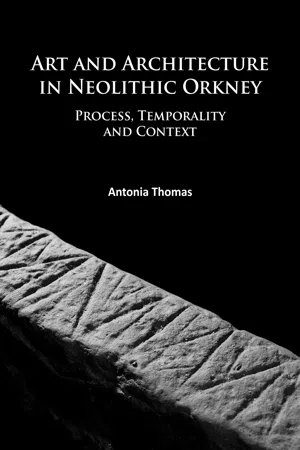
The Neolithic sites of Orkney include an impressive number of stone-built tombs, ceremonial monuments and – uniquely for northern Europe – contemporary dwellings. Many of these buildings survive in a remarkable state of preservation, allowing an understanding of the relationship between architectural space and the process of construction that is rarely achievable. Until recently, however, relatively little has been known about the decoration of these sites. This book addresses that gap to offer a groundbreaking analysis of Neolithic art and architecture in Orkney. Focussing upon the incredible collection of hundreds of decorated stones being revealed by the current excavations at the Ness of Brodgar, it details the results of the author's original fieldwork both there and at the contemporary sites of Maeshowe and Skara Brae, all within the Heart of Neolithic Orkney World Heritage Site. It provides the first major discussion of Orkney's Neolithic carvings, and uses these as a springboard to challenge many of the traditional assumptions relating to Neolithic art and architecture. By foregrounding the architectural context of mark-making, this book explores how both buildings and carvings emerge though the embodied social practice of working stone, and how this relates to the wider context of life in Neolithic Orkney.
Information
Table of contents
- Cover
- Title Page
- Copyright Page
- Contents
- List of Figures
- _GoBack
- Foreword
- Prologue
- 1. Introduction
- Figure 1. Photograph of the Brodgar Stone taken by Peter Leith in 1925 (Reproduced with the kind permission of Peter Leith).⤀
- _GoBack
- Figure 2. The Brodgar Stone photographed by Tom Kent in 1926 (reproduced with the kind permission of Orkney Library and Archives).
- 12_BACKGROUND_TO_THIS_THESIS
- Figure 3. Example of a Decorated Stone Recording Sheet used at the Ness of Brodgar (reproduced with the kind permission of ORCA).
- 2. Art, Architecture and Archaeology
- Figure 4. SF7530 on display at the Pier Arts Centre, Stromness, January 2011. Image © Antonia Thomas
- Figure 5. Altamira cave, Spain (detail). Image © Thomas Quine and licensed under Creative Commons.
- Setting_and_chronology
- Figure 6. NW Europe, showing the main areas of decorated passage graves. Image © Antonia Thomas, after Shee Twohig 1981, 12, Map 1 and Bradley 1997a, 41, Fig. 3.5 and using open-source map data licensed under Creative Commons.
- Figure 7. Distribution of megalithic art and open-air rock art in Britain and Ireland. Image © Antonia Thomas, after Robin 200, 236, Fig. 1.2 and Beckensall 1999 using open-source map data licensed under Creative Commons.
- Passage_grave_art_in_Ireland
- Figure 8. Examples of carvings in Boyne Valley passage graves, from Simpson 1867, Plate XXIX. Reproduced with kind permission of the Society of Antiquaries of Scotland.
- Passage_grave_art_in_Britain
- Figure 9. Examples of ‘megalithic art’ from Britain and Ireland. (a): Fourknocks; (b) Fylingdales; (c) Loughcrew; (d) Barclodiad y Gawres. (Image © Antonia Thomas: a, b, d after Shee Twohig 1981; b after Vyner 2011).
- Stone_circles_and_monoliths
- Motifs_and_style
- Figure 10. The principal motifs in British and Irish passage grave art. Image © Antonia Thomas, after Robin 2008, 300, fig. 3.34.
- Techniques_of_execution
- Figure 11. Incised slate disc from Woodcock Corner, Truro, Cornwall. Image © Antonia Thomas and reproduced with the kind permission of Cornwall Archaeological Unit.
- Reading_images
- Visibility_and_audience
- _GoBack
- Architecture_and_context
- 3. Orkney
- Figure 12. Victorian Graffiti at the Ring of Brodgar. Image © Antonia Thomas
- 32_BACKGROUND_TO_RESEARCH
- Golden_Age_of_antiquarian_inve
- The_early_20th_century
- _GoBack
- Figure 13. Childe at Skara Brae. Photograph by Tom Kent; reproduced with the kind permission of Orkney Library and Archives.
- Renfrew_Clarke_and_the_New_Arc
- Dwelling_amongst_the_monuments
- Recent_work_on_Neolithic_Orkne
- Figure 14. Simplified plan of the main buildings, Barnhouse. Image © Antonia Thomas, after Jones and Richards 2005, 29, Fig. 3.8.
- Figure 15. Orkney, showing the location of the main sites discussed in the text. Image © Antonia Thomas.
- Figure 16. Schematic representation of Early and Later Neolithic architecture and material culture. Image © Antonia Thomas.
- Figure 17. Knap of Howar, Papa Westray, showing the ‘typical’ Early Neolithic linear architectural layout. Image © Antonia Thomas.
- Figure 18. House 7, Links of Noltland, Westray, showing a ‘typical’ Later Neolithic concentric spatial layout. Image © Antonia Thomas.
- Figure 19. Approximate timeline of the main sites discussed in this thesis. Image © Antonia Thomas.
- Holm_of_Papa_Westray
- Eday_Manse
- Pickaquoy
- Figure 20. Examples of ‘classic’ megalithic art from Orkney. Image © Antonia Thomas, after Shee Twohig 1981 and Sharples 1984.
- Figure 21. Examples of incised motifs in Orkney tombs. Image © Antonia Thomas, after Bradley et al. 2000.
- Figure 22. SB14_10, one of the ‘new’ incised designs of infilled chevrons from House 7, Skara Brae (photograph with digitised overlay to highlight incised lines). Image © Antonia Thomas.
- Figure 23. Pecked stone from an Early Neolithic dwelling at Green, Eday. Face is approximately 580mm wide. Image © Antonia Thomas.
- Figure 24. Pecked stone from Early Neolithic house at Smerquoy, St Ola. Face is approximately 330mm wide. Image © Antonia Thomas.
- Figure 25. Refitting pieces of a decorated cist slab found at the Ness of Brodgar during excavation in 2006-7. Image © Antonia Thomas.
- Motifs_and_execution
- Figure 26. Stylised examples of typical Neolithic art motifs found in Orkney. Image © Antonia Thomas.
- Figure 27. Forms of Neolithic stoneworking and decoration found in Orkney showing their presence at the main sites discussed i this thesis. Image © Antonia Thomas.
- Decorated_stone_reused_in_late
- Portable_art_and_artefacts
- Grooved_ware_in_Orkney
- Figure 28. Examples of decorated Grooved ware pottery from the Ness of Brodgar. Image © Antonia Thomas.
- Figure 29. Decorated stone artefact from Skara Brae. Image © Antonia Thomas and reproduced with permission of National Museums Scotland.
- 4. Maeshowe
- FIgure 30. Mason’s mark and date of 1865, Maeshowe. Image © Antonia Thomas
- _GoBack
- Figure 31. Location of Maeshowe within the Stenness-Brodgar area. For wider context see Figure 15. Image © Antonia Thomas, after Historic Scotland 2014a: 8, Map 3 and using open-source map data licensed under Creative Commons.
- ARCHAEOLOGICAL_BACKGROUND
- Figure 32. The mound of Maeshowe, from the southeast. Image © Daniel Lee.
- Figure 33. “After a few days’ labour the whole of the rubbish filling the chamber was removed, but long ere this was accomplished, the keen eye of Mr. Joseph Robertson discovered the first of the Runic inscriptions” (Farrer 1862, 14). The interior of Maes
- Figure 34. Detail of Maeshowe’s internal masonry. Eastern buttress looking east (left), and northeast (right). Image © Antonia Thomas.
- Figure 35. The large block forming the right-hand side of the SE cell showing two stages of pick-dressing overlain by chiselli g. Image © Antonia Thomas.
- Figure 36. Distribution of previously recorded Norse runic inscriptions and contemporary figurative carvings in Maeshowe. Arabic numerals follow the numbering of Barnes (1994); Roman numerals follow that of Farrer (1862). Areas discussed by me are shown i
- Figure 37. Detail of runic inscriptions No.4 and No.5 (following Barnes 1994) on the west buttress. Image © Antonia Thomas.
- Figure 38. The Maeshowe ‘dragon’.
- Figure 39. “The remaining Nos. are considered by all the learned Professors as “scribbles” or scratches, and must be considered as unimportant” (Farrer 1862, Side note, Plate XIII). The ‘unimportant’ carvings in Maeshowe (published in Farrer 1862, Plate 1
- FIELDWORK_20122014
- Figure 40. Runic inscriptions overlying pick-dressing on the NW elevation. Other markings in the tomb are less easily dateable. Image © Antonia Thomas.
- SURVEY_RESULTS
- Figure 41. Plan of Maeshowe showing the carvings recorded during my survey. This includes all of the areas noted by Ashmore (1986) and Bradley at al (2000) but only some of the areas noted by Barnes (1994). All of the Norse inscriptions are shown in Figur
- Figure 42. Southwest internal elevation, showing pick-dressing and incised motifs discussed in the text. For detail of boxes see Figure 43. Image © Antonia Thomas, based on survey data kindly provided by Historic Environment Scotland.
- Figure 43. Southwest internal elevation. Detail of incised markings. Image © Antonia Thomas.
- Figure 44. Northwest internal elevation, showing pick-dressing and incised motifs discussed in the text. For detail of boxes see Figure 45. Image © Antonia Thomas, based on survey data kindly provided by Historic Environment Scotland.
- Figure 45. Northwest internal elevation. Detail of incised markings. Image © Antonia Thomas.
- Figure 46. Detail of incised motifs in the northwest cell. Image © Antonia Thomas.
- Figure 47. Northeast internal elevation, showing pick-dressing and incised motifs discussed in the text. For detail of boxes see Figure 48.
- Figure 48. Northeast internal elevation. Detail of incised markings. Image © Antonia Thomas.
- Figure 49. Detail of incised stones in the northeast cell. Image © Antonia Thomas.
- Figure 50. Northeast internal elevation, showing pick-dressing and incised motifs discussed in the text. For detail of boxes see Figure 51. Image © Antonia Thomas, based on survey data kindly provided by Historic Environment Scotland.
- DISCUSSION
- Figure 51. Northeast internal elevation. Detail of incised markings. Image © Antonia Thomas.
- Figure 52. Probable Neolithic carving MH14_28. For position on the southeast elevation see Figure 50.
- Figure 53. Approximate heights of incised motifs within the main chamber at Maeshowe. Image © Antonia Thomas.
- Figure 54. Incised motifs recorded within Maeshowe (selected). Image © Antonia Thomas.
- Figure 55. Distribution of banded, geometric motifs in Maeshowe. Image © Antonia Thomas.
- Figure 56. The inner lintel of the entrance passage, showing pick-dressing. Image © Antonia Thomas.
- Figure 57. Discrete sub-circular area of pick-dressing on the southeastern side of the passage. Image © Antonia Thomas.
- Figure 58. Detail of chiselling at the base of the south face of the north buttress. Image © Antonia Thomas.
- Figure 59. Table detailing the pecked recesses in Maeshowe. Image © Antonia Thomas.
- Figure 60. Recess C on the northwest internal elevation. For wider context see Figures 44 and 61. Image © Antonia Thomas.
- Figure 61. Northwest internal elevation showing pecked recesses and areas of loose stonework. Image © Antonia Thomas.
- Figure 62. Notches in the orthostats forming the southwest side of the passage. Image © Antonia Thomas.
- 5. Skara Brae
- Figure 63. William Watt’s ‘Intervention’: The sea-view window in House 1, Skara Brae. Image © Antonia Thomas.
- INTRODUCTION_SKARA_BRAE
- Figure 64. The location of Skara Brae (for location within Orkney see Figure 16). Image © Antonia Thomas, after Historic Scotland 2014a: 8, Map 2 and using open-source map data licensed under Creative Commons.
- ARCHAEOLOGICAL_BACKGROUND
- Figure 65. “Among those numerous remains of primitive dwellings of the early inhabitants of the Orkneys, which have been more or less examined, a great mass of ruins on the shore of the bay of Skaill…occupies a prominent place and deserves particular noti
- Figure 66. House 1 in 1924, looking W (Image © Historic Environment Scotland, image reference SC1165717).
- Figure 67. “When eventually we reached the floor layers we were working in a slimy mass having very much the consistency of a lanc mange [sic]” (Childe 1929, 250). House 7 during excavation in 1928, looking SSE. Image © Historic Environment Scotland (Ver
- Figure 68. Decorated slab SB14_097 on display. Image © Antonia Thomas and reproduced by permission of National Museums Scotland.
- THE_SITE_STRUCTURES_AND_ARTEFA
- Figure 69. Phased site plan showing the 1970s trench locations. Image © Antonia Thomas, after Shepherd 2000, Fig.1.
- _GoBack
- Figure 70. Decorated stone knives from Skara Brae. (a): SB14_089; (b): SB14_090. Image © Antonia Thomas, reproduced by permission of National Museums Scotland.
- Figure 71. SB14_092, found by Childe ‘in the midden’. Image © Antonia Thomas, reproduced by permission of National Museums Scotland.
- Figure 72. Phased site plan showing the distribution of decorated stones. Image © Antonia Thomas, after Shepherd 2000, Fig. 1.
- Figure 73. House 7. Distribution of decorated stones. Image © Antonia Thomas.
- Figure 74. SB14_002. Photograph by Tom Kent; reproduced with the kind permission of Orkney Library and Archives.
- Figure 75. House 7. Northern internal elevation, showing position of decorated stones discussed in the text. For detail of boxes see Figure 76. Image © Antonia Thomas, based on survey data kindly provided by Historic Environment Scotland.
- Figure 76. Decorated stones, northern internal elevation (detail). For position see Figure 75. Image © Antonia Thomas.
- Figure 77. House 7. Eastern internal elevation, showing position of decorated stones discussed in the text. For detail of boxes see Figure 78. Image © Antonia Thomas, based on survey data kindly provided by Historic Environment Scotland.
- Figure 78. Decorated stones, eastern internal elevation (detail). For position see Figure 77. Image © Antonia Thomas.
- Figure 79. House 7. Southern internal elevation, showing position of decorated stones discussed in the text. For detail of boxes see Figure 80. Image © Antonia Thomas, based on survey data kindly provided by Historic Environment Scotland.
- Figure 80. Decorated stones, southern internal elevation (detail). For position see Figure 79. Image © Antonia Thomas.
- Figure 81. Detail of SB14_015. Image © Antonia Thomas.
- Figure 82. The ‘limpet box’ in the SW corner, showing the position of SB14_015. Looking NW. Image © Antonia Thomas.
- Figure 83. House 7. Western internal elevation, showing position of decorated stones discussed in the text. For detail of boxes see Figure 84. Image © Antonia Thomas, based on survey data kindly provided by Historic Environment Scotland.
- Figure 84. Decorated stones, western internal elevation (detail). For position see Figure 83. Image © Antonia Thomas.
- Figure 85. Detail of western elevation, House 1, showing position of SB14_025 and SB14_026. Image © Antonia Thomas.
- Figure 86. Distribution of decorated stones in House 8. Image © Antonia Thomas, after Shee Twohig 1981, Fig. 287.
- DISCUSSION
- Figure 87. SB14_049, under glass in Passage A. Image © Antonia Thomas.
- Figure 88. Distribution of decorated stones in Passage A. Image © Antonia Thomas, after Shee Twohig 1981, Fig. 288.
- Figure 89. Distribution of decorated stones in Passage B. Image © Antonia Thomas, after Shee Twohig 1981, Fig. 288.
- Figure 90. Distribution of decorated stones in Passage C. Image © Antonia Thomas, after Shee Twohig 1981, Fig. 288.
- Figure 91. Distribution of chevron-decorated stones in House 7. Image © Antonia Thomas.
- Figure 92. Approximate heights above floor of decorated stones in House 7, compared with Maeshowe. Image © Antonia Thomas.
- SUMMARY_SKARA_BRAE
- Figure 93. Detail of SB14_020. Image © Antonia Thomas and reproduced by permission of National Museums Scotland.
- 6. The Ness of Brodgar
- Figure 94. SF16258 during removal from Trench P, The Ness of Brodgar. Image © Antonia Thomas
- Figure 95. Aerial view of the Ness of Brodgar during excavation, showing the relative position of Maeshowe, Barnhouse and the Stones of Stenness (looking SE). Image © Hugo Anderson-Whymark, with annotations.
- Figure 96. Ness of Brodgar, Structure 1 revealed during GUARD’s excavations in 2003. Image © ORCA.
- Figure 97. The Brodgar peninsula, showing trenches (red) and geophysical anomalies (blue). The excavated structures in Trench P (Figure 98) are shown in black. Image © Antonia Thomas, based on survey data kindly provided by ORCA.
- Masonry
- Figure 98. Ness of Brodgar, Trench P. Image © Antonia Thomas.
- Figure 99. Sample elevations of the main Trench P structures. Image © Antonia Thomas.
- Structure_1
- The_intramural_passage
- Figure 100. Structure 1 in 2014. Image © Hugo Anderson-Whymark.
- Figure 101. Orthostat 1024 inserted into the primary hearth of Structure 1. Image © ORCA.
- Figure 102. Structure 1’s south entrance. Image © ORCA.
- Structure_7
- Figure 103. Structure 7 under excavation in 2011. Image © ORCA.
- Structure_8
- Figure 104. Structure 8 under excavation in 2010, showing the ‘roof slate horizon’. Looking sw. Image © ORCA.
- Figure 105. Structure 12 under excavation in 2014. Image © Hugo Anderson-Whymark.
- Figure 106. North entrance, Structure 12, showing the position of decorated slabs SF6189, SF16190 and SF18251. Looking E. Image © Antonia Thomas.
- Figure 107. Structure 10 during excavation in 2010. Looking W. Image © ORCA.
- Figure 108. The dresser at the western end of Structure 10, with its central pillar of pick-dressed red sandstone. Looking W. Image © ORCA.
- Figure 110. Cup-marked stones SF6136 and SF6137 adjacent to standing stone 1332. Looking NE. Image © ORCA.
- Figure 111. Cup-marked stone SF7530, incorporated within secondary walling by the entrance. Looking NE. Image © ORCA.
- Structure_14
- Figure 112. Structure 14 under excavation in 2014. North is to the top of the picture. Image © Hugo Anderson-Whymark.
- SITE_PHASING_AND_CHRONOLOGY
- Figure 113. Ness of Brodgar, approximate phasing (as of summer 2015). Image © Antonia Thomas.
- Figure 114. Decorated and dressed stone recorded from Trench P, 2007-2013. Image © Antonia Thomas.
- Figure 115. Structure 1, S entrance, showing distribution of decorated stones. Image © Antonia Thomas.
- Figure 116. Examples of ‘banded’ designs from Trench P. Image © Antonia Thomas.
- Figure 117. Examples of opposed-triangle and opposed-fan motifs from Trench P. Image © Antonia Thomas.
- Figure 118. Examples of filled net and lattice motifs from Trench P. Image © Antonia Thomas.
- Figure 119. Examples of pecked curvilinear and protospiral motifs from Trench P. Image © Antonia Thomas.
- Figure 120. Distribution of cup-marked stones in Trench P. Image © Antonia Thomas.
- Figure 121. Distribution of pick-dressed stones in Trench P. Image © Antonia Thomas.
- _GoBack
- SUMMARY_THE_NESS_OF_BRODGAR
- 7. Process
- Figure 122. SF11566 in situ at The Ness of Brodgar. Image © Antonia Thomas.
- Materials_and_materiality
- Figure 123. One of the spoilheaps at the Ness of Brodgar, containing piles of discarded stone from the site. Image © Antonia Thomas.
- Texture_and_colour
- Figure 124. SF3585. Polished and incised flagstone from Structure 10, the Ness of Brodgar. Image © Antonia Thomas.
- Light
- Figure 125. Different surface textures created by different forms of pick-dressing and chiselling from the Ness of Brodgar. Clockwise from top left: SF8698, red sandstone with spread area pick-dressing on five faces; SF16138, heat-affected yellow sandston
- Figure 126. The play of light and shadow: SF11520 in situ, Structure 12, Ness of Brodgar. Top: at noon; Bottom: in the late af ernoon. Image © Antonia Thomas.
- Figure 127. Incised stones with barely visible, but extensive, ‘edge-to-edge’ decoration from the Ness of Brodgar. Top: SF1747 , Structure 12; middle: SF13733, Structure 1; bottom: SF11529, Structure 1. Right-hand images shown with digitised overlays to h
- Hidden_stones
- Design_and_planning
- Procurement_and_preparation
- Preparing_the_site
- Figure 128. Stones with dragging scars from the Ness of Brodgar. Left: SF6428; Right: SF7141. Both Structure 12. Image © Antonia Thomas.
- Figure 129. Ness of Brodgar, Structure 10. Decorated slabs SF16861 and SF16868 abutting SF16254, SW corner. Image © Antonia Thomas.
- Figure 130. Refitting slabs SF16861 and SF16868, studio photograph. Image © Antonia Thomas.
- Figure 131. Ness of Brodgar, Structure 10. Foundation deposit underlying rubble 4357, SW corner. Image © Antonia Thomas.
- Figure 132. Ness of Brodgar, Structure 19. Foundation deposit underlying outer (western) wall. Image © Antonia Thomas.
- Building_Structure_7
- Figure 134. Decorated stones visible in the main walling of Structure 7/19, the Ness of Brodgar. Image © Antonia Thomas.
- Figure 135. ‘Hidden’ decorated stones in the main walling of Structure 7/19, the Ness of Brodgar. Image © Antonia Thomas.
- Occupation
- Figure 136. Incised slab SF15036 with polished stone SF15037, placed as a final act at the end of occupation in Structure 14, he Ness of Brodgar. Image © ORCA.
- _GoBack
- Robbing
- Architecture_as_performance
- 8. Temporality
- Figure 138. Sequences of Attention on SF8036, Structure 10, The Ness of Brodgar. Image © Antonia Thomas
- 82_ARCHAEOLOGY_AND_TIME
- Figure 139. Extract from working sketch matrix for the area around the intramural passage and south entrance of Structure 1, Ness of Brodgar. Image © Daniel Lee.
- Figure 140. Distribution of decorated stones around Structures 1, 7 and 11 at the Ness of Brodgar (detail). Image © Antonia Thomas.
- Fuzzy_stratigraphy_at_the_Ness
- Figure 141. The south entrance to Structure 1, Ness of Brodgar, before blocking. Image © Antonia Thomas.
- Figure 142. The south entrance to Structure 1, Ness of Brodgar, after blocking. Image © Antonia Thomas.
- Figure 143. Intramural passage between Structure 1 and 11, Ness of Brodgar. Image © Antonia Thomas.
- Figure 144. SF15782 and SF23270 within wall 3079, Structure 8, Ness of Brodgar. Image © Antonia Thomas.
- Figure 145. “Development of the decorative vocabulary through the lifetime of the village with motifs from the earliest contex s at the bottom” (Shepherd 2000, 148, Fig.12.13).
- Back_to_the_Brodgar_Stone
- Figure 146. Depictions of the Brodgar Stone. Image © Antonia Thomas, after (a) Richards 1993a, 195, Fig.8.13; (b) Shepherd 200, 150, Fig.12.14a; (c) Brown and Chappell 2005, 40, Fig.44.3; and, (d) Bradley et al 2000, 61, Fig.13.
- Figure 147. The Brodgar Stone, as first displayed. Image © National Museums Scotland, with annotations.
- Figure 148. Ground cup-mark on the Brodgar Stone (detail). Image © Antonia Thomas and reproduced by permission of National Museums Scotland.
- 84_RHYTHMS_OF_ENGAGEMENT
- Figure 149. Triple-cup motifs from the Ness of Brodgar. From top left: a: The Brodgar Stone; b: SF17506; c: SF11546; d: SF1156; e:SF16599; f: SF6136; g:SF7726; h: SF11560. Image © Antonia Thomas.
- Figure 150. Christopher Gee carving a replica of decorated stone SF23270 with a flint tool. Image © Antonia Thomas.
- Cupmarked_stones_at_the_Ness
- Figure 151. ‘Portable’ cup-marked stones from Structure 12. (a): SF9233; (b): SF10116. Image © Antonia Thomas.
- _GoBack
- Functional_stones_at_the_Ness
- Figure 152. SF11268, polissoir from Structure 12, Ness of Brodgar. Image © Antonia Thomas.
- Figure 153. Grinding mortars from Structure 10 and 12, the Ness of Brodgar. Image © Antonia Thomas.
- Process_and_transformation
- 85_SUMMARY_TEMPORALITY
- 9. Context
- Figure 154. SF16189 during excavation, Structure 12, Ness of Brodgar. Image © Antonia Thomas
- Figure 155. Distribution of decorated and dressed stone by type, Trench P, Ness of Brodgar. Image © Antonia Thomas.
- Figure 156. Simplified geological map of Orkney showing known Neolithic quarries and the locations of the main sites in the text. Image © Antonia Thomas, based on open-source map data licensed by Creative Commons.
- _GoBack
- Figure 157. Re-used, incised roof-slates, Structure 7, Ness of Brodgar. Image © Antonia Thomas.
- FIgure 158. Bovid Astragalus and hammerstone tucked within Wall 1322, Structure 10 Annexe, showing the position of decorated s ones SF4701 and SF4702. Image © ORCA.
- Figure 159. “Designs on the outer walls of Rousay stalled cairns and Unstan pottery” (Callander and Grant 1937, 306, Fig.9).⤀
- Figure 160. Stone SB14_097 from Skara Brae, detail. Image © Antonia Thomas and reproduced by permission of National Museums Scotland.
- Figure 161. Flagstone pavement just south of Skara Brae, Skaill Bay. Image © Antonia Thomas.
- Figure 162. Landscape art on a portable piece? SF7870 from the Ness of Brodgar. Image © Antonia Thomas.
- Figure 163. SF18933, annexe, Structure 10, Ness of Brodgar. Image © Antonia Thomas.
- Figure 164. Entrance to forecourt, Structure 12, Ness of Brodgar, showing position of SF17482 (Looking N). Image © Antonia Thomas.
- Figure 165. Entrance to forecourt, Structure 12, Ness of Brodgar, showing position of SF17482 (looking S). Image © Antonia Thomas.
- Figure 166. Stone pot from Skara Brae, found with ochre in situ. Image © Rebecca Marr.
- Figure 167. The context of discovery. The Ness of Brodgar during excavation in 2014. Image © Hugo Anderson-Whymark.
- 10. Conclusions
- Figure 168. SF7530 during post-excavation recording. Image © Antonia Thomas
- _GoBack
- 11. Epilogue
- Figure 169. Finds bag containing fragments of SF7530. Image © Antonia Thomas
- (Reproduced with the kind permission of Peter Leith).
- Figure 170. Photograph of the Brodgar Stone taken by Peter Leith in 1925 (Reverse side).
- References
- _GoBack
- Index
- Back cover
Trusted by 375,005 students
Access to over 1.5 million titles for a fair monthly price.
Study more efficiently using our study tools.
Frequently asked questions
Yes, you can cancel anytime from the Subscription tab in your account settings on the Perlego website. Your subscription will stay active until the end of your current billing period. Learn how to cancel your subscription
No, books cannot be downloaded as external files, such as PDFs, for use outside of Perlego. However, you can download books within the Perlego app for offline reading on mobile or tablet. Learn how to download books offline
Perlego offers two plans: Essential and Complete
- Essential is ideal for learners and professionals who enjoy exploring a wide range of subjects. Access the Essential Library with 800,000+ trusted titles and best-sellers across business, personal growth, and the humanities. Includes unlimited reading time and Standard Read Aloud voice.
- Complete: Perfect for advanced learners and researchers needing full, unrestricted access. Unlock 1.5M+ books across hundreds of subjects, including academic and specialized titles. The Complete Plan also includes advanced features like Premium Read Aloud and Research Assistant.
We are an online textbook subscription service, where you can get access to an entire online library for less than the price of a single book per month. With over 1.5 million books across 990+ topics, we’ve got you covered! Learn about our mission
Look out for the read-aloud symbol on your next book to see if you can listen to it. The read-aloud tool reads text aloud for you, highlighting the text as it is being read. You can pause it, speed it up and slow it down. Learn more about Read Aloud
Yes! You can use the Perlego app on both iOS and Android devices to read anytime, anywhere — even offline. Perfect for commutes or when you’re on the go.
Please note we cannot support devices running on iOS 13 and Android 7 or earlier. Learn more about using the app
Please note we cannot support devices running on iOS 13 and Android 7 or earlier. Learn more about using the app
Yes, you can access Art and Architecture in Neolithic Orkney by Antonia Thomas in PDF and/or ePUB format, as well as other popular books in Social Sciences & Archaeology. We have over 1.5 million books available in our catalogue for you to explore.