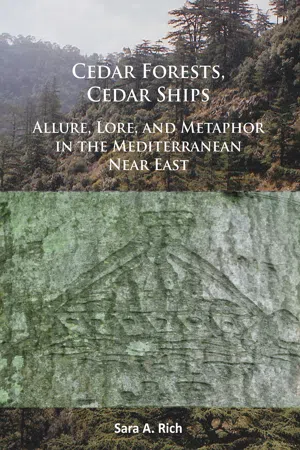
It is commonly recognized that the Cedars of Lebanon were prized in the ancient world, but how can the complex archaeological role of the Cedrus genus be articulated in terms that go beyond its interactions with humans alone? And to what extent can ancient ships and boats made of this material demonstrate such intimate relations with wood? Drawing from object-oriented ontologies and other 'new materialisms, ' Cedar Forests, Cedar Ships constructs a hylocentric anti-narrative spreading from the Cretaceous to the contemporary. With a dual focus on the woods and the watercraft, and on the considerable historical overlap between them, the book takes another step in the direction of challenging the conceptual binaries of nature/culture and subject/object, while providing an up-to-date synthesis of the relevant archaeological and historical data. Binding physical properties and metaphorical manifestations, the fluctuating presence of cedar (forests, trees, and wood) in religious thought is interpreted as having had a direct bearing on shipbuilding in the ancient East Mediterranean. Close and diachronic excavations of the interstices of allure, lore, and metaphor can begin to navigate the (meta) physical relationships between the forested mountain and the forest afloat, and their myriad unique realities.
eBook - PDF
Cedar Forests, Cedar Ships
Allure, Lore, and Metaphor in the Mediterranean Near East
- 298 pages
- English
- PDF
- Available on iOS & Android
eBook - PDF
About this book
Information
Table of contents
- Cover
- Copyright Page
- Contents
- List of Figures
- Preface
- An Object-Oriented Archaeology
- Figure 1. A souvenir cedar cross pendant. Author, 2016.
- Figure 2. Left: modern cedar in the Cyprus Troodos that exemplifies the growth pattern of younger trees that made them ideal for shipbuilding; the tree had been growing in a competitive forest environment before the construction of the road. Right: distor
- PART I
- The Realities and Relations of Wood
- The Enduring Qualities and the First Relations
- Figure 3. A mountainous valley of cedars in the Troodos of Cyprus. Author, 2009.
- Figure 4. An aging cedar in North Lebanon near Tannourine. Author, 2010.
- Figure 5. This photograph of a modern cedar forest in the Troodos Mountains of Cyprus is an approximation of how the late Cretaceous and early Paleogene (Tertiary) forests might have appeared. Tall, thin young cedars compete for the canopy while dense fer
- Figure 6. A section of the geologic time scale with the periodic emergence of cedars and some of their relatives and cohorts noted.
- Figure 7. A configuration of the current status of the ever-changing family tree of the Cedrus genus and now-proposed subfamily, which was previously that of Abitoideae (as proposed by Lin et al. 2010). Author, 2011.
- Figure 8. Close up of increment cores taken from East Mediterranean cedars. The annual growth rings are riddled with fire (left) and frost (center) scars, which result in missing and distorted rings in subsequent growth seasons. False rings (right) appear
- Figure 9. Map of assumed natural vegetation of the eastern Mediterranean, based on palynological records. 1. Eu-Mediterranean vegetation; 2. montane forests; 3. mixed broad-leaved and needle-leaved woodland resistant to cold; 4. cold-deciduous broad-leave
- The Seductive Forests
- Figure 10. Map of the East Mediterranean with locations mentioned in this chapter.
- Figure 11. Chronology of rulers and events pertaining to cedar forests as discussed throughout the chapter, from c. 3500 BC to 400 AD. All Egyptian dates are averages from conventional chronologies, and Mesopotamian dates correspond to the Middle Chronolo
- Figure 12. Egyptian relief panel from Karnak showing Canaanites forced to fell their own aš-trees during the Asian conquests o Seti I. Author, 2016, from Pritchard 2011, pl. 89 (cf. Meiggs, Trees and Timber, 1982, pl. 2).
- Figure 13. Relief panels from the palace of Sargon II at Dur-Šarru-kin (Khorsabad, late 8th century BC), now at the Louvre (AO 19889), interpreted as Phoenicians transporting lumber. Author, 2008.
- Figure 14. Neo-Assyrian relief panels depicting a royal hunting expedition in the king’s paradeisos, and featuring a stylized coniferous forest. Palace of Sargon II at Dur-Šarru-kin (Khorsabad, late 8th century BC), now at the Oriental Institute Museum, C
- The Allure and the Distortion
- Figure 15. Timeline of significant events mentioned in this chapter.
- Figure 16. Map of places mentioned in this chapter.
- Figure 17. Detail of Leaf 111v from the 13th century AD Bible Moralisée housed at the Bodleian Library (MS. Bodl. 270b), demo strating a parable of Cedars of Lebanon as the true faith, threatened by the fire of corruption that uses blackmail to gain the c
- Figure 18. By the 19th century, cedars were commonplace in European parks, private estates, and cemeteries, especially in Victorian England. Above: one of several cedars at the Royal Victoria Country Park in Netley. Below: one of four known shrines at the
- Figure 19. Young cedars act as ‘wish-bushes’ near the tomb of Archbishop Markarios III in the Troodos (Cyprus), featuring ribons that signify prayers. Author, 2007.
- PART II
- The Potency of Wood on Water
- Ships and Transformation
- Figure 20. Egyptian cities, necropolei, and geographical features that are mentioned in the text or are commonly known. Adapted from map courtesy of Bogomolov.PL via Wikimedia Commons.
- Figure 21. Distribution of Naqada II (NII) and Naqada III (NIII) petroglyphs in Egypt’s Eastern Desert. The stretch of rivered between Quft (ancient Coptos) to Quseir is the Wadi Hammamat, the route used to take boats overland from the Nile to the Red Se
- Figure 22. Left: example of one of the Abydos boat graves associated with the reign of Pharaoh Hor-Aha of Dynasty I, c. 3050 BC. Below: Plan of boat graves in relation to nearby structures. Courtesy of Matthew Adams; plan originally printed in O’Connor 20
- Figure 23. The papyriform cedar funerary ship, Khufu I. Top: in situ disassembly and burial. Bottom: view from the starboard s ern (left) and from the starboard bow (right) in the ship’s museum in Giza. Courtesy of Berthold Werner via Wikimedia Commons.
- Figure 24. Top: excavation of a buried boat by J.-J. de Morgan at Dahshur in 1894. De Morgan 1895, pl. 30. Bottom: the Cairo 4 25 White Boat, sister ship to the Carnegie Boat of Senwosret III (Dynasty XII, c. 1850 BC), shown from starboard stern to bow (l
- Figure 25. Table summarizing Egyptian boat burials and proposed symbolism. Entries with an asterisk ( * ) indicate that they were at least partially disassembled upon interment.
- Figure 26. Cyprus and the Levant with major Canaanite and Alašiyan cities labeled. Findspots for some shipwrecks mentioned in he text are also labeled. Adapted from map courtesy of Sémhur via Wikimedia Commons.
- Figure 27. Left: bronze ‘Ingot God’ from Enkomi (Cyprus). Courtesy of Gerhard Haubold via Wikimedia Commons. Right: scrap bro ze tools with modern handles and two stone hammers from the Gelidonya shipwreck. Courtesy of INA.
- Figure 28. Cedar timbers and stone anchor in situ at the Uluburun shipwreck site. Courtesy of INA.
- Figure 29. The bronze statuette found during excavations of the Uluburun shipwreck. Courtesy of INA.
- Figure 30. Parts of the Athlit Ram and drawings of symbols with which it was cast. Adapted from Steffy 1991, fig. 3, and Oron 006, fig. 2.
- Ship Construction, Myth Construction
- Figure 31. Map with archaeological findspots and living forests sampled (Rich et al., Ship in a bottle, 2016, fig. 1).
- The Ontology of Obsolescence
- Dark Ecology (or, On Pins & Needles)
- Figure 32. One of the carved images of Christ on a series of deceased trees near the Maronite Chapel at the Cedars of God (Arz ar-Rab) grove at Bcharre (Lebanon). Cross-sections of other dead limbs and trees are provided to local artists to carve images a
- Figure 33. A young cedar grove at Hadeth (Lebanon) where trash is deposited and burned. These dump areas are not only unsightly, but small trash-burning fires can easily become uncontrollable forest fires, especially in the dry heat of summer. Author, 201
- Figure 34. As was the case in Victorian Bcharre (see Chapter 3), cedars still bear graffiti, and the Hadeth (Lebanon) grove’s proximity to a main paved road makes it particularly vulnerable to labeling by passing lovers. Author, 2010.
- Figure 35. Stamps on a felled cedar at Akseki (north of Antalya, Turkey) identify the source forest and the forester, and so prevent over-cutting and poaching, a practice which has been in use since the late Ottoman period. Courtesy of Peter Ian Kuniholm.
- Figure 36. Some mixed-age cedars on Mount Tripylos (Cyprus) with the path leading to the forest station at the top of the mou tain. Author, 2009.
- Figure 37. Younger cedar grove in Cyprus’ Cedar Valley, where benches have been arranged for tourists from Paphos en route to Kykkos Monastery. Next to the benches is a small parking area and water fountain with a trail that leads up to Mount Tripylos. Au
- Bibliography
Trusted by 375,005 students
Access to over 1.5 million titles for a fair monthly price.
Study more efficiently using our study tools.
Frequently asked questions
Yes, you can cancel anytime from the Subscription tab in your account settings on the Perlego website. Your subscription will stay active until the end of your current billing period. Learn how to cancel your subscription
No, books cannot be downloaded as external files, such as PDFs, for use outside of Perlego. However, you can download books within the Perlego app for offline reading on mobile or tablet. Learn how to download books offline
Perlego offers two plans: Essential and Complete
- Essential is ideal for learners and professionals who enjoy exploring a wide range of subjects. Access the Essential Library with 800,000+ trusted titles and best-sellers across business, personal growth, and the humanities. Includes unlimited reading time and Standard Read Aloud voice.
- Complete: Perfect for advanced learners and researchers needing full, unrestricted access. Unlock 1.5M+ books across hundreds of subjects, including academic and specialized titles. The Complete Plan also includes advanced features like Premium Read Aloud and Research Assistant.
We are an online textbook subscription service, where you can get access to an entire online library for less than the price of a single book per month. With over 1.5 million books across 990+ topics, we’ve got you covered! Learn about our mission
Look out for the read-aloud symbol on your next book to see if you can listen to it. The read-aloud tool reads text aloud for you, highlighting the text as it is being read. You can pause it, speed it up and slow it down. Learn more about Read Aloud
Yes! You can use the Perlego app on both iOS and Android devices to read anytime, anywhere — even offline. Perfect for commutes or when you’re on the go.
Please note we cannot support devices running on iOS 13 and Android 7 or earlier. Learn more about using the app
Please note we cannot support devices running on iOS 13 and Android 7 or earlier. Learn more about using the app
Yes, you can access Cedar Forests, Cedar Ships by Sara A. Rich in PDF and/or ePUB format, as well as other popular books in Social Sciences & Archaeology. We have over 1.5 million books available in our catalogue for you to explore.