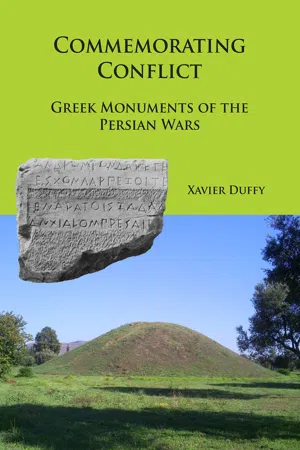
This study is concerned with how the Greek peoples, of primarily the classical period, collectively commemorated the Persian Wars. The data presented here are public monuments, which include both physical and behavioural commemorations. The aim of this work is to reveal and present the methods by which Greeks of the fifth century BC commemorated the Persian Wars. Several trends have drawn attention away from studies presenting commemorative practices in their entirety: the focus on singular monument types, individual commemorative places, a particular commemorating group or specific battle, and an overemphasis on Athenian commemorations. This project works towards rectifying this issue by highlighting the variations in commemorative traditions. This holistic approach to the data, which is inclusive in its remit of commemorative objects, places, and groups, allows for a more complete representation of the commemorative tradition. What emerges from this study is the compilation of all known ancient Greek monuments to commemorate the battles of Marathon, Salamis, Artemisium, Thermopylae and Plataea.
- 218 pages
- English
- PDF
- Available on iOS & Android
eBook - PDF
Commemorating Conflict: Greek Monuments of the Persian Wars
About this book
Information
Table of contents
- Copyright Info
- Cover
- Contents
- List of Figures
- Preface
- Chapter 2
- Chapter 3
- Figure 1 Establishing boundaries to the battlefield space (after Carman and Carman 2006: 135. Reproduced by kind permission of Dr John Carman).
- Chapter 4
- Table 1. Full monument list
- Table 2. Full monument list cont.
- Table 3. Cenotaphs
- Table 4. Trophies
- Table 5. Epigrams and epitaphs
- Table 6. Casualty lists
- Table 7. Collective burials
- Table 8. Commander burials
- Table 9. Spoils of war
- Table 10. Statues
- Table 11. Votive offerings
- Table 12. Altars
- Table 13. Sacred precincts, temples and stoas
- Table 14. Non-religious structures
- Table 15. Military vow
- Table 16. Oaths
- Table 17. Behavioural commemoration
- Table 18. Other
- Chapter 5
- Table 19. Confidence attributed to the acceptance of each monument
- Table 20. Confidence attributed to the acceptance of each monument cont.
- Figure 2 Athenian burial mound at Marathon (author’s own photograph).
- Figure 3 Plataean burial mound (author’s own photograph).
- Figure 4 Athenian trophy at Marathon (author’s own photograph).
- Figure 5. Inscribed stele mentioning the Herakleia (author’s own photograph).
- Figure 6. Herakleia inscription (author’s own photograph).
- Figure 7 Athenian treasury at Delphi (author’s own photograph).
- Figure 8 Stone A I (I 303 a, Agora Excavations, The American School of Classical Studies at Athens).
- Figure 10 Stone B (after Clairmont 1983: pl.13, 7b. Reproduced by kind permission of BAR Publishing).
- Figure 9 Stone A II (I 303 b, Agora Excavations, The American School of Classical Studies at Athens).
- Figure 11 Squared block on Salamis (author’s own photograph).
- Figure 12 Corinthian epitaph from Salamis (author’s own photograph).
- Figure 13 Burial Mound on Salamis (author’s own photograph).
- Table 21. Provisions of the Oath of Plataea
- Figure 14 Drawing of boundary stone (after Skia 1917: 161).
- Figure 15 Section of Acropolis wall displaying Temple of Athena Polias’ entablature (after Kousser 2009: 270. Reproduced by kind permission of Professor Rachel Kousser).
- Figure 16 Section of Acropolis Wall displaying column drums of the Older Parthenon (after Kousser 2009: 271. Reproduced by kind permission of Professor Rachel Kousser).
Trusted by 375,005 students
Access to over 1.5 million titles for a fair monthly price.
Study more efficiently using our study tools.
Frequently asked questions
Yes, you can cancel anytime from the Subscription tab in your account settings on the Perlego website. Your subscription will stay active until the end of your current billing period. Learn how to cancel your subscription
No, books cannot be downloaded as external files, such as PDFs, for use outside of Perlego. However, you can download books within the Perlego app for offline reading on mobile or tablet. Learn how to download books offline
Perlego offers two plans: Essential and Complete
- Essential is ideal for learners and professionals who enjoy exploring a wide range of subjects. Access the Essential Library with 800,000+ trusted titles and best-sellers across business, personal growth, and the humanities. Includes unlimited reading time and Standard Read Aloud voice.
- Complete: Perfect for advanced learners and researchers needing full, unrestricted access. Unlock 1.5M+ books across hundreds of subjects, including academic and specialized titles. The Complete Plan also includes advanced features like Premium Read Aloud and Research Assistant.
We are an online textbook subscription service, where you can get access to an entire online library for less than the price of a single book per month. With over 1.5 million books across 990+ topics, we’ve got you covered! Learn about our mission
Look out for the read-aloud symbol on your next book to see if you can listen to it. The read-aloud tool reads text aloud for you, highlighting the text as it is being read. You can pause it, speed it up and slow it down. Learn more about Read Aloud
Yes! You can use the Perlego app on both iOS and Android devices to read anytime, anywhere — even offline. Perfect for commutes or when you’re on the go.
Please note we cannot support devices running on iOS 13 and Android 7 or earlier. Learn more about using the app
Please note we cannot support devices running on iOS 13 and Android 7 or earlier. Learn more about using the app
Yes, you can access Commemorating Conflict: Greek Monuments of the Persian Wars by Xavier Duffy in PDF and/or ePUB format, as well as other popular books in Social Sciences & Archaeology. We have over 1.5 million books available in our catalogue for you to explore.