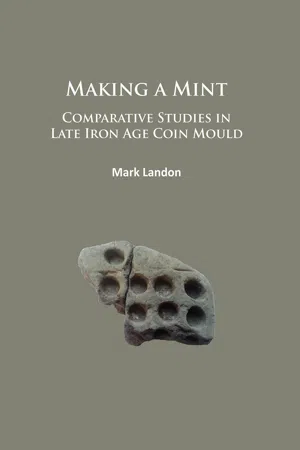
This book presents the first large-scale comparative study of Iron Age coin mould. The subject of Iron Age minting techniques is an important one that reveals a great deal about Iron Age political organisation and economy but which, until now, has remained largely unreported. In addition to examining in detail approximately 20% of all the coin mould ever found, the book also addresses the lack of an agreed reporting protocol, the main and considerable obstacle to progress in this field. In addition to the detailed interpretation of all mould studied the volume also serves as a field guide to best practice in dealing with new material and finds.
- 217 pages
- English
- PDF
- Available on iOS & Android
eBook - PDF
Making a Mint: Comparative Studies in Late Iron Age Coin Mould
About this book
Information
Table of contents
- Cover
- Title Page
- Copyright Page
- Contents
- Chapter 1
- Starting point
- Figure 1.1: The Ford Bridge mint trench.
- Figure 1.2: In situ coin mould at Ford Bridge.
- Figure 1.3: Presumed method of using pellet mould.
- The Literature
- Recording coin mould: aims and methodology
- Figure 3.1: A completed record card, front and back.
- Figure 3.2: ‘Verulamium’ form tray.
- Figure 3.3 Verulamium form tray from Merlin Works, Leicester
- Figure 3.4: ‘Puckeridge’ form tray.
- Figure 3.5: I-section profile
- Figure 3.10: ‘Angled section’ profile
- Figure 3.11: ‘Rolled edge’ profile
- Figure 3.6: An experimental ‘box-mould’ with one open end.
- Figure 3.7: ‘Lazy S’ Profile
- Figure 3.8: An experimental ‘bowl-mould’ with one open end.
- Figure 3.9: ‘Straight section’ profile.
- Figure 3.12: ‘Overhang’ profile.
- Figure 3.13: ‘Cut and tear’ banding.
- Figure 3.14: Results of an experiment to produce 26 holes with a controlled depth of 5mm.
- Figure 3.15 Comparing the average depth and standard deviation for four experimental trays attempting to achieve a hole depth of 5mm.
- Figure 4.1: Average number of holes in rows and columns for fragments with more than 5 holes.
- The Henderson Collection (Braughing) coin mould assemblage
- Figure 4.2: Tray average thickness in the Henderson Collection expressed as percentages.
- Figure 4.3: Comparing composition - position types expressed as percentages of the total number of individually listed fragmen s.
- F igure 4.4: Record-card diagram of fragment HC/30
- Figure 4.5: Edge profile distribution.
- Figure 4.6: Average intra-fragment standard deviations in three hole parameters compared - How careful were the mould-makers?
- Figure 4.7: Variability in relationship between top and base hole diameters in the Henderson Collection and the Ford Bridge assemblages expressed as percentages of the number of holes in each assemblage exhibiting both measurements.
- Figure 4.8: Top diameter distribution in the Henderson Collection
- Figure 4.10: Fragment average base diameter distribution in the Henderson Collection expressed graphically.
- Figure 4.11 : Intra-fragment diameter variation in fragments with 2 or more measurable diameters
- Figure 4.12: Fragment average hole depths in the Henderson Collection
- Figure 4.9: Fragment average base diameter distribution in the Henderson Collection.
- Figure 4.13: Fragment average hole depths in the Henderson Collection expressed as percentages.
- Figure 4.14: Hole size variation in the Henderson Collection tabulated.
- Figure 4.15: Average hole volume plotted against average hole base diameter.
- Figure 4.16: Average intra-fragment total variation in three hole parameters in the Henderson Collection compared with experimentally generated data.
- Figure 5.1: Average thickness measurements from the Ford Bridge assemblage compared with study averages.
- Figure 5.2: Fragment average thicknesses expressed as percentages.
- The Ford Bridge (Braughing) assemblage
- Figure 5.3: Verulamium form pediment with horizontal incised guideline. Note the deformation of the apex hole.
- Figure 5.4: Edge profile distribution.
- Figure 5.5: Band and lines edge marking
- Figure 5.6: Mould lining mark, possibly made by bast or bark
- Figure 5.7: Possible Puckeridge form fragment with 17mm diameter holes and an incised guideline.
- Figure 5.8: Hole slighting in two axes – arrows show the characteristic flattening
- Figure 5.10: Top diameter distribution.
- Figure 5.9: Variability in relationship between top and base hole diameters in the Ford Bridge Assemblage
- Figure 5.11: Base diameter distribution by percentage.
- Figure 5.12: Homogenous base diameter distribution. Context 00 forms the first cluster, context 03 the second, and the extended third cluster is formed from contexts 04; 06; 09 and VH.
- Figure 5.13: Fragment average hole depths
- Figure 5.14: Fragment average hole depths expressed as percentages
- Figure 5.15: Base diameter plotted against volume
- Figure 5.16: Variation within hole size groups tabulated.
- Figure 5.17: Chalk wash in mould holes, approximately 1.5mm thick at the base.
- Figure 5.18: Signs of extreme heating - Ford Bridge and Puckeridge compared.
- Figure 5.19: Grass marks on tray base.
- Figure 5.20: Grain cast in hole base (Frag. BRR/03/096).
- Figure 5.21: Key to Figures 5.22 and 5.23.
- Figure 5.22: Inclusions and tempers from Ford Bridge (BRR) and Puckeridge (PUC) expressed as % of total inclusions + tempers for each site.
- Figure 5.23: Chalk and shell tempers from Ford Bridge (BRR) and Puckeridge (PUC) expressed as % of individually recorded fragments.
- Figure 5.24: Moulded platform fragment (Frag. BRR/06/006). Note vesiculation.
- Figure 6.1: High-peaked Verulamium form tray fragment
- The PuckeridgeAssemblage
- Figure 6.2: Puckeridge form tray (PUC/Box 2/0008)
- Figure 6.3: Edge profile distribution in the Puckeridge assemblage
- Figure 6.4: ‘Lines and banding’ edge marking
- Figure 6.5: Lateral and double horizontal incised guidelines
- Figure 6.6: Boustrophedon hole making revealed by slighting
- Figure 6.7: The distribution of differences between top and hole base diameter in the Puckeridge assemblage.
- Figure 6.8: Distribution of intra-fragment variation in the difference between top and hole base diameters.
- Figure 6.9: Hole top diameter distribution.
- Figure 6.10: Fragment mean hole base diameter distribution.
- Figure 6.11: Fragment mean hole base diameter distribution expressed graphically
- Figure 6.12: Mean intra-fragment variation in base diameter (in mm) correlated with fragment size.
- Figure 6.13: Fragment average hole depths in the Puckeridge assemblage.
- Figure 6.14: Scatter graph plotting base diameter in mm against volume in mm3
- Figure 6.15: Range and distribution of volumes in the Puckeridge assemblage.
- Figure 6.16: Calcium carbonate wash. Arrow shows incised guideline.
- Figure 6.20: Evidence of trays adhering during heating
- Figure 6.21: Occlusion of mould hole by heat-induced slumping
- Figure 6.22: Two fragments melted together after breakage: a second heating episode?
- Figure 6.23: Evidence of heat applied by tuyère? A ‘plume’ of differential heating on the top surface of a fragment.
- Figure 6.24: Grain cast on a tray base
- Figure 6.25: Large pebble inclusion
- Figure 6.26: Partial clay caps
- Figure 6.27: Intact clay cap
- Figure 6.29: Possible luted hole from Puckeridge
- Figure 7.1: Concordance attempting to reconcile Landon numbering with Cowell and Tite indexing.
- Figure 7.2: Average number of holes in rows and columns for fragments with 5 holes or more.
- The Wickham Kennels assemblage
- Figure 7.3: Percentages of position types compared.
- Figure 7.4: Edge profile distribution.
- Figure 7.5: Intra-fragment standard deviations in three hole parameters compared - How careful were the mould-makers?
- Figure 7.6: Fragment average hole depths in the Wickham Kennels assemblage.
- Figure 7.7: Individual hole depth variation on frag. BR82/WK/3
- Figure 7.8: Fragment average volumes and intra-fragment total variation in volume.
- Figure 8.1: Comparing position type percentages.
- Figure 8.2: Comparing average fragment size (Length 1 and Length 2).
- Figure 8.3: Proportions of incomplete vs. complete holes compared.
- Small finds from Braughing/Puckeridge
- Figure 8.4: Fragment RR/BC/5860, showing where thickness measurements were taken.
- Figure 8.5: RR/BC/5860 – Thickness compared.
- Figure 8.6: Patterns of slighting on RR/BC 5860. Arrows denote the direction of slighting. Slighting holes were made after slighted holes.
- Figure 8.7: Intra-fragment base diameter variability compared between fragments with 18+ holes.
- Figure 8.10: RR/BC/5860 - Variation in volume plotted against hole base diameter.
- Figure 8.8: Hole base diameter variability on RR/BC 5860.
- Figure 8.9: Depth variation on RR/BC 5860 compared.
- Figure 8.11: Grass marks on the base of RR/BC 5860.
- Figure 8.12: Fragment WB/SOG 5171.
- Figure 8.13: Probable grain cast on WB/SOG 5171.
- Figure 8.14: Arrow shows massive flint inclusion.
- Figure 8.15: Fragment RR/RC 01
- Plate 8.16: Fragment RR/RC 02
- Figure 8.17: Selective deposition – fragment sizes compared.
- Figure 8.18: Selective deposition – Average number of holes per fragment.
- Figure 8.19: Fragment RR/BER 5881
- Figure 8.20: Hole numbering on RR/BER 5881.
- Figure 8.21: Hole base diameter variation on RR/BER 5881
- Figure 8.22: Hole depths in mm across RR/BER 5881.
- Figure 8.23: RR/BER 5881 - Hole volume in mm3
- Figure 8.25: Arrows indicate black crust, possibly silver salts, around hole mouth. Areas immediately above these marks are stained purple. Note also vesiculation.
- Figure 8.26: Chaff cast on the upper surface of RR/BER 5881.
- Figure 8.27: Incomplete grain cast on the base of RR/BER 5881
- Figure 9.1: Correlating fragment numbering systems for the Bagendon study sample.
- The Bagendon study sample
- Figure 9.2: Average number of holes in rows and columns for fragments with more than 5 holes in the Bagendon study sample and he Ford Bridge assemblage.
- Figure 9.3: Purposive trimming or accidental fracture?
- Figure 9.4: Bagendon edge profile types tabulated.
- Figure 9.5: Edge profile percentages compared.
- Figure 9.6: Hole numbering on BAG 81/44.93/None (1)
- Figure 9.7: Slighting in two axes. Arrows indicate
- Figure 9.8: Intra-fragment variability in the difference between top and hole base diameter in mm
- Figure 9.10: Base diameter distribution
- Figure 9.11: Average intra-fragment variation in base diameter in the Bagendon 1981 material compared.
- Figure 9.12: Correlating hole base diameter in mm with hole volume in mm3
- Figure 9.13: Ancient or modern? – Arrows indicate channels linking holes on this fragment of possible potin mould.
- Figure 9.14: Differential signs of heating on base and top of a single mould fragment.
- Figure 9.15: Grain cast on the base of a Bagendon coin mould fragment. BAG 81/20.83/Sample 9.
- Coin mould from Old Sleaford in the British Museum
- Figure 10.1: Fragment average thicknesses in the Old Sleaford study sample expressed as percentages
- Figure 10.2: Unusual orientation of hole-row to edge and corner on Fragment OS/1684
- Figure 10.3: Minimum number of corners in the Old Sleaford assemblage for a range of tray sizes.
- Figure 10.4: Edge profile types in the Old Sleaford study sample.
- Figure 10.5: Edge marking on fragment OS/1693.
- Figure 10.6: Diastemas expressed as percentages of hole top diameter.
- Figure 10.7: Average intra-fragment variation in three hole parameters compared: how careful were the mould-makers?
- Figure 10.8: Comparing the range in variation between base and top hole diameters, expressed as percentages, in Old Sleaford a d experimental material.
- Figure 10.9: Possible range of base diameters for Old Sleaford coin mould.
- Figure 10.10: Fragment average hole depths in the Old Sleaford study sample
- Figure 10.11: Fragment average hole depths in the Old Sleaford study sample expressed as percentages.
- Figure 10.12: Hole size variation in the Old Sleaford study sample tabulated.
- Figure 10.13: Average hole volume plotted against average hole base diameter.
- The Turners Hall Farm Assemblage
- Figure 11.1: Context numbering for coin mould in the Turners Hall Farm archive.
- Figure 11.2: Average thicknesses for the Turners Hall Farm Assemblage compared with study averages.
- Figure 11.3: Thickness distribution for the Turners Hall assemblage.
- Figure 11.4: Turners Hall Farm position type distribution compared with the study averages.
- Figure 11.5: Fragment 1012.55/1, after Nicky Metcalf.
- Figure 11.6: Using the ‘minimum trays’ formula to demonstrate a shortfall in corners in the Turners Hall Farm assemblage.
- Figure 11.7: Turners Hall Farm edge profile types tabulated.
- Figure 11.8: Fragment 1012.53/1, after Nicky Metcalf, showing relation of incised guideline to corner.
- Figure 11.10: Top diameter distribution at Turners Hall Farm compared with the study average.
- Figure 11.9: Variability in relationship between top and base diameters in the Turners Hall Farm material, compared with resul s from experimental tray manufacture.
- Figure 11.11: Average intra-fragment variation in hole base diameter at Turners Hall Farm compared with the study average and experimental hole-making.
- Figure 11.12: Distribution of hole base diameters in the Turners Hall Farm assemblage.
- Figure 11.13: Distribution of hole base diameters in the Turners Hall Farm assemblage.
- Figure 11.14: Distribution of intra-fragment average depth measurement from the Turners Hall Farm assemblage.
- Figure 11.15: Variability in base diameter and hole volume in the Turners Hall Farm assemblage tabulated.
- Figure 11.16: Intra-fragment average hole volume tabulated against intra-fragment average base diameter.
- Conclusions
- Figure 12.1: Context and size of assemblages discussed in this work, where known.
- Figure 12.2: Context and size of several other assemblages of British coin mould.
- Figure 12.3: Assemblage average fragment sizes in mm.
- Figure 12.4: Effectiveness of two methods of retrieval used on the same Ford Bridge, Braughing, context.
- Figure 12.5: Retrieval rates for larger assemblages expressed in terms of the percentage of very small fragments of coin mould.
- Figures 12.6a & 12.6b: Average lengths compared – larger assemblages versus smaller assemblages.
- Figure 12.7: Shortfall of corners expressed as percentages for a range of tray forms.
- Figure 12.8: Corners expressed as a percentage of all fragments in three assemblages.
- Figure 12.9: Shortfall in corners in the Ford Bridge and Puckeridge assemblages.
- Figure 12.10: Maximum number of trays of varying circumferences allowed by the total edge length in the Ford Bridge assemblage.
- Figure 12.11: Shortfall in edge in the Ford Bridge assemblage between actual edge length and edge length required by 46 trays of varying circumferences.
- Figure 12.12: Edge fragments in the larger assemblages expressed as percentages of the total number of fragments.
- Figure 12.13: Edge fragments in the smaller assemblages expressed as percentages of the total number of fragments.
- Figure 12.14: Edge and corner percentages for both larger and smaller assemblages combined.
- Figure 12.15: Profile type distribution in the assemblages studied expressed as percentages of total profiles per assemblage (excluding ‘Cut & Tear’).
- Figure 12.16: Study total of instances of Type 3 and Type 4 edge profiles in the Ford Bridge, Puckeridge and Wickham Kennels assemblages.
- Figure 12.50: Rationalising edge marking categories
- Figure 12.17: The incidence of 17 categories of edge marking across six assemblages expressed as percentages of all edge fragments.
- Figure 12.18: Total incidence in 6 assemblages of 17 categories of edge marking expressed as percentages of all edge fragments.
- Figure 12.19: Number of assemblages in the study in which each of 17 categories of edge marking occurs.
- Figure 12.20: The number of assemblages in which edge markings, resolved into 4 categories, occur.
- Figure 12.21: Incised guideline codes used in the study.
- Figure 12.22: Distribution of thirteen classes of incised guideline in four assemblages of coin mould.
- Figure 12.23: Three possible orientations for an ‘Incised guideline’ parallel with a non-pedimental edge.
- Figure 12.27: Common combination - IGL + IGL.
- Figure 12.24: Incised guideline parallel with Row 1.
- Figure 12.25: Incised guideline parallel with pediment edge.
- Figure 12.26: Common combination – IGL + IGR.
- Figure 12.28: Guidelines on a near-complete Verulamium form tray originally part of the Puckeridge assemblage.
- Figure 12.29: Combinations of ‘incised guidelines’ at Ford Bridge and Puckeridge.
- Figure 12.30: Double incised guidelines parallel with a Non-pedimental edge.
- Figure 12.31: Double incised guidelines parallel with Row 1.
- Figure 12.32: Incised guidelines outlining pediment.
- Figure 12.33: The occurrence of hole slighting and boustrophedon dibbing in seven assemblages of coin mould.
- Figure 12.34: Variability in the relationship between top and base hole diameters for 7 assemblages, expressed as assemblage percentages, compared with results generated experimentally.
- Figure 12.35: Amalgamated study average variation in hole diameter.
- Figure 12.36: Hole base diameter distribution in the Ford Bridge and Puckeridge assemblages
- Figure 12.37: Average intra-fragment depth variation in mm for eight assemblages of coin mould.
- Figure 12.38: ‘Depth signatures’ of seven assemblages.
- Figure 12.39: Average intra-fragment variation in volume in 8 assemblages.
- Figure 12.40: Inter-fragment variation in volume in six assemblages.
- Figure 12.41: Percentage of fragments in each of the study assemblages classified as Burn Category 0: ‘Unclassifiable’
- Figure 12.42: Percentage of fragments in each assemblage studied showing no sign of heating beyond the temperature necessary for firing.
- Figure 12.43: Heating Category B (Reddening only) expressed as percentages of each assemblage.
- Figure 12.44: Heating Category C (Slight Vitrification and/or Vesiculation) expressed as percentages of each assemblage.
- Figure 12.45: Heating Category D (Extreme Heating) expressed as percentages of each assemblage.
- Figure 12.46: Vitrification, vesiculation and other signs of heating tabulated by location, and expressed as percentages of (Both+Top only+Base only).
- Figure 12.47: How were the trays dried? – Grass marks, chaff marks and matting marks tabulated by location on the fragment, and expressed as percentages of the total number of individually listed fragments in each assemblage.
- Figure 12.48: The incidence of grain casts in eight assemblages of coin mould. Percentages are expressed in terms of the numbe of individually listed fragments in each assemblage.
- Figure 12.49: Inclusions and tempers expressed as percentages of the total number (2837) of individually listed fragments in he study.
- Appendix
- Some experiments in the manufacture of coin mould
- Figure A.1: Box-mould with three sides.
- Figure A.2: Bowl-mould with one open end.
- Figure A.10: Tray 9 – Vertical diameters in schematic representation.
- Figure A.11: Tray 9 – Hole depths in schematic representation.
- Figure A.12: Variation in diameter in 63 holes made in wet clay with the same single-pronged dibber (horizontal diameter 14.45mm; vertical diameter 14.60mm)
- Figure A.3: Tray 7 – Horizontal diameters in schematic representation.
- Figure A.4: Tray 7 – Vertical diameters in schematic representation
- Figure A.5: Tray 7 – Hole depths in schematic representation.
- Figure A.6: Tray 8 – Horizontal diameters in schematic representation
- Figure A.7: Tray 8 – Vertical diameters in schematic representation.
- Figure A.8: Tray 8 – Hole depths in schematic representation.
- Figure A.9: Tray 9 – Horizontal diameters in schematic representation.
- Figure A.13: Control of depth – error margins expressed as percentages.
- Figure A.14: Control of depth – standard deviation and tray total variation for three experimental trays
- Figure A.15: Variation in experimental hole volumes
- Figure A.16: Intra-fragment hole variability in different samples of coin mould compared.
- Figure A.17: The distribution of deviation in diameter in two axes of holes made in wet clay from the diameter of the dibber used to make them.
- Figure A.18: Schematic representation of a sixteen-hole tray, with holes denoted by letters.
- Figure A.19: An experimental multi-pronged dibber.
- Figure A.20: Experimental multi-pronged dibber – the spaces between prongs.
- Figure A.21: Experimental multi-pronged dibber – Horizontal and vertical diameters and prong lengths.
- Figure A.22: Tray 10 – Horizontal diameters in schematic representation
- Figure A.23: Tray 10 – Vertical diameters in schematic representation
- Figure A.24: Tray 10 – Hole depths in schematic representation
- Figure A.25: Tray 11 – Hole spacings in the horizontal axis in schematic representation
- Figure A.26: Tray 11 – Horizontal diameters in schematic representation
- Figure A.27: Tray 11 – Vertical diameters in schematic representation
- Figure A.28:Tray 11 - Hole depths in schematic representation.
- Figure A.29: Tray 12 – Hole spacings in the horizontal axis in schematic representation
- Figure A.30: Tray 12 – Horizontal diameters in schematic representation
- Figure A.31: Tray 12 – Vertical diameters in schematic representation
- Figure A.32: Tray 12 – Hole depths in schematic representation
- Figure A.33: Total variation in hole spacing across eight dibbing iterations for three gaps in a fixed axis.
- Figure A.34: Tray 11 – Deviation from dibber spacing: dibber spacing subtracted from hole spacing.
- Figure A.35: Tray 12 – Deviation from dibber spacing: dibber spacing subtracted from hole spacing.
- Figure A.36: Standard deviation in diameter of holes made with single- and multi-pronged dibbers.
- Figure A.37: Tray total variation in diameter of holes made experimentally with single– and multi-pronged dibbers.
- Figure A.38: Standard deviation in diameter for 6 fragments of coin mould with 18 or more holes.
- Figure A.39: Tray Total Variation in diameter for 6 fragments of coin mould with 18 or more holes.
- Figure A.40: Average variation in depth – Comparing holes made in experimental trays using single- and multi-pronged dibbers with depth variation on real fragments.
- Figure A.41: Dimensions of the dibber used in Experiment Series 4.
- Figure A.42: The force required (in grams) to make five holes in wet clay using a single-pronged dibber.
- Figure A.43: Force required to use dibbers of various diameters and in varying numbers.
- A List of British Find-Sites
- Bibliography
Trusted by 375,005 students
Access to over 1.5 million titles for a fair monthly price.
Study more efficiently using our study tools.
Frequently asked questions
Yes, you can cancel anytime from the Subscription tab in your account settings on the Perlego website. Your subscription will stay active until the end of your current billing period. Learn how to cancel your subscription
No, books cannot be downloaded as external files, such as PDFs, for use outside of Perlego. However, you can download books within the Perlego app for offline reading on mobile or tablet. Learn how to download books offline
Perlego offers two plans: Essential and Complete
- Essential is ideal for learners and professionals who enjoy exploring a wide range of subjects. Access the Essential Library with 800,000+ trusted titles and best-sellers across business, personal growth, and the humanities. Includes unlimited reading time and Standard Read Aloud voice.
- Complete: Perfect for advanced learners and researchers needing full, unrestricted access. Unlock 1.5M+ books across hundreds of subjects, including academic and specialized titles. The Complete Plan also includes advanced features like Premium Read Aloud and Research Assistant.
We are an online textbook subscription service, where you can get access to an entire online library for less than the price of a single book per month. With over 1.5 million books across 990+ topics, we’ve got you covered! Learn about our mission
Look out for the read-aloud symbol on your next book to see if you can listen to it. The read-aloud tool reads text aloud for you, highlighting the text as it is being read. You can pause it, speed it up and slow it down. Learn more about Read Aloud
Yes! You can use the Perlego app on both iOS and Android devices to read anytime, anywhere — even offline. Perfect for commutes or when you’re on the go.
Please note we cannot support devices running on iOS 13 and Android 7 or earlier. Learn more about using the app
Please note we cannot support devices running on iOS 13 and Android 7 or earlier. Learn more about using the app
Yes, you can access Making a Mint: Comparative Studies in Late Iron Age Coin Mould by Mark Landon in PDF and/or ePUB format, as well as other popular books in Social Sciences & Archaeology. We have over 1.5 million books available in our catalogue for you to explore.