eBook - PDF
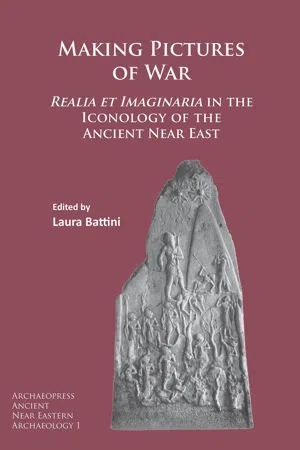
Making Pictures of War
Realia et Imaginaria in the Iconology of the Ancient Near East
- 105 pages
- English
- PDF
- Available on iOS & Android
eBook - PDF
About this book
This book brings together the main discussions that took place at an international conference on the iconology of war in the ancient Near East, a subject never addressed at an international meeting before. The articles span the 3rd to the 1st millennium, with a special stress on the Neo-Assyrian period. They try to respond to many questions about representations of war: what is 'warrior' iconography and on what basis it can be defined? Did the war scenes follow a specific directory whereby they adopted the most varied forms? Can we determine the most usual conditions for the creation of pictures of wartime (such as periods of great change)? Were the war scenes referring to specific historical events or were they generic representations? What can a society accept from the representations of war? What did war images silence and why? What is a 'just' punishment for enemies and thus the 'just' representation of it? Who has control of the representation and therefore also the memory of war? Who is the real subject of war representations? What emerges from all the articles published here is the relevance of textual data in any analysis of iconological material. And this is not only true for iconology, but for all the archaeological material discovered at historical sites.
Information
Table of contents
- Front Cover
- Title Page
- Copyright Page
- Contents
- List of Figures
- Abbreviations and General References
- Acknowledgments
- Dedications
- Introduction: the War and its Representations
- Some Observations on the War Scenes on the Seals from Mari City II
- Some Observations on the War Scenes on the Seals from Mari City II
- Figure 1.1: Schematic Diagram of the North Part of P-1 with the Positions of the Sigillographic Finds.
- Figure 1.2: Door Seal with Imprints of Version a of Ishqi-Mari’s Seal.
- Figure 1.4: Graphic Reconstruction of the Imprint of Version a.
- Figure 1.5: Door Seal with Fragmentary Imprints of Version b of Ishqi-Mari’s Seal.
- Figure 1.7: Fragmentary Imprint: Upper Section of Version b.
- Figure 1.8: Fragmentary Imprint: King Ishqi-Mari (Version b) .
- Figure 1.9: Graphic Reconstruction of the Imprint of Version b (2007) .
- Figure 1.10: Graphic Reconstruction of the Imprint of Version b: New Version.
- Figure 1.11: Door Seal with Fragmentary Imprints of Iddin-Eshtar’s Seal.
- Figure 1.13: Graphic Reconstruction of the Imprint of Iddin-Eshtar’s Seal.
- Elements Of War Iconography At Mari
- Elements Of War Iconography At Mari
- Figure 2.1: Inlaid mother-of-pearl from the Temple of Ninni-zaza (Mari, City II) : helmeted soldiers. H. average 4.5-5cm. a - Parrot 1952: fig. 66. b - Drawing of a selection of parts. Parrot 1967: 209-214, fig. 252-254 (cf. pl. LXIII).
- Figure 2.3: Terracotta stamped plaques from the Great Royal Palace (Mari, City III) : soldier with a long weapon (spear?) and an axe. a - M. 768, room 62 (near the Throne Room 65, official sector M). Parrot 1959: fig. 55 et cf. pl. XXIX. b - M. 1073, cour
- Figure 2.4: Fragments of mural painting from room 220’ (sector F: royal private apartments on the first floor) of Great Royal Palace (Mari, City III). a - M. 4596 : archer standing at rest. H. 31cm. Gouache J. Depauw, © MAM, slide A. Parrot. b - M. 4592 :
- Figure 2.5: Fragments of mural painting from the West wall of the Court 106 (official sector M) of the Great Royal Palace (Mari, City III) : figure of victorious King (module 1, restored h. c.1.60m). Parrot 1958: fig. 35 and 36. a - Elements of garment wi
- Figure 2.6: Graffiti engraved with a point on plaster (juss) of a wall of room 52 (sector H, chambers of the staff belonging to the Women’s House) of the Great Royal Palace (Mari, City III) : soldiers. Parrot 1958: fig. 13 and 14. a - Bearded and helmete
- Figure 2.7: Piece of inlaid mother-of-pearl from space 4 of the pseudo-Palace (Mari, City II) : deck tank showing a pair of e graved reins in its upper indentation ; the lower edge curved leaves room for the installation of a wheel. H. 6.8cm. Never publis
- Figure 2.8: Piece of inlaid mother-of-pearl from space 20 (square) south of the Temple of Ishtar (Mari, City II) and belongi g to the Standard: fragmentary wheel associated with the box of a chariot on whose step the legs of a soldier brace themselves. To
- Figure 2.9: Miniature registry of fragmentary mural paintings from room 220’ (sector F: royal private apartments on first floor) of Great Royal Palace (Mari, City III). a – Head caped with a polos blue and white striped. (M. 4587) at the corner of a brick
- Figure 2.10: Piece of inlaid mother-of-pearl M. 2477 from room 13 of the temple of Ninni-zaza (Mari, City II) : Kneeling prisoner. H. 7cm. Parrot 1952: fig. 67.
- Figure 2.11: Pieces of Standard from space 20 (square) south of the temple of Ishtar (Mari, City II). A - bust of the milita y dignitary M. 474 in situ, yet in connection with the background and border, while the bottom of the garment is visible above on
- Figure 2.12: Fragment of the panel inlaid from the passage 52/49 of the pseudo-Palace of City II, level P-1: helmeted soldier pushing a prisoner (M. 4785 and M. 4793) and wearing clothes of this one on the top of his javelin which is pointed downward. H.
- Beyer in Margueron 2004: fig. 506-2 and cf. Amiet 1960: fig. 12; Parrot 1959: 189-191.
- Figure 2.13: Contour of warrior M. 471 (temple of Ishtar, Standard) by comparison with the previous figure.
- Figure 2.15: Restitution drawing of the impression of a seal known from different clay door-lock sealings from the Great Royal Palace (Mari, City III) inscribed with the name of Mukannishum, intendant of the palace: the King hits a standing enemy with his
- Figure 2.16: Modern impression of the seal of Ana-Sin-taklâku. A lot of his sealings (especially of jars) were found in the G eat Royal Palace (Mari, City III): the King, surrounded by deities and holding an harpè tramples an enemy. H. 2.7cm. Louvre AO 21
- Figure 2.17: Iconographic and architectural restitution of paintings of room 220’, south wall, of the Great Royal Palace (Mari, City III). H. 3.50m c., L. 14.75m. Margueron et al. 1990: fig. 11.
- Figure 2.18: Fragments of wall painting on coating of juss from the court 106 of the Great Royal Palace (Mari, City III) : presentation panel conceived by B. Muller and realized after restoration by CEPMR/CNRS (Centre d’Etudes de Peintures Murales Romaine
- Figure 2.19: Restitution drawing of the impression of the seal (n° 1) of Ishqi-Mari from different sealings discovered in room 11 of the pseudo-Palace (Mari, City II) : battle and banquet celebrating victory. Beyer 2007: fig. 17. Scale 2: 1.
- Figure 3.1: Victory Stele of Eannatum. From Tello. Early Dynastic period. Louvre Museum (after Forest 1996: 222).
- Visualizing War in the Old Babylonian Period: Drama and Canon
- Figure 3.2: Victory Stele of King Dadusha of Eshnunna. From Tell Asmar. Old Babylonian period. Baghdad Museum (after Ismail and Cavigneaux 2003: pl. 34)
- (after Orthmann 1975: 325, pl. 247)
- Figure 3.3: Neo-Assyrian bas-relief. From Nineveh. North Palace, Room S. Reign of Ashurbanipal. British Museum
- Figure 3.4: Cylinder seal. Newell Collection. Old Babylonian period (after von der Osten 1934: pl. 14: 155)
- Figure 3.5: Cylinder seal. Moore Collection. Old Babylonian period (after Eisen 1940: pl. 7: 60)
- Figure 3.6: Victory Stele of Naramsin. Akkadian period. Louvre Museum (after Orthmann 1975: 196, pl. 196)
- Figure 3.7: Terracotta Plaque. From Kish. Old Babylonian Period. Baghdad Museum (after Moorey 1975: pl. 23a)
- Figure 4.1: Pyxis lid from Assur (Berlin, Vorderasiatische Museum, VA7989), 13th s. BC. Source: Matthiae 1997: 32.
- Middle Assyrian Drama in depicting war: a Step towards Neo-Assyrian Art
- Figure 4.2: stone Cult Pedestal of Tukulti-Ninurta I. Source: Matthiae 1997: 31-32.
- Figure 4.3: stele from Suse (Louvre, Sb 7). Source: Matthiae 2000: 52.
- Figure 4.4: Hunt seals Source: Harper et alii 1995: 65-66, fig. 26 ; Invernizzi 1992 : n° 310.
- Figure 4.5: Broken Obelisk of Assur-bel-kala (11th century BC), from Nineveh. Source: Matthiae 1997: 33.
- Figure 4.6: Old Babylonian terracotta representing the epiphany of god (Philadelphie, Penn Museum, Y.B.C. 10.035). Source: Opificius 1961: n° 399.
- Figure 4.7: Urban settings of Kar-Tukulti-Ninurta and Dur-Sharrukin. Source: original setting.
- “Losing One’s Head”. Some Hints on Procedures and Meanings of Decapitation in the Ancient Near EastMeus
- Figure 5.1: Neo-Assyrian bas relief.
- Figure 5.2: Detail of the Stele of Vultures (IIIrd mill. BC)
- Figure 5.3: Example of paintings from Catal Höyük
- Figure 5.4: Heaps of SH piled up next to valuable furnishings and weapons, Neo-Assyrian period.
- Figure 5.5: Soldiers bringing decapitated heads. From Ebla, IIIrd mill. BC
- Figure 5.6: Soldiers bringing decapitated heads. From Tell Taynat, Ist mill. BC
- Figure 5.7: Removal of SH and their transportation to the place of “counting”. Neo-Assyrian period.
- Figure 5.8: Heads became food for birds of prey, example from Uruk glyptic.
- Figure 5.9: Heads became food for birds of prey, example from Catal Höyük.
- Figure 5.10: Flying vultures grabbing the heads of enemies, IIIrd mill. BC (Stele of vultures).
- Figure 5.11: Stele of the king Dadusha, early IInd mill. BC
- Where is the public? A new look at the brutality scenes in Neo-Assyrian royal inscriptions and art
- Figure 6.1: Atrocities in Neo-Assyrian royal inscriptions
- Figure 6.2: The addressees of the royal inscriptions.
- Figure 6.3: Battle of Til-Tuba. A soldier holds Teumman’s cut-off head (second register from the bottom, left side; Cat.-No 44); corpses of defeated Elamites are thrown into the River Ulai (lower half, right side; Cat.-No 45). From Barnett, Bleibtreu and
- Figure 6.4: Shalmaneser’s Balawat gates as displayed in the British Museum (Cat.-Nos 3–7). Door reconstruction based on Schachner 2007: 24, fig. 6; depictions from Schachner 2007: plates 2, 4, 8, 10 and 13.
- Figure 6.5: Soldiers carrying severed heads for inventory (Cat.-No 37). From Barnett, Bleibtreu and Turner 1998: pl. 210.
- Figure 6.6: Grinding the ancestor’s bones (upper register, left side; Cat.-No 40); soldiers carrying severed heads for inventory (second register from the top, right side; Cat.-No 41); a soldier holds Teumman’s cut-off head (second register from the top,
- Figure 6.7: Siege of Lachish, impalement of three prisoners (Cat.-No 30). From Barnett, Bleibtreu and Turner 1998: pl. 330.
- Figure 6.8: Flaying of two prisoners (Cat.-No 29). From Barnett, Bleibtreu and Turner 1998: pl. 338.
- Figure 6.9: Soldiers flay prisoners while another one holds a severed head (second register from the top; Cat.-No 46); soldie s pull out the tongue of prisoners (third register from the top; Cat.-No 47). From Barnett, Bleibtreu and Turner 1998: pl. 300.
- Figure 6.10: Zincirli Stele. Esarhaddon holds two ropes attached to rings pierced in Uš-Anaḫuru’s and Abdi-Milkūti’s lower lips (Cat.-No 35). From Börker-Klahn 1982: Nr. 218.
- Figure 6.11: Sargon gouging out the eyes of a prisoner (Cat.-Nr. 13). From Botta and Flandin 1849b: pl. 118.
- Figure 6.12: Brutality scenes in Neo-Assyrian art
- Figure 6.13: The addressees of the iconographic sources
- Figure 6.14: Degrees of accessibility to the palace reliefs
- Figure 6. 15: Location of the brutality scenes
- Figure 6.16: Visibility of the brutality scenes
- Images of War in the Assyrian Period: What They Show and What They Hide
- Back Cover
Trusted by 375,005 students
Access to over 1.5 million titles for a fair monthly price.
Study more efficiently using our study tools.
Frequently asked questions
Yes, you can cancel anytime from the Subscription tab in your account settings on the Perlego website. Your subscription will stay active until the end of your current billing period. Learn how to cancel your subscription
No, books cannot be downloaded as external files, such as PDFs, for use outside of Perlego. However, you can download books within the Perlego app for offline reading on mobile or tablet. Learn how to download books offline
Perlego offers two plans: Essential and Complete
- Essential is ideal for learners and professionals who enjoy exploring a wide range of subjects. Access the Essential Library with 800,000+ trusted titles and best-sellers across business, personal growth, and the humanities. Includes unlimited reading time and Standard Read Aloud voice.
- Complete: Perfect for advanced learners and researchers needing full, unrestricted access. Unlock 1.5M+ books across hundreds of subjects, including academic and specialized titles. The Complete Plan also includes advanced features like Premium Read Aloud and Research Assistant.
We are an online textbook subscription service, where you can get access to an entire online library for less than the price of a single book per month. With over 1.5 million books across 990+ topics, we’ve got you covered! Learn about our mission
Look out for the read-aloud symbol on your next book to see if you can listen to it. The read-aloud tool reads text aloud for you, highlighting the text as it is being read. You can pause it, speed it up and slow it down. Learn more about Read Aloud
Yes! You can use the Perlego app on both iOS and Android devices to read anytime, anywhere — even offline. Perfect for commutes or when you’re on the go.
Please note we cannot support devices running on iOS 13 and Android 7 or earlier. Learn more about using the app
Please note we cannot support devices running on iOS 13 and Android 7 or earlier. Learn more about using the app
Yes, you can access Making Pictures of War by Laura Battini in PDF and/or ePUB format, as well as other popular books in Social Sciences & Archaeology. We have over 1.5 million books available in our catalogue for you to explore.