The overall purpose of this book is to provide a foundation for Samoan students to become the custodians of the historical narrative based on Archaeological research. Issues that are explored are; Do ancient remains matter in contemporary Samoa? What is the chronological status, and spatial relationship of archaeological monuments found in Samoa? Is the settlement pattern stable over the past 3000 years that Samoa has been populated and/or does central places emerge trough time? Previous efforts from the outside during the 1960 -70 of introducing Archaeology to Samoa that used archaeological methods, historical linguistics and ethno-history to interpret the Samoan past are assessed in regard to the development in Samoa but also in a wider West-Polynesian context. The book also contains data and discussions on our three-year program for archaeology at the large and important Pulemelei mound in Savai'i during 2002-2004, some of which has not been published before. Results and further implications of these investigations that were followed up by an eight-year program where the author introduced courses in Archaeology at The National University of Samoa are also presented and discussed. These efforts served as a foundation to create a Bachelors program for Archaeology and Cultural Heritage Management. Results from our archaeological field schools, collaborations with the Museum of Samoa and interview projects on Cultural Heritage Management, education and legislation are also discussed here. They provide a foundation to understand the role of and the Historical Cultural Heritage in the past and present Samoa and how to move on to manage and protect this heritage in the future.
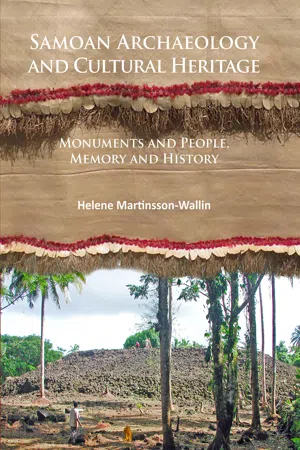
eBook - PDF
Samoan Archaeology and Cultural Heritage
Monuments and People, Memory and History
- 201 pages
- English
- PDF
- Available on iOS & Android
eBook - PDF
Samoan Archaeology and Cultural Heritage
Monuments and People, Memory and History
About this book
Information
Table of contents
- Cover
- Copyright Information
- Contents
- List of Figures
- Preface
- Archaeology in Samoa – setting the stage
- Chapter 1
- Figure 1.1. Map of the Samoan islands.
- Figure 1.2. Map of the distribution of the various Lapita pottery groups.
- Figure 1.3. The Prehistory room at the National Museum of Samoa (Fale mata’aga) re-furbishing 2013. From left Mikael Hannikanien, Ailini Ah Ken, Mainifo Nua Viliamu, Helene Martinsson-Wallin, Mira Lumbye, Lumepa Apelu
- Figure 1.4. Map of the Independent State of Samoa showing areas of archaeological investigations.
- Figure 1.5. The Letolo survey that was made by Gregory Jackmond in 1977-78. Original documentation is on file at Auckland War Memorial Museum.
- Figure 1.6. Type I adze (occur both early and late) after Green and Davidson’s definition 1969 b.
- Figure 1.7. Type V adze (early type) after Green and Davidson’s definition 1969b
- Figure 1.8. Type X adze (late type) after Green and Davidson’s definition 1969b
- Figure 1:9a) Excavation at Laupule mound 2010, Archaeology students Samantha Kwan and Lafaeli Eli, 1.9b) Excavation at Fale o le fee 2007, Archaeology students, Akuso Kafe, Silau Vagai, and John Kalolo (photos Helene Martinsson-Wallin).
- Chapter 2
- The Pulemelei mound site investigations 2002-2004
- Figure 2.1. Survey map of archaeological remains in southern Savai’i and the location of Letolo plantation. Pulemelei mound is SS-Le-1 (after Scott 1969).
- Figure 2.2. Detail of Letolo plantation. New plantation road is dashed and old road is the solid line (after Scott 1969).
- (photo Helene Martinsson-Wallin). (1)
- Figure 2.3. a) Pulemeli 1965 (photo: Stuart Scott with permission from University of Auckland photo archive),
- b) Pulemelei 2001 (photo Paul Wallin), c) Pulemelei 2004 (photo Helene Martinsson-Wallin), d) Pulemelei 2013
- (photo Helene Martinsson-Wallin). (2)
- Figure 2.3. a) Pulemeli 1965 (photo: Stuart Scott with permission from University of Auckland photo archive),
- b) Pulemelei 2001 (photo Paul Wallin), c) Pulemelei 2004 (photo Helene Martinsson-Wallin), d) Pulemelei 2013
- Figure 2.4. Archaeological digital map of Pulemelei mound and surrounding features (2002-2004).
- Figure 2.5. a,b 3D-models of Pulemelei mound based on digital mapping (worked out by Geoffrey Clark).
- Figure 2.6. Pulemelei mound from the south side during extensive clearing in 2002 (photo Paul Wallin).
- Figure 2.7. Pulemelei mound from the east side during extensive clearing in 2002 (photo Paul Wallin).
- Figure 2.8. Plan and section drawing of test pit 1 with umu .
- Figure 2.9. Plan and section drawing of test pit 6.
- Figure 2.10. West section with ramp Trench 1.
- Figure 2.11. Trench 1 wall of first platform and foundation stones (photo Helene Martinsson-Wallin).
- Figure 2.12. Trench 1 section drawing, wall and foundation stones.
- Figure 2.13. Trench 1 plan and section drawing with feature 1, umu.
- Figure 2.14. Top platform section from clearing of
- tree stump.
- Figure 2.15. Ceremony at Pulemelei mound in 2003, si’a lighting of fire at the North mound (photo Bengt Jonsson Sebra film).
- (Photo Bengt Jonsson Sebra film).
- Figure 2.16. Ceremony at Pulemelei mound, precession of chiefs from Palauli area (photo Helene M-W).
- Figure 2.17. Sua presentation from the village of Asua at Tupua Tamaseses residence at Tuaefu close to Apia
- Figure 2.18. Presentation of coconuts with asi (sandalwood) oil from ceremony at Pulemelei mound and Siapo (bark cloth from Tonga) in honour of late Thor Heyerdahl to the Heyerdahl family at the Kon-Tiki Museum in 2004. Tupua Tamasese and Helene Martinsso
- Figure 2.19. Trench 1 B plan drawings of level 1-2.
- Figure 2.20. Trench 2 a) section drawing of wall and foundation stones of the initial platform, b) photo of section and Helene Martinsson-Wallin (photo Paul Wallin).
- Figure 2.21. Trench 3 entrance way to the west side of the mound/platform.
- Figure 2.22. Adze preform of basalt found in trench 3 at the early entrance way.
- Figure 2.23. a) North section of trench 3, b) east section of trench 3.
- (photo Bjørnar Storfjell).
- Figure 2.24. Samples of pot sherds from trench 3
- Figure 2.25. Earth oven (umu) in trench 3 (photo Helene Martinsson-Wallin).
- Figure 2.26. a) Section drawing of earth oven (umu) in trench 5, b) Photo of earth oven in trench 5 (photo Helene Martinsson-Wallin.
- Figure 2.27. Plan drawing of South Platform.
- Figure 2.28. a) Trench 6 plan drawing level 1 b) Trench 6 plan drawing cultural layer.
- Figure 2.29. Trench 6 section drawing.
- Figure 2.30. Trench 7 plan drawings, a) level 1 (0-10cm) with curb stones and part of pavement of house foundation of round ended house, b) level 2 (-10-20cm) pavement stones and scattered charcoal, c) level 3 (-20-40cm) early cultural layer with top of e
- Figure 2.31. Trench 7 section west and south drawings.
- Figure 2.32. Excavation of trench 7 (photo Helene Martinsson-Wallin).
- Figure 2.33. Chisel of basalt from early cultural layer in trench 7 (photo Helene Martinsson-Wallin).
- Figure 2.34. Plan drawing of west part of Pulemelei complex with trench 3, 13 and test pits 4-6.
- Figure 2.35. Photo of west entrance with line of ili’ili stones (indicated with arrow) that served as pavement of the first Pulemelei platform (photo Helene Martinsson-Wallin).
- Figure 2.36a) Plan and section drawing of earth oven under the mound in trench 13. b) Photo of small earth oven in trench 13 under the mound on the west side (photo Helene Martinsson-Wallin).
- Figure 2.37. Plan drawing of trench 13 ground level.
- Figure 2.38. a)Top platform trench 16 with ili’ili pavement (photo Helene Martinsson-Wallin), b) excavation of trench 16, section (photo Helene Martinsson-Wallin).
- Figure 2.39 Trench 7B.
- Figure 2.40. Trench 9.
- Figure 2.41. Trench 10.
- Figure 2.42.Trench 12.
- Figure 2.43. Trench 14.
- Figure 2.44. Sections of South platform.
- Figure 2.45. Plan drawing of North mound area.
- Figure 2.46. Section though North mound trench 15 (photo Helene Martinsson-Wallin).
- Figure 2.47 Pa Tonga towards the east after clearing (photo Helene Martinsson-Wallin).
- Figure 2.48. Plan drawing of the location of trenches 1-3 at Pa Tonga.
- Figure 2.49. Mapping of Pa Tonga and its relationship to Pulemelei mound.
- Figure 2.50a. Applying the method of magnetometer Antoine de Biran on the left and Geoffrey Clark on the right (photo Helene Martinsson-Wallin).b. Georadar equipment at the top of Pulemelei and geophysisist Antoine de Biran (photo Helene Martinsson-Wallin
- Figure 2.51a-b Georadar analyses. (1)
- Figure 2.51a-b Georadar analyses. (2)
- Figure 2.52 a) Construction phases of Pulemelei mound, b) section of Pulemelei and North mound.
- Figure 2.53. Montage of Stone Adzes found at Pulemelei excavation a) Adze from trench 2 which was given as a coronation gift to the former King of Tonga George Tupou V in 2008, b) Adze preform from trench 3, c) Adze from trench 15 North mound, d) Chisel f
- Figure 2.54. Montage of some of the ceramic pot sherds found at Pulemelei excavation (drawing Paul Wallin).
- Figure 2.55. a) Samoan Crew in 2003; Aiolupo Setisefano( orman of the plantation, standing fifth from the right ) Latu Ageli (forman of the workers; sitting to the left) Helene Martinsson-Wallin (standing to the right): workers:Tuvale, Siaki, Fito, Sefo,
- Chapter 3
- Figure 3.1. The location of the Mulifanua Lapita site and other areas that have been suggested by Green and Dickenson (1998) o be areas where other Lapita sites could be possible to locate.
- Prehistoric settlement patterns in Samoa - the Letolo
- plantation revisited
- Figure 3.2. A representation of a household unit (HHU) (after Holmer 1980:79).
- Figure 3.3. Areas of excavated archaeological sites.
- Figure 3.4 The Letolo survey with ‘ward’ areas A-E.
- Figure 3.5. Districts of Independent State of Samoa (after Ward and Ashcroft 1998).
- Figure 3.6. Map of ‘Upolu with districts and central places and Tamua group titles (based on Tuvale 1917).
- Figure 3.7. Map of Sava’i with districts and central places and Pule group titles based on Tuvale 1917).
- Figure 3.8. Map showing large mound sites. Note that on Savai’i no. 1 Pulemelei mound is close to Palauli /Satupaitea,, 5-6 is close to Safutu, no. 8 is close to Saleuala but this area also suffered from the lava flow in the eruptions 1905-1911 and no.
- Figure 3.9. Detail of Jackmod’s survey showing the location of the investigated structures 709,721, 724, 725.
- Figure 3.10. Map over the investigation area 2006.
- Figure 3.11. Section of trench 1 in platform 721.
- Figure 3.12. Type IV adze found under the platform 721.
- Figure 3.13. a)East section of umu 724, b) south section of umu.
- Figure 3.14. a)excavation of umu standing in the centre Mr. Selafi Purcell and standing to the right Mr. Gafa Gogo.
- b) Sections and bottom of umu (photo Helene Martinsson-Wallin).
- Figure 3.15. a) a grinding stone found at structure 709, b) an adze fragment found at structure 709.
- Figure 3.16. 200 m circular ‘ward’ catchment around Pulemelei mound.
- Chapter 4
- Figure 4.1. Map over Independent State of Samoa with the location of the monument places indicated in the text.
- Star- and chiefly mounds and ‘the house of the octopus’ – investigations of various monuments in Samoa
- Figure 4.2 Boulder at the entrance of the Malaefono organic plantation. The dotted back line show a grinding groove and the areas with the dotted white lines are grinding/polishing surfaces (foaga) (photo Helene Martinsson-Wallin).
- Figure 4.3. Maleaefono platform when cleared in 2005 (photo Helene Martinsson-Wallin).
- Figure 4.4. Plan drawing of Malaefono platform.
- Figure 4.5. Photo of entrance at notch E trench 1 (photo Helene Martinsson-Wallin)
- Figure 4.6. East and south section drawing of trench 2.
- Figure 4.7. Table of radiocarbon dates from the Malaefono platform excavation.
- Figure 4.8. Map showing the location of Fale o le fee (modified after Freeman 1944a)
- Figure 4.10. Plandrawing of Fale o le fee in the 1940s (modified after Freeman 1944a).
- Figure 4.9. The photo shows Dr. Schultz, Governor of German Samoa 1910-1914 on the stone seat at Fale o le fee called nofoa o le fe’e (photo by A.J. Tattersall Apia).
- Figure 4.11. Digital mapping of Fale o le Fee in 2007 (Gustaf Svedjemo).
- Figure 4.12.a) Test pit excavation at Fale o le Fe’e with outcrop with prisms (analcite dolerite) in the back (photo Helene Martinsson-Wallin), b) Overview of cleared area of Fale o le Fe’e with fragmented column and disrupted pavement from the south (pho
- Figure 4.13. Partly destroyed mound at Vaioso-uta (photo Helene Martinsson-Wallin).
- Figure 4.14. a) Road section at Vaiosu-uta (photo Helene Martinsson-Wallin),
- b)Section drawing of road section at Vaioso-uta.
- Figure 4.15. Drawing of the Vailele earth mound (after Thompson 1928).
- Figure 4.16. Laupule mound in 1965 (photo William Dickenson).
- Figure 4.17. Drawing of the Fagali’i area with Laupule mounds and the Tapuitea mound that was partly destroyed when the area was subdivided for housing in 2005. Based on mapping from the Land and Survey Department MNRE.
- Auckland War Memorial Museum).
- Figure 4.18. The Vailele survey by Roger Green in 1963-64 (based on documents on file at
- Figure 4.19. Plan drawing of Laupule mounds during the archaeological investigation 2010 with the trenches.
- Figure 4.20. Section drawing of trench 1 at Laupule mound excavation 2010.
- Figure 4.21. Trench 2, dispersed platform and post hole (photo Helene Martinsson-Wallin).
- Archaeology, Cultural Heritage Management and
- Chapter 5
- Education in Contemporary Samoa
- Figure 5.1. a) Talking chief (Tulafale) Fao Ualesi Malietoa and presentation of fine mat b)Presentation (Sua) of a fine mat (i’toga) at a chiefly bestowal, b) Presentation (Sua) of large tapa cloth at a chiefly bestowal c) Presentation (Sua) of boxes with
- Figure 5.1. a) Talking chief (Tulafale) Fao Ualesi Malietoa and presentation of fine mat b)Presentation (Sua) of a fine mat (i’toga) at a chiefly bestowal, b) Presentation (Sua) of large tapa cloth at a chiefly bestowal c) Presentation (Sua) of boxes with
- Figure 5.2. Cleared Pulemelei mound in 2004 (photo Helene Martinsson-Wallin).
- (‘The voyage to the past’) (design by Steven Percival).
- Figure 5.3. Poster to seminar on Archaeology and Cultural Heritage Management Folauga Mai Anamua
- (photo Helene Martinsson-Wallin).
- Figure 5.4. The opening of the Prehistory room at Samoan Museum (Fale Mata Aga) in 2011 with students of Archaeology. From front to back Jordanna Mareko, Foketi Fuimaono, Leiloa Talosaga Asaasa and Maria Netzler Meredith
- (photo Helene Martinsson-Wallin).
- Figure 5.5. The opening of the Prehistory room at Samoan Museum (Fale Mata Aga) in 2011. From left to right. Janet Davidson, he museum director Sina Ahpoe (later Malietoa), Tautala Asaua and Helene Martinsson-Wallin
- Figure 5.6. Helene Martinsson-Wallin deposit the Pulemelei finds to the Samoan State and the Prime Minister Tuilaepa Lupesoliai Sailele Malielegao at the Samoan Museum (Fale Mata Aga) in 2013. (photo Helene Martinsson-Wallin).
- Figure 5.7. Re-furbishing the Prehistory room at the Samoan Museum (Fale Mata Aga) in 2013 (
- photo Helene Martinsson-Wallin).
- Figure 5.8. Me holding the Newspaper Samoan Observer 9th of March 2012. Front cover article on the demolition of the ‘Freedom Fale’ (photo Helene Martinsson-Wallin).
- Archaeology in Samoa - Synthesising the Past?
- Chapter 6
- Figure 6.1. A model of fa’asamoa including archaeology
- Figure 6.2. A model of adze trade and negative reciprocity
- Chapter 7
- Conclusions, Further Perspectives and English and Samoan Summaries
- Appendix I
- Table of Samoan Excavations
- Appendix II
- Radiocarbon Dates
- Appendix III
- Artefacts found at the Malaefono plantation
- Artifact Analysis
- Letolo 2006. Artefacts and samples found during the excavation
- Pulemelei Lithics
- _GoBack
- Malaefono find list
- Pulemeli Artifacts
- Pulemelei catalogue 2003
- Pulemelei catalogue 2004
- References
Trusted by 375,005 students
Access to over 1.5 million titles for a fair monthly price.
Study more efficiently using our study tools.
Frequently asked questions
Yes, you can cancel anytime from the Subscription tab in your account settings on the Perlego website. Your subscription will stay active until the end of your current billing period. Learn how to cancel your subscription
No, books cannot be downloaded as external files, such as PDFs, for use outside of Perlego. However, you can download books within the Perlego app for offline reading on mobile or tablet. Learn how to download books offline
Perlego offers two plans: Essential and Complete
- Essential is ideal for learners and professionals who enjoy exploring a wide range of subjects. Access the Essential Library with 800,000+ trusted titles and best-sellers across business, personal growth, and the humanities. Includes unlimited reading time and Standard Read Aloud voice.
- Complete: Perfect for advanced learners and researchers needing full, unrestricted access. Unlock 1.5M+ books across hundreds of subjects, including academic and specialized titles. The Complete Plan also includes advanced features like Premium Read Aloud and Research Assistant.
We are an online textbook subscription service, where you can get access to an entire online library for less than the price of a single book per month. With over 1.5 million books across 990+ topics, we’ve got you covered! Learn about our mission
Look out for the read-aloud symbol on your next book to see if you can listen to it. The read-aloud tool reads text aloud for you, highlighting the text as it is being read. You can pause it, speed it up and slow it down. Learn more about Read Aloud
Yes! You can use the Perlego app on both iOS and Android devices to read anytime, anywhere — even offline. Perfect for commutes or when you’re on the go.
Please note we cannot support devices running on iOS 13 and Android 7 or earlier. Learn more about using the app
Please note we cannot support devices running on iOS 13 and Android 7 or earlier. Learn more about using the app
Yes, you can access Samoan Archaeology and Cultural Heritage by Helene Martinsson-Wallin in PDF and/or ePUB format, as well as other popular books in Social Sciences & Archaeology. We have over 1.5 million books available in our catalogue for you to explore.