This book provides a holistic and longitudinal study of war memorialisation in the UK, France and the USA from 1860 to 2014. Moving beyond the social-political circumstances of a memorial's construction, this study examines memorialisation as a continuing and transformative process. It explores the many ways in which war memorials are repeatedly appropriated, and re-appropriated, undergoing both physical and symbolic transformations. In order to study this full range of transformations, this book presents a unique analytical model that conceptualises objects of memory within three intersecting timescales: the chronological timescale, the conflict timescale and the object timescale. This new methodology facilitates an innovative, holistic approach of understanding engagement with a monument at any given moment in time, allowing meaningful comparisons to be made across both spatial and cultural boundaries. In doing so, it enables an approach to the cultural heritage conflict that moves beyond the socio-political to conceptualise war memorials within a shared cultural experience.
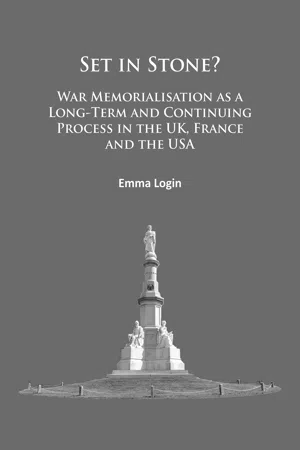
eBook - PDF
Set in Stone?
War Memorialisation as a Long-Term and Continuing Process in the Uk, France and the USA
- 196 pages
- English
- PDF
- Available on iOS & Android
eBook - PDF
Set in Stone?
War Memorialisation as a Long-Term and Continuing Process in the Uk, France and the USA
About this book
Information
Topic
ArchitectureSubtopic
ArchaeologyTable of contents
- Cover
- Copyright Information
- Contents
- List of Figures
- Abstract
- Introduction
- Figure 1.1 Japanese American Memorial to Patriotism during World War II (2000), Washington, D.C. USA.
- Figure 1.2 Entrance to the memorial and crane sculpture by Nina Akamu. The Japanese American Memorial to Patriotism during World War II (2000), Washington, D.C. USA. (Photograph by the author, 2012).
- Figure 1.3 Raised reflecting pool with five large rocks, the temple bell is visible on the top left of the memorial, and the quote ‘Here we admit a wrong. Here we affirm our commitment as a nation to equal justice under the law’ is inscribed on the wall.
- Figure 1.4 Three parallel timescales relating to the understanding of a war memorial at any given point in time: O-P: 1860 – 214 chronological timescale/ memorial tradition, CT: Time passed from conflict, MT: Time passed from memorial construction
- Figure 1.5 Chronological periods addressed within each chapter: Chapter 4: 1860-1914, Chapter 5: 1914-1939, Chapter 6: 1939-204
- Background and Literature
- Methodology
- Figure 3.1 Franco-Prussian War Memorial to the Prussian Infantry Regiment n.78 with surrounding graves visible behind the monument (circa 1871) near Flavigny, France . (Photograph by the author, 2012).
- Figure 3.2 Questions addressed during field research
- Figure 3.3 National Memorial Arboretum, (2001) Alrewas, Staffordshire, UK. (Photograph by the author, 2012)
- Figure 3.4 Historic postcard of First World War Memorial (1924), Sedan, France (Postcard collection of the author).
- Figure 3.5 German Franco-Prussian War Memorial with German symbolism defaced (circa 1871), near Vionville, France. (Photograph by the author, 2012)
- Figure 3.6 Interviews with individuals associated with memorials
- Early War Memorialisation Processes: O-P =1870-1914
- Figure 4.1 Three parallel timescales relating to the understanding of a war memorial at any given point in time: O-P: 1860 – 214 Chronological timescale CT: Time passed from conflict MT: Time passed from memorial construction
- Figure 4.2 Soldiers’ National Memorial, National Cemetery (cemetery 1963, monument 1869), Gettysburg, P.A., USA (Photograph by the author, 2012).
- Figure 4.3 Detail of individual grave markers at Soldiers’ National Memorial, National Cemetery (1864), Gettysburg, P.A., USA. (Photograph by the author, 2012)
- Figure 4.4 French and German Franco-Prussian War Memorials located opposite each other Cimetière du Faubourg (circa 1873), Mouzon France. (Photograph by the author, 2012)
- Figure 4.5 Joint French and German Franco Prussian War Memorials, (circa 1873) Villemontry France. (Photograph by the author, 2012) (The memorials have clearly been moved at some point during their history, but given the relationship between other similar
- Figure 4.6 French and German Franco-Prussian War memorials located opposite each other Cimetière Communal (1873), Mouzon France. (Photograph by the author, 2012).
- Figure 4.7 (Left) French and (Right) German memorials located opposite each other in Mouzon Cemetery (1873), Mouzon, France. (Photograph by the author, 2012).
- (begun 1878 and completed 1890) Bazeilles, France. (Photograph by the author, 2011).
- Figure 4.8 Memorial and ossuary, Cimetière St Charles (original circa 1878, reconstructed circa 1912), Sedan, France. (Photograph by the author, 2011).
- Figure 4.9 Ossuary, inside which are the visible remains of French victims of the conflict,
- Figure 4.10 The church of Bazeilles, following the Battle of Bazeilles, 1st September 1870.
- Figure 4.11 German memorials within the ossuary, Bazeilles, France (Photograph courtesy of John Carman).
- Figure 4.12 Monument marking the grave of Benjamin Eugene Commander and all French soldiers killed in the municipality of Gorze, (circa 1871) Gorze France (Photograph by the author, 2012).
- Figure 4.13 Memorial to the 5th Wisconsin Volunteer Infantry Regiment, (1888) Gettysburg, P.A. USA. (Photograph by the author, 2012).
- Figure 4.14 Franco-Prussian War memorials in the Cimetiére de Madeline, (Left) Soldiers Memorial , (Right) Memorial to Captain Jean-François Vogel (circa 1872) Amiens, France. (Photograph by the author, 2012).
- Figure 4.15 Detail of the Franco-Prussian War memorial demonstrating the numbered marker system, 1870 memorial, Cimetiére de Madeline, Amiens, France. (Photograph by the author, 2012).
- Figure 4.16 Royal Warwickshire Regiment Memorial Fountain in its original location in Chamberlain Square (circa 1930) Birmingham, UK.
- Figure 4.17 Royal Warwickshire Regiment Sudan Campaign memorial fountain, Birmingham Central Library, Birmingham, UK. (Photograph by the author, 2010).
- Figure 4.18 Original memorial to Lieutenant Joseph Felix Vever, rededicated to the Franco-Prussian War, (original circa 1855, rededication circa 1871) Cimetiére Saint-Simon, Metz , (Postcard collection of the author).
- Figure 4.19 Details of Franco-Prussian War Memorial, showing the original dedication to Lieutenant Vever who died during the C imean War, Cimetiére de l’Est, Metz, France. (Photograph by the author, 2012).
- Figure 4.20 Details of Franco-Prussian War Memorial, showing the subsequent dedication to those from Metz who died during the Franco-Prussian War Cimetiére de l’Est, Metz, France. (Photograph by the author, 2012).
- Figure 4.21 T.L. Dunkin Memorial (circa 1986), Manassas, V.A. USA. (Photograph by the author, 2012)
- Figure 4.22 Engraving of Bartow Memorial, (1861) Manassas National Battlefield Park, V.A. USA. (Image courtesy of Mahr, repost, Manassas National Battlefield Park. (Copy taken by the author with permission from the Manassas National Battlefield Park).)
- Figure 4.23 Remains of the Bartow Memorial, Manassas National Battlefield Park, V.A. USA
- Figure 4.24 Franco-Prussian War memorial (1875) Bazeilles, France. (Photograph by the author, 2011).
- Figure 4.25 Detail of civilian casualty list, Franco-Prussian War memorial (1875), Bazeilles, France
- Figure 4.26 Monument aux victims de l’explosion accidentelle de la Cartoucherie (1871), Dunkerque Cemetery (Photograph by the author, 2012).
- Figure 4.27 The Arsenal Memorial, Congressional Cemetery, (circa 1864), Washington D.C., United States
- Figure 4.28 Civil War Memorial (1909), Downtown Charlottesville, VA, USA. (Photograph by the author, 2012).
- Figure 4.29 Confederate Civil War Memorial, Confederate Cemetery (1893), Charlottesville, V.A. USA. (Photograph by the author, 2012).
- Figure 4.30 Detail of the engraving on Confederate Civil War Memorial, Charlottesville, V.A. USA.
- Figure 4.31 Franco-Prussian War Memorial, (1897) Sedan, France. (Photograph by the author, 2011).
- Figure 4.32 Detail of Franco-Prussian War Memorial relief panels, Sedan, France. Showing ‘ Maison de la dernière cartouche’ at Bazeilles (above) and ‘Charge des Chasseurs d’Afrique’ at Floing (below). (Photographs by the author, 2011).
- Figure 4.33 Memorial on the Rotunda, (1906) University of Virginia, Charlottesville, V.A. United States
- Figure 4.34 Clark’s Battery Memorial, Sickles Avenue, (1888) Gettysburg, P.A. National Battlefield Park, United States. (Photograph by the author, 2012).
- Figure 4.35 17th Maine Volunteer Infantry Regiment Monument, (1889) DeTrobriand Avenue, The Wheatfield, Gettysburg P.A. United States (Photograph by
- the author, 2012).
- Figure 4.36 Franco-Prussian War memorial commemorating the spot where Kaiser Wilhelm rested, Rezonville,
- Figure 4.37 Scene of Kaiser Wilhelm resting on a ladder from the back of the monumental bench
- Figure 4.38 German memorial, (circa 1900) Vionville, France (at the time part of the regions annexed by Germany) (Postcard collection of the author).
- Figure 4.39 Franco-Prussian War memorial to the 5th Division Prussian Infantry (circa 1900), near Rezonville, France (Postcard collection of the author).
- Figure 4.40 Memorial to historic events, (1873) Cassel, France. (Photograph by the author, 2012).
- Figure 4.41 Napoleonic War Memorial erected by the Souvenir Français (est1887) Place du Chateau, Gorze, France (annexed by Germany) (Photograph by the author, 2011).
- Figure 4.42 Napoleonic War Memorial erected by the Souvenir Français (circa 1887) Place du Chateau, Gorze, France (annexed by Germany) (Photograph by the author, 2011).
- Figure 4.43 Bataille de Bouvines Memorial, Bouvines (Nord) Colone, (1914) (Postcard collection
- Figure 4.44 Norman Cross Memorial (photograph taken 2012, memorial not in original location) (Photograph by the author, 2012).
- of the author).
- Figure 5.1 Three parallel timescales relating to the understanding of a war memorial at any given point in time: O-P: 1914-193 Chronological timescale CT: Time passed from conflict MT: Time passed from memorial construction A: Processes of engagement wit
- Post-First World War Memorialisation Processes: O-P = 1914-1939
- Figure 5.3 First World War memorial, in its parkland location (circa 1919) Kinver, Staffordshire.
- Figure 5.4 Common Wealth War Graves, Arras Cemetery, France (Photograph by the author, 2012)
- Figure 5.5 (Left) First World War Memorial, (circa 1918) Tanny, France and (Right) First World War (circa 1918) Memorial, Bellicourt, France, both with standardised poilus figure . (Photographs by the author, 2012).
- Figure 5.6 First World War memorial (1924), Sedan, France (Photograph by the author, 2011). For historic postcard of the memorials see Figure 3.3.
- Figure 5.7 First World War Memorial (1920), Gettysburg, P.A. United States. (Photograph by the author, 2012).
- Figure 5.9 Barrow-upon-Soar war memorial, (1921) provided a permanent memorial to individuals listed on the temporary memorial (Photograph by the author, 2014).
- Figure 5.10 First World War Memorial Sopwell Lane St Albans (1920-21). One of ten memorials erected in St Albans Abbely Parish which commemorates the dead of individual streets. (Image courtesy of John Carman).
- Figure 5.11 Victory parade through the Arc de Triomphe depicting temporary cenotaph (bottom right), Paris, France 14th July 1 19 (Postcard collection of the author).
- Figure 5.12 First World War Memorial listing the names of the dead, (circa 1918) Comines, France.
- Figure 5.13 First World War Memorial surrounded by individual memorial plaques, Comines, France (Photograph by the author, 2012).
- Figure 5.14 Individual plaques First World War memorial, Comines, France. (Photograph by the author, 2012).
- Figure 5.15 Pennsylvania State Memorial (1910), Gettysburg, P.A., United States (Photograph by the author, 2012).
- Figure 5.16 War Memorial 1214-1914, (1934) St Peter’s Church, Bouvines, France
- Figure 5.17 Original French First World War Memorial (1924), Metz (Postcard collection of the author).
- Figure 5.19 1870 Ossuary at Sedan, surrounded by First World War Graves. Cimetière St, Charles, Sedan, France. (Photograph by the author, 2011).
- Figure 5.20 First World War Memorial Window which includes earlier casualties from the Boer War St Mary’s Roman Catholic Church, Brewood, Staffordshire (Photograph courtesy of Paul Collins).
- Figure 5.21 First World War Memorial Plaque which includes earlier casualties from the Boer War St Mary’s Roman Catholic Church, Brewood, Staffordshire (Photograph courtesy of Paul Collins).
- Figure 5.23 Lieutenant James Gordon Keay, First World War Memorial, St Augustine of Hippo Church, Edgbaston,
- United Kingdom. (Photograph by the author, 2009).
- Figure 5.24 Kaiser Wilhelm memorial bench Franco-Prussian War, Rezonville, France. (For original see Figure 4.36. (Photograph by the author, 2012).
- Figure 5.25 French memorial, built onto German base Vionville (for original see Figure 4.40, photograph by the author, 2012).
- Figure 5.26 French postcard depicting the destruction of the equestrian statue of Kaiser Wilhelm, 18 November, 1918, Metz, Fra ce (Postcard collection of the author).
- Figure 5.27 Temporary statue of a French poilu erected on the base of the former Kaiser Wilhelm statue.
- Figure 5.28 Postcard depicting the original statue of Kaiser Wilhelm on the left and the First World War memorial erected in i s place on the right
- (Below) Detail of beheaded German eagle
- Figure 5.29 (Above) German Franco-Prussian War memorial near Vionville with German symbolism defaced
- Figure 5.30 (Above) German Franco-Prussian War memorial in its original condition and (Below) in its present (2012), Rezonville, France. (Postcard collection of author, photograph by the author, 2012).
- Figure 5.31 (Left) German Franco-Prussian War memorial original condition and (Right) in its present condition (2011), Gravelotte, France. (Postcard collection of author, Photograph by the author, 2011).
- Figure 5.32 (Above) German Franco- Prussian War memorial in its original condition and (Below) in its present condition (2012), Vionville, France. (Postcard collection of author, photograph by the author, 2012).
- Figure 5.33 ‘Heldenfriedhof’ monument , German First World War Memorial circa 1915, Cimetière Saint Charles, Sedan, France (Postcard collection of the author).
- Figure 5.34 German First World War Memorial, Cimetière Nord, Comines, France. (Photograph by the author, 2012).
- Figure 5.35 Heldenfriedhof’ monument , German First World War Memorial, 2012 Cimetière Saint Charles, Sedan, France (Photograph by the author, 2012).
- Figure 5.36 The destroyed village of Fleury devant Douaumont preserved as a memorial to the conflict.
- Figure 5.37 First World War memorial in the destroyed village of Vaux (1924),Vaux France.
- Figure 5.38 First World War memorial in the destroyed village of Fleury (circa 1920) near Douaumont, France.
- Figure 5.39 First World War Memorial, constructed next to original monument, Metz, France (1935)
- Figure 5.40 The temporary Guynemer monument (1934), Dunkerque on the front cover of the L’Illustation newspaper, August 1934. (Newspaper cover,
- Figure 5.41 Completed Memorial to Guynemer, (1938) Dunkerque, France, (Postcard collection of the author).
- collection of the author).
- Figure 5.42 Memorial to Francis Stebbings Bartow (1936), Manassas, V.A. (Photograph by the author, 2012).
- Figure 5.43 ‘Nuns of the Battlefield’ memorial, Washington D.C (1925) (Photograph by the author 2012)
- Figure 5.44 Eternal Light Peace Memorial, (1938), Gettysburg, Pennsylvania. United States. (Photograph by the author, 2012).
- Figure 6.1 Three parallel timescales relating to the understanding of a war memorial at any given point in time: O-P: 1939 –204 Chronological timescale, CT: Time passed from conflict, MT: Time passed from memorial construction, A: Processes of engagement
- Post-Second World War Memorialisation: O-P = 1939- 2014
- Figure 6.2 First World War Memorial, Codsall, Staffordshire, United Kingdom. with addition of Second World War memorial plaques. (Photograph by the author, 2012).
- Figure 6.3 First World War Memorial, Kinver Staffordshire, United Kingdom with Second World War names added to the obelisk, (Photograph by the author, 2012).
- Figure 6.4 First (Above) World War Memorial Douzy, France, with detail of addition of Second World War casualties to base (Below). (Photograph by the author, 2012).
- Figure 6.5 First World War Memorial with addition of Second World War memorial plaques. Bazeilles, France. (Photograph by the author, 2011).
- Figure 6.6 French War Memorial, Sablon, (1948) near Metz, France. (Photograph by the author, 2012).
- Figure 6.7 War Memorial in its present form, Metz, France (Photograph by the author, 2012).
- Figure.6.8 First World War Memorial in its present position following retrieval from the basement and restoration St Chads, Bi mingham, UK
- Figure 6.10 Fragment of original Guynemer Memorial incorporated into the 1989 monument, Dunkerque, France.
- Figure 6.9 Guynemer Memorial, outside the Musée de la Bataille de Dunkerque et de l’opération Dynamo (1989), Dunkerque, France (Photograph by the author, 2012).
- Figure 6.11 (Left) Guynemer memorial, 1989 outside the Musée de la Bataille de Dunkerque et de l’opération Dynamo . (Right) Detail of the Guynemer memorial 1989, depicting the original memorial. Dunkerque, France.
- Figure 6.12 New First World War Memorial, located in the centre of the village (circa 2010) Kinver, Staffordshire (Photograph by the author, 2012).
- Figure 6.13 War Memorial Kinver, Staffordshire. Original First World War Memorial with addition of gates to commemorate the ce tenary 1914-2014 (Photograph by the author, 2014).
- Figure 6.14 War Memorial (1995) in Cathedral grounds, Peterborough, Cambridgeshire, United Kingdom.
- Figure 6.15 First World War Memorial, Pearl Insurance, Peterborough. (Photograph of image exhibited at the unveiling of the memorial, taken by the author, 25th June 2012).
- Figure 6.16 New War Memorial on the high street (2012), Peterborough, Cambridgeshire, United Kingdom
- Figure 6.17 Peterborough War Memorial Fund, donors certificate. (Photograph by the author, 2012).
- Figure 6.18 Peterborough memorial dedication ceremony, 25th June, 2012. (Photograph by the author, 2012).
- Figure 6.19 The African American Civil War Memorial, (1997), Washington, D.C. (Photograph courtesy of
- Hari Jones, 2012).
- Figure 6.21 Women in Military Service for America Memorial, (1992), Arlington Cemetery, Washington, D.C.
- Figure 6.22 The Railway Industry Memorial, UK National Memorial Arboretum (2012), Alrewas, Staffordshire. (Photograph by the author, 2012).
- Figure 6.23 Australian Battle of Fromelles Memorial (1998), Fromelles France. (Photograph by the author, 2012).
- Figure 6.24 Australian Memorial to the Battle of Fromelles, Somme, France. (Photograph by the author, 2012).
- Figure 6.25 Japanese American Memorial to Patriotism during World War II (2000), Washington, D.C.
- Figure 6.26 Mike Masaoka quote on the Japanese American Memorial to Patriotism during World War II.
- Figure 6.27 Crane sculpture by Nina Akamu. The Japanese American Memorial to Patriotism during World War II, Washington, D.C. (Photograph by the author, 2012).
- Figure 6.28 Poppy cross left at Commonwealth
- Figure 6.29 Photographs left at Commonwealth
- War Graves Cemetery in Arras, France.
- War Graves in Arras Cemetery, France.
- Figure 6.30 First World War memorial plaques, Preston Museum and Art Gallery, Preston, UK
- Figure 6.31 First World War Memorial, Preston, UK. Light installation by Andy McKeown on Preston Cenotaph, specially commissio ed by the Preston Remembers project with the support of the Arts Council 23rd November 2013 (Photograph by the author, 2013).
- Figure 6.32 First World War Memorial, Preston, UK. Reverse illuminated with images of the deceased. Light installation by Andy McKeown on Preston Cenotaph, specially commissioned by the Preston Remembers project with the support of the Arts Council 23rd N
- Figure 6.33 Stourbridge First World War Memorial (1923) in its current location in Mary Stevens Park
- Figure 6.34 ‘Orphaned’ monuments, National Memorial Arboretum, London and Lancashire Insurance Company First World War Memorial (left), Phoenix Staff First World War Memorial (right) Alwreas, Staffordshire, United Kingdom (Photograph by the author, 201).
- Figure 6.35 ‘Orphaned’ memorial plaques at the National Memorial Arboretum. Alrewas, Staffordshire, United Kingdom. (Photograph by the author, 2011).
- Figure 6.36 Battlefield Memorial in the Ulster Memorial Tower. ‘In loving memory of LT. Wright Killed near this spot never forgottin [sic]’ (Photograph by the author, 2012).
- Figure 6.37 Photographs of memorial in its original location and of LT. Wright placed next to the memorial.(Photograph by the author, 2012).
- Figure 6.38 Memorial to General Margueritte in the Sedanese region of France. This memorial now forms part of a heritage memorial trail which documents the progression of the Battle of Sedan, 1870. (Photograph by the author, 2012).
- Figure 6.39 Information board outside the tourist information centre in Sedan, which describes the town in terms of its unfair victimhood (Photograph by the author, 2012).
- Figure 6.40 German memorial near the village of Floing, with interpretation board. (Photograph by the author, 2012).70
- Figure 6.41 The Memorial to Kaiser Wilhelm in its current state, Rezonville, France (Photograph by the author, 2012).
- Figure 6.42 The memorial as it is presented hidden behind a low hedge, Rezonville, France (Photograph by the author, 2012).
- Figure 6.43 Memorial plaque in remembrance of those who were imprisoned and died at the fort during the First World War (Photograph by the author, 2012).
- Figure 6.44 Heldenfriedhof First World War Memorial, Cimetière Saint Charles, Sedan, France.
- Figure 6.45 (Left) Heldenfriedhof First World War Memorial, interior and (Right) exterior, illustrating level of decay. Cime ière Saint Charles, Sedan, France. (Photograph by the author, 2012).
- Discussion
- Figure 7.1 The three parallel timescales relating to the understanding of a war memorial at any given point in time: O-P: 1860 – 2014 Chronological timescale, CT:Time passed from conflict, MT:Time passed from memorial construction
- Figure 7.2 The chronological development of the war memorial tradition: O-P:1860 – 2014 Chronological timescale/ memorial tradition, CT:Time passed from conflict, MT:Time passed from memorial construction, x₁ :Point during the memorial tradition in which
- Figure 7.3 (Left) Detail of Franco-Prussian War Memorial, Sedan, France. (Right) Confederate War Memorial, Charlottesville Virginia (Photographs by the author, 2012).
- Figure 7.4 Vietnam Veterans Memorial (1982), Maya Lin Washington, D.C. United States (Photograph by the author, 2012).
- Figure 7.5 Diagram illustrating the importance of the time that has passed from the conflict itself: O-P: 1860 – 2014 Chronological timescale, CT: Time passed from conflict, MT: Time passed from memorial construction, AM: Period of autobiographical memor
- Figure 7.6 (Left) War Memorial, Kinver, Staffordshire. New First World War Memorial, located in the centre of the village (Photograph by the author, 2012). (Right) The African American Civil War Memorial, 1997, Washington, D.C. (Photograph courtesy of Ha
- Figure 7.7 (Left) Battle of Bouvines Memorial 1914, Bouvines, France (Nord) Colone. (Middle) Norman Cross Memorial, 1914 near Peterborough, Cambridgeshire, United Kingdom. (Right) Napoleonic Memorial (circa 1887) Gorze, France.
- Figure 7.8 The biography of a memorial: CT: Time passed from conflict, MT: Time passed from memorial construction, IT: Idea to construct a memorial is first conceived, DT: Destruction of the memorial
- Figure 7.9 (Above) First World War Memorials, Metz, France original memorial, (Below) Second First World War memorial (contemporary photograph, original memorial contained reliefs and inscriptions, see 5.3.2) (Postcard collection of the author, photgraph
- Figure 7.10 (Above) Original First World War memorial in parkland location. (Below) Second First World War memorial in village location, Kinver, Staffordshire, UK.
- Figure 7.11 Position marker on the Battlefield of Manassas (Position 7th C.A. Regt Captured Pickett’S Battery July 21 1861) (Photograph by the author, 2012).
- Figure 7.12 French and German Franco-Prussian War memorial located opposite each other Cimetière du Faubourg, Mouzon France. (Photograph by the author, 2012).
- Figure 7.13 Napoleonic War Memorial erected by the Souvenir Français on the site of a hospital used by the French military during the Napoleonic War (Photograph by the author, 2012).
- Figure 7.14 (Left) First World War Memorial Plaques, Preston Museum. (Right) Light Show projecting names onto the Preston Wa Memorial 23rd November 2013. (Photographs by the author, 2013).
- Figure 7.15 (Left) First World War Memorial surrounded by individual memorial plaques, Comines, France. (Right) Photographs left at Commonwealth War Graves in Arras Cemetery, France.
- Conclusion
- Appendix 1
- Questionnaires
- Appendix 2
- Historical Background to the Initial Development of the
- War Memorial Tradition
- 17th Maine Memorial, Gettysburg
- Appendix 3
- Bibliography
- Back Cover
Trusted by 375,005 students
Access to over 1.5 million titles for a fair monthly price.
Study more efficiently using our study tools.
Frequently asked questions
Yes, you can cancel anytime from the Subscription tab in your account settings on the Perlego website. Your subscription will stay active until the end of your current billing period. Learn how to cancel your subscription
No, books cannot be downloaded as external files, such as PDFs, for use outside of Perlego. However, you can download books within the Perlego app for offline reading on mobile or tablet. Learn how to download books offline
Perlego offers two plans: Essential and Complete
- Essential is ideal for learners and professionals who enjoy exploring a wide range of subjects. Access the Essential Library with 800,000+ trusted titles and best-sellers across business, personal growth, and the humanities. Includes unlimited reading time and Standard Read Aloud voice.
- Complete: Perfect for advanced learners and researchers needing full, unrestricted access. Unlock 1.5M+ books across hundreds of subjects, including academic and specialized titles. The Complete Plan also includes advanced features like Premium Read Aloud and Research Assistant.
We are an online textbook subscription service, where you can get access to an entire online library for less than the price of a single book per month. With over 1.5 million books across 990+ topics, we’ve got you covered! Learn about our mission
Look out for the read-aloud symbol on your next book to see if you can listen to it. The read-aloud tool reads text aloud for you, highlighting the text as it is being read. You can pause it, speed it up and slow it down. Learn more about Read Aloud
Yes! You can use the Perlego app on both iOS and Android devices to read anytime, anywhere — even offline. Perfect for commutes or when you’re on the go.
Please note we cannot support devices running on iOS 13 and Android 7 or earlier. Learn more about using the app
Please note we cannot support devices running on iOS 13 and Android 7 or earlier. Learn more about using the app
Yes, you can access Set in Stone? by Emma Login in PDF and/or ePUB format, as well as other popular books in Architecture & Archaeology. We have over 1.5 million books available in our catalogue for you to explore.