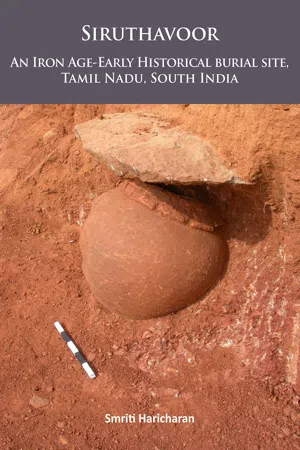
Archaeological artifacts such as stone tools, ceramics, coins, metal implements, and ornaments like beads, are generally used to evaluate and understand the history of humans. These artifacts are especially important for the study of periods that lack concrete literary evidence. Intangible aspects such as spiritual beliefs and ceremonies, as well as tangible but perishable objects, are lost in the passage of time but artifacts are more likely to survive the vicissitudes of time. Pollen analysis, plant ecology and not least prehistoric archaeology have contributed to the recognition of the transitional zone between uncontaminated nature and what eventually became known as a cultural landscape. Cultural landscapes are looked upon not only as products of human intervention, but also and in particular as the result of human desire to leave an imprint of control and power, often associated with territoriality and religious or political ambitions. Megalithic burials, which are found in vast numbers in southern and central India, are a well-known global phenomenon and their builders have left behind a landscape altered by their funereal remains. This study aims at using and understanding man-land relationships in order to better comprehend the megalithic burials of Tamil Nadu. Funereal remains are one of the most important lingering means of understanding society, customs and religion of pre and proto historic periods. Many questions remain unanswered for the Iron Age of south India, and the megalithic burials are an important piece of this puzzle. This site specific study helps us better understand some aspects such as spatial distribution, chronology and post depositional changes of the burials at Siruthavoor.
eBook - PDF
Siruthavoor: An Iron Age-Early Historical burial Site, Tamil Nadu, South India
- 106 pages
- English
- PDF
- Available on iOS & Android
eBook - PDF
Siruthavoor: An Iron Age-Early Historical burial Site, Tamil Nadu, South India
About this book
Information
Table of contents
- Cover
- Title Page
- Copyright Page
- Contents
- List of Figures
- List of Tables
- Acknowledgment
- Preface
- Chapter 1 Introduction
- Figure 1.2 Map showing excavated sites in Tamil Nadu (map prepared by Kelly G and Haricharan S. 2010).
- Table 1.1 Correlation between sites and type of burial of coastal sites in Tamil Nadu
- Table 1.2 Correlation between site and artifact excavated of coastal sites in Tamil Nadu
- Table 1.3 Correlations between sites and type of burial of inland sites in Tamil Nadu
- Table 1.4 Dates from Previously Excavated IA-EH Sites
- Table 1.5 Classification of burials put forward by several archaeologists
- Chapter 2 Siruthavoor: An Iron Age-Early Historic site
- Figure 2.1 The study area: Siruthavoor
- Figure 2.2 Study area showing 1. encroachment, 2. dolmen with circle and 3. Siruthavoor Lake
- Figure 2.3 Exposed Statigraphic sections at Siruthavoor
- Table 2.1 Stratigraphy of the Siruthavoor site
- Table 2.2 Major plant varieties found around Chennai
- Figure 2.4 Large areas of the site destroyed due to natural and anthropogenic activities
- Table 2.3 Some varieties of Acacia found growing around Chennai
- Chapter 3 Methodology
- Figure 3.1 Flow chart showing the different methodologies adopted for understanding the formation of the site
- Chapter 4 Exploration and Excavation at Siruthavoor
- Figure 4.1 Study area Siruthavoor and other IA-EH sites around Siruthavoor
- Figure 4.2 Site Sirukunram: Cairn Circle
- Figure 4.3 Dolmen with curved cairn circle stones at Siruthavoor
- Figure 4.4 Dolmen with curved cairn circle stones at Amur
- Figure 4.5 Dolmen very low in Siruthavoor with 2 large slabs as capstone
- Figure 4.6 Dolmen very low in Amur with 2 large slabs as capstone
- Figure 4.7 Dolmen at Amur with anti-chamber and large flat boulder as capstone
- Table 4.1. Individual type of burial and their number
- Figure 4.10 Capstone at Amur showing signs of being shaped
- Figure 4.11 Capstone from Siruthavoor with a line of holes probably for cutting or shaping of stone
- Figure 4.8 Dolmen at Siruthavoor with anti-chamber and large flat boulder as capstone
- Figure 4.9 Gnranatic Gneiss and Charnokite used for IA-EH burials at Siruthavoor
- Figure 4.12 Map of Siruthavoor showing all the burial types including cairn circle, dolmen, cist, dolmen with circle, cist with circle and dolmenoid cist
- Figure 4.13 Over all map of Siruthavoor (close up) showing the spatial outlay of all IA-EH burials at Siruthavoor
- Figure 4.14 Spatial outlay cist and cist with circle type burial at Siruthavoor
- Figure 4.15 Spatial outlay of dolmen and dolmen with circle type burials at Siruthavoor
- Figure 4.16 Spatial outlay of cist with circle and dolmen with circle type burials at Siruthavoor
- Figure 4.17 Spatial outlay of dolmen, cist and dolmenoid cist type of burials at Siruthavoor
- Figure 4.18 Spatial outlay of cairn circle type burials at Siruthavoor
- Figure 4.19 Spatial outlay of cist type burials at Siruthavoor
- Figure 4.20 Spatial outlay cist with circle type burials at Siruthavoor
- Figure 4.21 Spatial outlay of dolmen with circle type burials at Siruthavoor
- Figure 4.22 Spatial outlay of dolmen type burial at Siruthavoor
- Figure 4.23 cairn circle with lateritic blocks outside circle
- Figure 4.24 Cairn circle around hillock showing overlap of burials
- Figure 4.25 Dolmen with low/flush capstone
- Figure 4.26 Dolmen with circle, dolmen has five stones supporting the capstone and is circular shaped
- Figure 4.27 Low dolmen with long slabs as capstone
- Figure 4.28 Dolmen with long boulder shaped stones
- Figure 4.29 Dolmen with outcrop, and open on two sides
- Figure 4.30 Dolmen with symbolic features and outcrop used as part of a dolmen
- Figure 4.31 Dolmenoid cist showing swastika pattern and roughly shaped stones
- Figure 4.32 Dolmenoid cist with swastika pattern at Amur
- Figure 4.33 Cist burial situated northwest of Siruthavoor Lake with swastika pattern clearly visible on the surface
- Figure 4.34 Cist burial with one orthostat higher above ground than rest
- Figure 4.35 Exposed section showing cist burial
- Figure 4.36 exposed section of cist burial with sarcophagus and urn seen
- Figure 4.37 Iron implements found near disturbed cist burials during exploration
- Figure 4.38 Map showing distribution of lithosection at Sairuthavoor
- Figure 4.39 Graph of lithosections 1-5
- Figure 4.40 Image showing lithosections 1-5 at Siruthavoor
- Figure 4.41 Distribution of excavated burials and lithosection at Siruthavoor
- Figure 4.42 Plan of Burial 1 at Siruthavoor, situated close to the lake, having an extra stone inside the cairn circle in the east
- Figure 4.43 Statigraphy of burial 1 eastern section
- Figure 4.44 Southwestern quadrant with coarse Red Ware pottery
- Figure 4.45 Western quadrant showing sarcophagus
- Figure 4.46 Burial 1 after excavation of eastern and western quadrants showing stone assemblage in the centre
- Figure 4.47 Burial 2:Exposed sarcophagus with remnants of lid
- Figure 4.48 Iron implements and beads from excavated burials at Siruthavoor
- Figure 4.49 Burial 3: Cist type burial with fourth orthostat disturbed
- Figure 4.50 Outside cist, cairn packing on eastern and south eastern areas
- Figure 4.51 Slab on top of cist with cairn packing on top with slab in eastern side
- Figure 4.52 Cist with pottery
- Figure 4.53 Iron implements from burial 3, sword like object and 2 large iron slabs found near sarcophagus inside cist
- Figure 4.54 Sarcophagus, large iron implements and Red Ware stand
- Figure 4.56 Sarcophagus of cist with stone below legs to balance the structure
- Figure 4.57 sarcophagus from cist with associated grave goods
- Figure 4.58 Burial 4: dolmen associated with outcrop, next to smaller hillock
- Figure 4.59 Burial 4 showing association with outcrop
- Figure 4.60 Burial 5: Dolmen in pentagon/circular shape with two triangular stones in the east
- Figure 4.61 Burial 5 with stone packing between boulders below captsone
- Figure 4.62 Gold ring from burial 5
- Figure 4.63 Sarcophagi A, B and C within burial 5 with remains of lid on top
- Figure 4.64 Bedrocks on which sarcophagi were kept in burial 5
- Figure 4.65 Dolmenoid cist type burial, burial 6
- Figure 4.68 Burial 7, urn with capstone
- Figure 4.69 Urn with inverted lid on top burial 8
- Chapter 5 Results
- Table 5.1 Textural analysis of burial 1
- Table 5.2 Textural Analysis of Burial 2
- Table 5.3 Textural Analysis of Burial 3
- Table 5.4 Textural analysis of burials 4, 5, 7 and 8
- Table 5.5 Textural analysis of lithosection 1
- Figure 5.1 Trilinear diagram of sediments from burial 1
- Figure 5.2 Trilinear diagram of sediments from burial 2
- Figure 5.3 Trilinear diagram of sediments from burial 3
- Figure 5.4 Trilinear diagram of sediments from burial’s 4,5,7 and 8
- Figure 5.5 Trilinear diagram of sediments from lithosection 1
- Table 5.6 Statistically analyzed sieving data of Burial 1
- Table 5.7 Statistically analyzed sieving data of Burial 2
- Table 5.8 Statistically analyzed sieving data of Burial 3
- Table 5.9 Statistically analyzed sieving data of Burial’s 4, 5,7 and 8
- Table 5.10 Statistically analyzed sieving data of Lithosection 1 1
- Table 5.12 Major elemental data of Burial 2
- Table 5.14 Major elemental data of burial 4,5, 7 and 8
- Table 5.15 Major elemental data of lithosection 1
- Table 5.16 Major elemental and CIA data of burial 1
- Table 5.17 Major elemental and CIA data of burial 2
- Table 5.18 Major elemental and CIA data of burial 3
- Table 5.19 Major elemental and CIA data of burial 4, 5, 7 and 8
- Figure 5.6 The figure represents depth (cm) versus ratios Al203 /FeO, Si/Al and LOI, CIA, SiO2, Al203 indicating geochemical break between 70-80 cm
- Table 5.20 Major elemental and CIA data of lithosection 1
- Table 5.21 Trace metal data of sediment samples of burial 1
- Table 5.22 Trace metal data of sediment samples of burial 2
- Table 5.23 Trace metal data of sediment samples of burial 3
- Table 5.24 Trace metal data of sediment samples of burial 4, 5, 7 and 8
- Table 5.25 Trace metal data of sediment samples of lithosection 1
- Table 5.26 OSL dates of pottery
- Figure 5.7 Ni versus Cr values of burial sediments and lithosection 1 indicate local source and post Archaean origin
- Figure 5.8 Red Ware stand from Burial 3 with graffiti mark at the base
- Figure 5.10 Pottery from Burial 3 showing graffiti marks
- Figure 5.9 Black and Red Ware cup from burial 7
- Figure 5.11 REE data normalized using PASS values of clay samples from Siruthavoor and a potter from Chennai
- Table 5.27 REE data normalized using PAAS values of clay samples from Siruthavoor and a present day potter from Chennai
- Table 5.28 REE data normalized using PASS values of pottery samples from burials 1, 5, 7 and 8
- Figure 5.12 REE data normalized using PASS values of pottery samples from burials 1, 5, 7 and 8
- Figure 5.13 Shapes of Various pottery pieces from Siruthavoor excavation
- Figure 5.14 (a-d) Photomicrographs of the potsherd thin sections
- Figure 5.14 (e-j) Photomicrographs of the potsherd thin sections
- Figure 5.14 (k-l) Photomicrographs of the potsherd thin sections
- Chapter 6 Discussion and Conclusion
- Table 6.1 Dates from excavated burial pottery
- Figure 6.1 Plan of IA-EH burials at Ramalai, in Upper Palar region (after Darshana 1997)
- Figure 6.2 Plan of IA-EH burials at Kargur, in Upper Palar region (after Darshana 1997)
- Figure 6.3 Plan of IA-EH burials at Pogalur, in Upper Palar region (after Darshana 1997)
- Figure 6.4 Plan of IA-EH burials at Poongulam, in Upper Palar region (after Darshana 1997)
- Figure 6.5 Plan of IA-EH burials of Kodumanal (after Rajan 1997)
- Figure 6.6 Plan of Brahmagiri, with Area A,B and C marked and spatially separated from each other (after Wheeler 1948)
- Figure 6.7 Plan of Area’s B and C of Brahmagiri (after Wheeler 1948)
- Figure 6.8 Different types of dolmen from Siruthavoor, using long dressed and undressed slabs
- Figure 6.9 Different cairn circle burials at Siruthavoor located in different areas of the site
- References
- Back cover
Trusted by 375,005 students
Access to over 1.5 million titles for a fair monthly price.
Study more efficiently using our study tools.
Frequently asked questions
Yes, you can cancel anytime from the Subscription tab in your account settings on the Perlego website. Your subscription will stay active until the end of your current billing period. Learn how to cancel your subscription
No, books cannot be downloaded as external files, such as PDFs, for use outside of Perlego. However, you can download books within the Perlego app for offline reading on mobile or tablet. Learn how to download books offline
Perlego offers two plans: Essential and Complete
- Essential is ideal for learners and professionals who enjoy exploring a wide range of subjects. Access the Essential Library with 800,000+ trusted titles and best-sellers across business, personal growth, and the humanities. Includes unlimited reading time and Standard Read Aloud voice.
- Complete: Perfect for advanced learners and researchers needing full, unrestricted access. Unlock 1.5M+ books across hundreds of subjects, including academic and specialized titles. The Complete Plan also includes advanced features like Premium Read Aloud and Research Assistant.
We are an online textbook subscription service, where you can get access to an entire online library for less than the price of a single book per month. With over 1.5 million books across 990+ topics, we’ve got you covered! Learn about our mission
Look out for the read-aloud symbol on your next book to see if you can listen to it. The read-aloud tool reads text aloud for you, highlighting the text as it is being read. You can pause it, speed it up and slow it down. Learn more about Read Aloud
Yes! You can use the Perlego app on both iOS and Android devices to read anytime, anywhere — even offline. Perfect for commutes or when you’re on the go.
Please note we cannot support devices running on iOS 13 and Android 7 or earlier. Learn more about using the app
Please note we cannot support devices running on iOS 13 and Android 7 or earlier. Learn more about using the app
Yes, you can access Siruthavoor: An Iron Age-Early Historical burial Site, Tamil Nadu, South India by Smriti Haricharan in PDF and/or ePUB format, as well as other popular books in Social Sciences & Archaeology. We have over 1.5 million books available in our catalogue for you to explore.