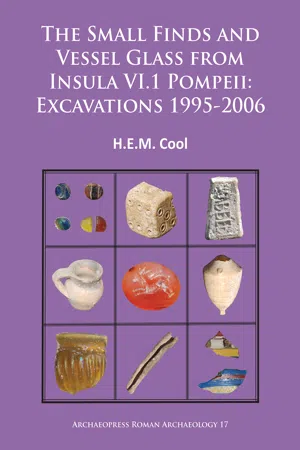
eBook - PDF
The Small Finds and Vessel Glass from Insula VI.1 Pompeii: Excavations 1995-2006
- 339 pages
- English
- PDF
- Available on iOS & Android
eBook - PDF
The Small Finds and Vessel Glass from Insula VI.1 Pompeii: Excavations 1995-2006
About this book
This report presents the vessel glass and small finds found during the excavations between 1995 and 2006 that took place in Insula VI.1, Pompeii (henceforth VI.1). More than 5,000 items are discussed, and the size of the assemblage has meant that the publication is in two parts. The book you are reading consists of the discussion with associated illustrations and the catalogue entries for a subset of the data. The other half is available digitally on the Archaeological Data Service. That part contains the full catalogue of the material recorded, additional contextual information, and details about the initial excavations of the insula during the eighteenth century.
Information
Table of contents
- Cover
- Contents
- Title Page
- Copyright Page
- Dedication
- List of Figures
- List of Tables
- List of illustrations used for the chapter headings
- Preface
- Acknowledgements
- Chapter 1
- Chapter 1. The elaborate bronze vessel found in pieces within the Inn Bar in December 1784 and published by Giovambatistia Finati in volume 8 of the Museo Borbonico in 1832.
- Figure 1.1. Location of Insula VI.1. 1: Bay of Naples with the local sites mentioned in the text. 2. Plot locations and names in Insula VI.1 with location of insula within Pompeii shown in inset.
- Figure 1.2. The area excavated and location of AAs within the Inn and Triclinium.
- Figure 1.3. The area excavated and location of AAs within the Casa delle Vestali and Vestals Bar.
- Figure 1.4. The area excavated and location of AAs within the Casa del Chirurgo.
- Figure 1.5. The area excavated and location of AAs within the Shrine.
- Figure 1.6. The area excavated and location of AAs within the Workshop, Bars of Acisculus and Phoebus, and the Well and Fountain area.
- Figure 1.7. The archaeological areas excavated in the sidewalk areas.
- Figure 1.8. The locations of the Pompeian insulae and gates mentioned in the text.
- Chapter 2
- Chapter 2. A selection of ivory hair pins published by F. Ab. Avellino in volume 9 of the Museo Borbonico in 1833. As discussed in Chapter 1, this image was to be re-used many times over the century and a half that followed.
- Figure 2.1. Unguiform (1), Jezerine (2-5) and La Tène II type (6) brooches with miscellaneous sprung pin fragments (9-10). Copper alloy – 1-6, 10; silver – 9. Scale 1:1.
- Table 2.1. The brooches by period.
- Figure 2.2. Alesia (11-13) and Aucissa (14-6) brooches with miscellaneous hinged brooch pin (17). Composite – 11-3; copper alloy – 14-7. Scale 1:1.
- Figure 2.3. Buckles. Copper alloy. Scale 1:1.
- Figure 2.4. Buckle plates. Copper alloy. Scale 1:1.
- Figure 2.5. Button and loop fasteners. Copper alloy. Scale 1:1.
- Figure 2.6. Baluster fittings. Bone. Scale 1:1.
- Figure 2.7. Phallic toggles or pendants. Bone. Scale 1:1.
- Figure 2.8. Hair pins. Bone – 47-51, 54, 56; ivory - 52, 57). Scale 1:1.
- Figure 2.9 Ear rings . Copper alloy and ivory – 58; gold and pearl – 60. Scale 1:1.
- Figure 2.10. Beads. Emerald – 61-3; cornelian – 64; pearl – 65; unidentified – 66; glass – 67-78, 80, 81, 83-4, 87, 89, 92-4; 02, 103, 106, 108. Scale 1:1.
- Table 2.2. The monochrome glass beads by colour and type. (Nos 88 and 106 excluded). Abbreviations: Ann 8+ - annular diameter more than 8mm, Ann <8 – annular diameter more than 8mm, LC – long cylindrical, Misc. – miscellaneous, Op. - opaque.
- Figure 2.11. Beads. Faience – 109, 113-4; bone – 118, 121-2, 127, 130, 138; ivory – 126, 128, 133, 137; metal – 139-40; fired clay – 141. Scale 1:1.
- Figure 2.12. Phallic amulets. Silver – 142; coral – 143. Scale 1:1.
- Figure 2.13. Finger rings, copper alloy – 144-6, 148, 150; silver – 147. Scale 1:1.
- Figure 2.14. Intaglios. Glass – 151, 154, 160; cornelian – 152, 158, 161; garnet – 153; agate – 157; unidentified – 159. Scale: line drawings 1:1, photographs of stone and impressions 2:1.
- Figure 2.15. Miscellaneous jewellery elements. Gold – 165; copper alloy – 166-8; shell – 169-70. Scale: 165 2:1, all other items 1:1.
- Table 2.3. The larger categories of personal equipment by site phase. The table excludes those items from contexts where there is reason to suspect intrusion (indicated by ‘*’ and discussed in text), and includes the ear ring pendant no. 60 in the stone a
- Table 2.4. The larger categories of the personal equipment and jewellery by plot. (This table includes the unphased and the possibly intrusive material).
- Chapter 3
- Chapter 3. Two pyxides of ivory decorated with cupids and one of rock crystal published by F. Ab. Avellino in volume 9 of the Museo Borbonico in 1833.
- Table 3.1. Blown unguent bottles by type and colour quantified by weight (g).
- Table 3.2. Blown unguent bottles by type and colour quantified by EVEs.
- Figure 3.1. Glass unguent bottles. Core-formed – 1, 3; blown – all others. Scale; core-formed 1:1, all others 1:2.
- Table 3.3. Distribution of blown unguent bottles through time, quantified by weight in g. and EVEs. (The complete ovoid unguent bottle no. 53 from a modern context is omitted).
- Table 3.4. Distribution by plot of blown glass unguent bottles. (The difference between the totals here and in Tables 3.1-2 reflect the fact that there are fragment which have not retained their context numbers).
- Figure 3.2. Ceramic unguent bottles. Scale 1:2.
- Table 3.5. Ceramic unguent bottles by category and time, weight in g. Abbreviations: Ped – pedestal; Glob – globular.
- Table 3.6. Ceramic unguent bottles by category and plot, weight in g. (The slight difference in the totals between this table and Table 3.5 is accounted for by rounding the original measurement (two decimal points) to one decimal point, and the exclusion
- Figure 3.3. Alabaster unguent bottles. Scale 1:1.
- Figure 3.4. Pyxides and other lidded containers. Glass – 91-2; ivory – 93; alabaster – 94-5. Scale 1:1.
- Table 3.7. A comparison of the mean and median weights (g.) of different unguent bottle types.
- Table 3.8. A comparison of the glass and pottery unguent bottles from selected plots quantified by weight (g.) and EVEs.
- Chapter 4
- Chapter 4. Bronze bathing equipment from Pompeii published by Giovambatistia Finati in volume 7 of the Museo Borbonico in 1831. Another image frequently re-used in the years since.
- Figure 4.1. Strigils. Copper alloy. Scale 1:1
- Figure 4.2. Bath flask fittings. Glass and copper alloy – 3; copper alloy – 4. Scale 1:1.
- Figure 4.3. Copper alloy mirrors (5-6) and pietre pomice (8-9). Scale 1:1.
- Figure 4.4. Copper alloy tweezers (10-12) and composite (?) cosmetic set (13). Scale 1:1.
- Figure 4.5. Long-handled implements. Bone – 14-9, 22; copper alloy – 20, 23-4. Scale 1:1.
- Figure 4.6. Stone palette (26) and bone box fitting (27). Scale 1:1.
- Figure 4.7. Copper alloy dissector. Scale 1:1.
- Figure 4.8. Glass stirring rods. Scale 1:1.
- Table 4.1. The glass stirring rods by period. (Note one unphased bichrome example omitted).
- Table 4.2. The toilet equipment by period. (For categories see text).
- Table 4.3. The toilet equipment by plot. (Abbreviations of categories – Fem – Female equipment, Bath. – Bathing equipment, Stir. Rod – Stirring rods. For categories see text.)
- Chapter 5
- Chapter 5. Glass vessels from Pompeii published by Bernardo Quaranta in volume 5 of the Museo Borbonico in 1829.
- Table 5.1. Types of cast glass by weight (g.). (Abbreviations used for colour: M – Monochrome; P – Bichrome or polychrome).
- Table 5.2. Types of cast glass by fragment count. (Abbreviations as in Table 5.1).
- Table 5.3. Incidence of cast grooved and linear-cut bowls by colour and phased context quantified by weight (g,) and fragment count. Abbwreviations: Wt – weight; fr - fragment count; D – dark; GT – green-tinged.
- Figure 5.1. Canosa (1), grooved and linear-cut cast glass bowls. Scale 1.2.
- Figure 5.2. Cast glass bowls ‘à décor végétal’ (39) and ‘à décor cannelé’ (40). Scale 1:2.
- Table 5.4. Incidence of cast ribbed and pillar moulded bowls by colour and phased context quantified by weight (g,) and fragment count. Abbreviations as for Table 5.3.
- Table 5.5. A comparison of ribbed and pillar moulded bowls through time quantified by weight (g.).
- Figure 5.3. Ribbed (41-3, 45, 47-8) and pillar moulded (52, 56, 82-3) cast glass bowls. Scale 1:2.
- Table 5.6. Distribution of colours of monochrome pillar moulded bowls by phase, quantified by weight (g.).
- Figure 5.4. Millefiori, mosaic and marbled cast glass vessels. Scale 1:2 unless otherwise stated.
- Table 5.7. Type 2 cast vessels by colour and type quantified by weight (g.). Abbreviations: I – Isings Form; G – Gorga Form; Han – handle; Fla – flask; BR – base ring.
- Table 5.8. Type 2 cast vessels by context date and type quantified by weight in (g.). Abbreviations as in Table 5.7.
- Table 5.9. Type 2 cast vessels by context date and type quantified by fragment count. Abbreviations as in Table 5.7.
- Figure 5.5. Petrianna Gruppo 2 cast glass vessels. Scale 1:2.
- Table 5.10. Colours of the stratified Type 2 cast vessels by context date quantified by weight (g.).
- Figure 5.6. Other colourless cast glass vessels. Scale 1:2.
- Table 5.11. Summary of the blown glass by type and through time quantified by weight (g.).
- Figure 5.7. Wheel-cut cups and beakers. Blown glass. Scale 1:2.
- Table 5.12. The colours of drinking vessels with cracked off rims and abraded or wheel-cut lines through time, quantified by weight (g.) and fragment count. Abbreviations as in Table 5.3.
- Table 5.13. Distribution of different types of drinking vessels with cracked off rims and abraded or wheel-cut lines through time, quantified by weight (g.) and EVE measures.
- Figure 5.8. Abraded and ‘plain’ cups and beakers. Blown glass. Scale 1:2
- Figure 5.9. Bichrome cylindrical beaker (226) and ribbed cups. Blown glass. Scale 1:2
- Table 5.14. The colours of the blown ribbed cups quantified by weight (g.) and fragment count. Abbreviations as in Table 5.3.
- Table 5.15. Distribution of the different types of blown ribbed cups through time, quantified by weight (g.) and EVE measures.
- Table 5.16. The colours of the mould blown beakers, indented beakers, and fire-rounded rim vessels quantified by weight (g.) and fragment count.
- Table 5.17. Distribution of mould blown beakers (MB), indented beakers, externally ground (Ex Gr) and fire-rounded rim vessels (FR) through time, quantified by weight (g.) and EVE measures where appropriate.
- Figure 5.10. Mould blown glass vessels. Scale 1:2.
- Figure 5.11. Indented beakers. Blown glass. Scale 1:2.
- Figure 5.12. Externally ground colourless beakers. Blown glass. Scale 1:2.
- Figure 5.13. Glass vessels with fire-rounded rims. Blown glass. Scale 1:2.
- Figure 5.14. Tubular-rimmed bowls and cups. Bowl glass. Scale 1:2.
- Figure 5.15. Rim diameters of the tubular-rimmed cups, bowls and dishes from Insula VI.1.
- Table 5.18. The colours of the tubular-rimmed bowls, dishes and cups.
- Table 5.19. The distribution of the tubular-rimmed bowls, dishes and cups through time, quantified by weight (g.) and EVEs. Abreviations: Deep Y/B – deep yellow brown; Emerald G = emerald green; Y/Brown – yellow brown;. NB Colourless is green-tinged.
- Table 5.20. The distribution of the handled cups through time, quantified by weight (g.) and EVEs where appropriate.
- Figure 5.16. Handled cups. Blown glass. Scale 1:2.
- Figure 5.17. Jars. Blown glass. Scale 1:2.
- Figure 5.18. Jugs. Blown glass. Scale 1:2.
- Table 5.21. The colours of the jugs, flasks, bottles and unguent bottles, quantified by weight (g.) and fragment count.
- Table 5.22. The distribution of the jugs, flasks, bottles and unguent bottles through time quantified by weight (g) and EVEs. Abbreviations: nm – not measurable.
- Figure 5.19. Flasks. Blown glass. Scale 1:2.
- Figure 5.20. Bottles. Blown glass. Scale 1:2.
- Figure 5.21. Funnels. Blown glass. Scale 1:2.
- Table 5.23. The colours of the different types of bases quantified by weight (g.) and fragment count. Abbreviations: nr – not recorded.
- Table 5.24. The distribution of the base fragments through time quantified by weight (g) and fragment count. Abbreviations: n – not recorded.
- Figure 5.22. Miscellaneous bases. Blown glass. Scale 1:2.
- Table 5.25. The distribution of copper alloy vessel feet through time and across the plots.
- Figure 5.23. Vessel feet with concave ends. Copper alloy. Scale 1:1.
- Figure 5.24. Vessel feet with peltate ends. Copper alloy. Scale 1:1.
- Figure 5.25. Vessel handles (440-45) and escutcheons (446-7). Copper alloy. Scale 1:1.
- Figure 5.26. Vessel handles. Copper alloy. Scale 1:1.
- Figure 5.27. Other copper alloy vessel fragments. Copper alloy. Scale 1:1.
- Table 5.26. The proportion of diagnostic cast and blown vessel glass in selected levelling deposits quantified by weight (g.) and row percentages.
- Table 5.27. Types of glass vessels in selected levelling deposits compared to the eruption level data set. The VI.1 material quantified by EVEs. The presence of forms which could not have an EVE measure assigned is shown by ‘+’. Both totals are also sho
- Table 5.28. Colours of blown glass from the selected levelling deposits compared with the eruption level data set. The VI.1 ma erial has been quantified by number of contexts with each colour in.
- Table 5.29. The distribution of selected categories of glass vessels by plot quantified by EVEs. The data is presented as row percentages which may not sum to 100 because of rounding. The bottom three rows in bold show; (a) the total EVE values for the se
- Chapter 6
- Chapter 6. Silver spoons from Herculaneum and Pompeii published by Bernardo Quaranta in volume 10 of the Museo Bobonico in 184.
- Figure 6.1. Cochlearia spoons. Ivory – 1, bone – 2-4. Scale 1:1.
- Figure 6.2. Ligulae spoons. Bone. Scale 1:1
- Figure 6.3. Size of hinge cylinders labelled by material (left) and date of the context (right).
- Figure 6.4. Hinge cylinders. Ivory. Scale 1:1.
- Figure 6.5. Hinge cylinders and other hinge fittings (38-40). Bone – 25-7, 32-3, 36, 38-9; ivory – 40. Scale 1:1
- Figure 6.6. Couch fittings. Bone. Scale 1:1.
- Figure 6.7. Veneers and relief inlays. Ivory – 43; bone – 44-9. Scale 1:1.
- Figure 6.8. Flat inlays. Bone. Scale 1:1.
- Figure 6.9. Mounts. Bone. Scale 1:1.
- Figure 6.10. Mount (72) and possible inlays (73-7). Copper alloy. Scale 1:2.
- Figure 6.11. Inlays (78-81, 87, 90) and opus sectile elements (82-5). Glass. Scale 1:1.
- Figure 6.12. Miscellaneous inlays. Stone – 92-3; shell – 95; gilded glass – 98. Scale 1:1.
- Figure 6.13. Composite studs and mounts. Copper alloy and lead alloy. Scale 1:1.
- Table 6.1. Copper alloy studs and nails through time.
- Table 6.2. Identified forms of copper alloy studs and nails by plot. Unprovenanced examples and those recovered from the sidewalks excluded.
- Figure 6.14. Nails. Copper alloy. Scale 1:1.
- Figure 6.15. Nails with moulded reverses. Copper alloy. Scale 1:1.
- Figure 6.16. Studs. Copper alloy. Scale 1:1.
- Figure 6.17. Lock fittings. Copper alloy. Scale 1:1.
- Figure 6.18. Box and chest fittings. Copper alloy – 158-9, 161-3; composite, see legend – 160. Scale 1:1
- Table 6.3. Incidence of ivory and bone artefacts in the Household Equipment category compared to that of copper alloy studs by plot.
- Chapter 7
- Chapter 7. The lead loomweight no. 7.27 with the inscription EME HABEBIS found in the Shrine.
- Figure 7.1. Spindle and spindle whorls. Stone (?) – 1; bone – 2-3, 6-7; ivory – 4. Scale 1:1
- Figure 7.2. Distaffs. Ivory – 8-9; bone 10-11. Scale 1:1.
- Table 7.1. Ceramic loom weights (complete and fragmentary) by plot and through time.
- Figure 7.3. Small ceramic loomweights. 12-16 show range of sizes. Scale 1:2.
- Figure 7.4. Large ceramic loomweights. 18-21 show range of sizes and 22 is the largest of the outliers. Scale 1:2.
- Figure 7.5. Kernel density estimates for the weight of the complete ceramic loomweights in the large and small categories. Figure 7.5a shows the weight along. Figure 7.5b shows the data as a contour plot against height.
- Table 7.2. Complete ceramic loom weights by size category and through time.
- Figure 7.6. Barcharts showing the warp thread tension per centimetre counts for the small and large ceramic loomweights. See ext for discussion.
- Figure 7.7 . Small ceramic loomweights with decoration on top and side faces. Scale 1:2.
- Figure 7.8. Lead alloy loomweights. Scale 1:2.
- Figure 7.9. Pin beaters (?) and needles. Bone – 29-31, 35, 38-40; copper alloy – 32-4. Scale 1:1.
- Figure 7.10. Ivory working waste. Scale 1:1.
- Figure 7.11. Mould (44) and former (45) for the manufacture of copper alloy items. Fired clay – 44; lead alloy – 45. Scale 1:1.
- Figure 7.12. Pestles. Stone. Scale 1:2.
- Table 7.3. Distribution of the fishing equipment through time.
- Table 7.4. Distribution of the fishing equipment across the plots.
- Figure 7.13. Fishing equipment. Copper alloy – 48, 50-53, 55-7; lead alloy – 58, 60, 62, 66, 71, 78, 82). Scale 1:1.
- Figure 7.14. Implement handles. Wood and copper alloy – 88; bone – 89-90. Scale 1:1.
- Figure 7.15. Miscellaneous items possibly associated with craft activity. Lead alloy – 91; stone 92-4. Scale 1:1.
- Chapter 8
- Chapter 8. A silver mount depicting two cupids playing the tibia and dancing. This was found in the Casa del Chirurgo in April 1771 and is recorded in the same entry of PAH that describes the famous find of surgical instruments. It was published by the A
- Figure 8.1. Dice. Bone – 1, 5; ivory 3; stone – 4. Scale 1:1.
- Table 8.1. The colours of the glass counters through time. The codes in bold after the colour are those used in Figure 8.3.
- Figure 8.2. Glass counters. Scale 1:1. Photographs (stones) Mike Baxter, (impressions) author.
- Table 8.2. Comparison of the colours used for glass counters and cast and blown vessel glass expressed as percentages. (The counter data is by count and the vessel data by weight. For the blown glass only the weights of the diagnostic pieces are given).⤀
- Table 8.3. The size of the VI.1 glass counters compared to that of the grave dataset.
- Figure 8.4. A comparison of the size colours of the VI.1 glass counters and those from the grave data set.8.4a compares the sizes overall and 8.4b compares selected colours. See text for full discussion. Scale of counters in 8.4a – 1:1.
- Figure 8.5. Ivory (41) and bone (42) gaming pieces. Scale 1:1.
- Figure 8.6. Stone counters. Scale 1:1.
- Table 8.4. Counters and discs made from fired clay.
- Table 8.5. The distribution of the glass counters by size within the Bar contexts and other contexts in Insula VI.1 belonging o the Post-earthquake and modern phases. Small counters have a diameter of 7-14.5mm and large counters have a diameter of 15-22.
- Chapter 9
- Chapter 9. The Well and fountain area looking toward the Porta Ercolano. The area was the location of continuing religious practices throughout the life of the insula. Photographed in 2013 by Mike Baxter.
- Table 9.1. A comparison of the types of miniature vessels present from Pompeii (Source Grassi 2004) and from Insula VI.1. (Note: *see discussion of coperchi for two possibly aberrant piatti).
- Figure 9.1. Miniature vessels. Fired clay. Scale 1:1.
- Table 9.2. Distribution of the miniature vessels within insula VI.1. (NB the areas marked * have not had their pottery fully sorted and additional ones could well be found if this was ever to be done).
- Figure 9.2. Miniature loomweights. Fired clay. Scale 1:1.
- Figure 9.3. Labyrinth tablet and herm. Fired clay. Scale 1:2.
- Figure 9.4. Miscellaneous terracotta religious artefacts. Scale 1:1. Photographs Mike Baxter.
- Copper Alloy Bells
- Figure 9.5. Bells. Copper alloy. Scale 1:1.
- Overview
- Chapter 10
- Chapter 10
- Chapter 10. Part of the AAPP finds store in the Casa delle Vestali photographed in 2009 by Mike Baxter. As explained in the preface, an area which lived in its own space time continuum.
- Figure 10.1. Stylii. Bone – 1-9, 11; ivory – 10. Scale 1:1.
- Table 10.1. The distribution of the writing equipment through time and by plot. Abbreviations: St – stylus (numbers in bold), SB – seal box (numbers in italics).
- Figure 10.2. Stylii. Bone. Scale 1:1.
- Figure 10.3. Seal boxes. Bone – 17-9; ivory – 21; copper alloy – 23-6. Scale 1:1.
- Figure 10.4. Harness pendants. Copper alloy. Scale 1:1.
- Figure 10.5. Elements of statuary. Marble – 32; ivory – 33. Scale 1:1.
- Figure 10.6. Lead sealing. Scale 1:1.
- Table 10.2. The distribution of the fired clay balls through time and by plot.
- Figure 10.7. Size of the fired clay balls compared to time.
- Table 10.3. A summary of the larger miscellaneous categories of items not ascribable to function.
- Figure 10.8. Lead alloy weights with perforations. Scale 1:1.
- Figure 10.9. Lead alloy ‘weights’ without perforations. Scale 1:1.
- Figure 10.10. Copper alloy mounts and fittings. Scale 1:1.
- Figure 10.11. Bone finials. Scale 1:1.
- Figure 10.12. Other miscellaneous items. Copper alloy – 58-60; ivory – 61-2; lead alloy 63-4. Scale 1:1.
- Table 10.4. The distribution of window glass through time and by colour. Quantified by area (cm2).
- Figure 10.13. Window glass. Scale 1:2.
- Figure 10.14. Clay tobacco pipes. Scale 1:1 but see footnote 49.
- Chapter 11
- Chapter 11
- Chapter 11. Detail of the handle depicting fighting barbarians on the vessel from the Inn Bar found in December 1784 (see the chapter heading illustration for Chapter 1). Published by Giovambatistia Finati in volume 8 of the Museo Borbonico in 1832.
- Table 11.1. Comparison of the numbers of coins, glass counters and household items from selected deposits. The data are shown y absolute numbers and as row percentages.
- Table 11.2. The phased small finds by function.
- Table 11.3. Selected finds categories, dating to the Tiberian-Neronian phase onwards, from the Casa delle Vestali, the Casa del Chirurgo, the Inn and the Workshop. The number columns (Nos) present the small finds data as counts and the vessel glass as wei
- Appendix 3
- Appendix 3
- Table A3.1. Numbers of cast vessels from the eruption layers (Source Scatozza Höricht 2012).
- Table A3.2. Numbers of mould blown vessels from the eruption layers (Source Scatozza Höricht 2012). Note 1: Miscellaneous mould blown jug includes Isings Form 98 and M-J 17 and two unclassified.
- Table A3.3. Numbers of blown vessels from the eruption layers (Source Scatozza Höricht 2012).
- Table A3.4. Numbers of blown vessels from the eruption layers by Regio (Source Scatozza Höricht 2012).
- Table A3.5. Concordance for the colour categories in Tables A3.1-3.
Trusted by 375,005 students
Access to over 1.5 million titles for a fair monthly price.
Study more efficiently using our study tools.
Frequently asked questions
Yes, you can cancel anytime from the Subscription tab in your account settings on the Perlego website. Your subscription will stay active until the end of your current billing period. Learn how to cancel your subscription
No, books cannot be downloaded as external files, such as PDFs, for use outside of Perlego. However, you can download books within the Perlego app for offline reading on mobile or tablet. Learn how to download books offline
Perlego offers two plans: Essential and Complete
- Essential is ideal for learners and professionals who enjoy exploring a wide range of subjects. Access the Essential Library with 800,000+ trusted titles and best-sellers across business, personal growth, and the humanities. Includes unlimited reading time and Standard Read Aloud voice.
- Complete: Perfect for advanced learners and researchers needing full, unrestricted access. Unlock 1.5M+ books across hundreds of subjects, including academic and specialized titles. The Complete Plan also includes advanced features like Premium Read Aloud and Research Assistant.
We are an online textbook subscription service, where you can get access to an entire online library for less than the price of a single book per month. With over 1.5 million books across 990+ topics, we’ve got you covered! Learn about our mission
Look out for the read-aloud symbol on your next book to see if you can listen to it. The read-aloud tool reads text aloud for you, highlighting the text as it is being read. You can pause it, speed it up and slow it down. Learn more about Read Aloud
Yes! You can use the Perlego app on both iOS and Android devices to read anytime, anywhere — even offline. Perfect for commutes or when you’re on the go.
Please note we cannot support devices running on iOS 13 and Android 7 or earlier. Learn more about using the app
Please note we cannot support devices running on iOS 13 and Android 7 or earlier. Learn more about using the app
Yes, you can access The Small Finds and Vessel Glass from Insula VI.1 Pompeii: Excavations 1995-2006 by H.E.M. Cool in PDF and/or ePUB format, as well as other popular books in Social Sciences & Archaeology. We have over 1.5 million books available in our catalogue for you to explore.