eBook - PDF
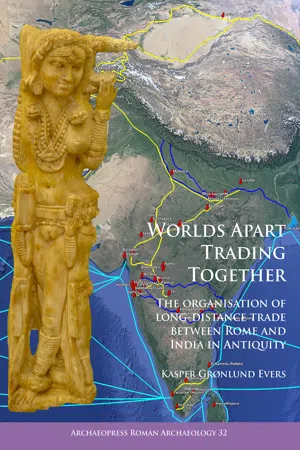
Worlds Apart Trading Together: The organisation of long-distance trade between Rome and India in Antiquity
- 227 pages
- English
- PDF
- Available on iOS & Android
eBook - PDF
Worlds Apart Trading Together: The organisation of long-distance trade between Rome and India in Antiquity
About this book
Worlds Apart Trading Together sets out to replace the outdated notion of 'Indo-Roman trade' with a more informed perspective integrating the new findings of the last 30 years. In order to accomplish this, a perspective focusing on concrete demand from the ground up is adopted, also shedding light on the role of the market in long-distance exchange. Accordingly, the analysis conducted demonstrates that an economically highly substantial trade took place between the Mediterranean and the Indian Ocean in the 1st–6th cen. CE, altering patterns of consumption and modes of production in both India, South Arabia and the Roman Empire. Significantly, it can be documented that this trade was organised at the centres of demand and supply, in Rome and India, respectively, by comparable urban associations, the transport in-between being handled by equally well-organised private networks and diasporas of seagoing merchants. Consequently, this study concludes that the institution of the market in Antiquity was able to facilitate trade over very long distances, acting on a scale which had a characteristic impact on the economies of the societies involved, their economic structures converging by adapting to trade and the market.
Information
Table of contents
- Cover
- Copyright Page
- List of Figures
- Chapter 1
- Chapter 2
- Chapter 3
- Figure 1
- Inscription of the collegium of negotiatores eborarii et citriarii; CIL VI, 33,885. Source: Borsari 1887: pl. 1.
- Figure 2
- Figure 3
- Ivory statuette from Pompeii, front; height 24.5 cm. Museo archeologico Nazionale di Napoli, in the ‘Gabinetto Segreto,’ inv.no. 149425. Photograph by the author.
- Same as Figure 2, back. Photograph by the author.
- Figure 4
- Same as Figure 2, detail of hole penetrating the crown of the head down to the waist. Photograph by the author.
- Drawing of Pompeii figurine’s base. Source: Maiuri 1938–9: 112, fig. 1.
- Figure 5
- Begram ivory statuette, height 45 cm; Hackin 1939: no. 320a. Source: Hackin 1954: fig. 234.
- Begram ivory statuette, height 45.6 cm; Hackin 1939: no. 320b. Source: Hackin 1954: fig. 235.
- Figure 6
- Figure 7
- Figure 8
- Ivory statuette encased in ivory frame at Begram. Source: Hackin 1939: fig. 75 (no. 320a in situ).
- Elephant-headed ivory leg from Begram, height 26 cm; Hackin 1939: no. 342. Source: Hackin 1939: fig. 229.
- Figure 9
- Elephant-headed bed legs, stone relief from Gandhara. Source: Marshall 1960: pl. 91, fig. 127. Copyright: Cambridge University Press.
- Figure 10
- Drawing of detail from mural in Ajanta Cave 1, cf. Takata 1971: pl. 89.
- Figure 11
- Drawing of detail from mural in Ajanta Cave 17, cf. Takata 1971: pl. 36.
- Figure 12
- Figure 13
- Wooden, three-legged Roman table form Herculaneum, animal legs and griffins’ heads with ivory eyes (= Mols 1999: cat.no. 18). Copyright: S. Mols.
- Figure 14
- Roman bronze table converted into brazier. Source: Pernice 1908: 108, fig. 1.
- Figure 15
- Wooden armrest support from Loulan, Xinjiang. Source: Stein 1921, IV: pl. XXXIV.
- Figure 16
- Ivory faun from the Naples area, approximate height 20–5 cm. In Museo archeologico Nazionale di Napoli, 1st floor, room LXXXVIII, ‘La collezione degli oggetti in avorio ed osso.’ Photograph by the author.
- Chapter 4
- Chapter 5
- Chapter 6
- Chapter 7
- Chapter 8
- Figure 17
- Outside view of the vihara at Nashik whose verandah is inscribed with Ushavadata’s endowment along its upper walls, Maharashtra. Photograph by the author.
- Figure 18
- Inside view of the Karla chaitya hall, Maharashtra. Photograph by the author.
- Figure 19
- View of the drip ledge and cave shelter on Mangulam Hill sponsored by the president of the merchants of nearby Vellarai. His i scription can be traced (faintly) along the side of the chiselled cliff face. Tamil Nadu. Photograph by the author.
- Conclusion
- Map 1: Overview of the Mediterranean World
- Map 2: Overview of the Indian Ocean
- Map 3: Latium and Campania, Italia
- Map 4: Central Mediterranean
- Map 5: Eastern Mediterranean
- Map 6: Western Provinces
- Map 7: Upper Adriatic Sea
- Map 8: Near East
- Map 10: Bay of Aden
- Map 9: Upper Red Sea
- Map 11: Western Indian Ocean
- Map 14: North India
- Map 15: Eastern Indian Ocean
- Map 16: Central Asia and Tarim Basin
- Contents Page
Trusted by 375,005 students
Access to over 1.5 million titles for a fair monthly price.
Study more efficiently using our study tools.
Frequently asked questions
Yes, you can cancel anytime from the Subscription tab in your account settings on the Perlego website. Your subscription will stay active until the end of your current billing period. Learn how to cancel your subscription
No, books cannot be downloaded as external files, such as PDFs, for use outside of Perlego. However, you can download books within the Perlego app for offline reading on mobile or tablet. Learn how to download books offline
Perlego offers two plans: Essential and Complete
- Essential is ideal for learners and professionals who enjoy exploring a wide range of subjects. Access the Essential Library with 800,000+ trusted titles and best-sellers across business, personal growth, and the humanities. Includes unlimited reading time and Standard Read Aloud voice.
- Complete: Perfect for advanced learners and researchers needing full, unrestricted access. Unlock 1.5M+ books across hundreds of subjects, including academic and specialized titles. The Complete Plan also includes advanced features like Premium Read Aloud and Research Assistant.
We are an online textbook subscription service, where you can get access to an entire online library for less than the price of a single book per month. With over 1.5 million books across 990+ topics, we’ve got you covered! Learn about our mission
Look out for the read-aloud symbol on your next book to see if you can listen to it. The read-aloud tool reads text aloud for you, highlighting the text as it is being read. You can pause it, speed it up and slow it down. Learn more about Read Aloud
Yes! You can use the Perlego app on both iOS and Android devices to read anytime, anywhere — even offline. Perfect for commutes or when you’re on the go.
Please note we cannot support devices running on iOS 13 and Android 7 or earlier. Learn more about using the app
Please note we cannot support devices running on iOS 13 and Android 7 or earlier. Learn more about using the app
Yes, you can access Worlds Apart Trading Together: The organisation of long-distance trade between Rome and India in Antiquity by Kasper Grønlund Evers in PDF and/or ePUB format, as well as other popular books in Social Sciences & Archaeology. We have over 1.5 million books available in our catalogue for you to explore.