In recent years, major new archaeological discoveries have redefined the development of towns and cities in the Japanese archipelago. The uncovering of the plans of major port towns such as Sakai, Kusado Sengen and Ichij?dani, and the revealing of early phases in the development of cities such as Kamakura and Hakata provide an important new resource in understanding the cultural and economic processes which shaped medieval Japan.
This fully illustrated book provides a sampler of these findings for a western audience. The new discoveries from Japan are set in context of medieval archaeology beyond Japan by accompanying essays from leading European specialists.
The global significance of Japanese medieval archaeology is assessed through comparing the development of towns in Japan and northern Europe. The medieval period in Japan and northwest Europe saw urban growth with towns not only providing centres of administration but also fostering economic development. The pressures which led to such growth, however, be they political or social, were universal in character. following basic requirements of food, shelter, security and spiritual nourishment, towns provided commercial infrastructures, transport and storage facilities, and the setting for trade, craft specialists and art.
Chapters include 'The archaeology of medieval towns in Japan and europe: an introduction' (Brian Ayers and Simon Kaner); 'Permanent urban frameworks ('armature') and economic networks in northern France c.700 – c.1000' (Henri Galinié); 'Medieval urbanism and culture in the cities of the Baltic: with a comparison between Lübeck, Germany, and Sakai, Japan' (Manfred Gläser); 'The development of Hakata as a medieval port town' (?ba K?ji); 'The establishment and transformation of Japan's medieval capital, Kamakura' (Oka Y?ichir?); 'Ichij?dani: the archaeology of a Japanese medieval castle town' (Ono Masatoshi); 'Japanese medieval trading towns: Sakai and Tosaminato' (Richard Pearson); and 'Medieval ceramic production in the aegean, 1100 – 1600 AD: some considerations in an east-west perspective' (Joanita Vroom).
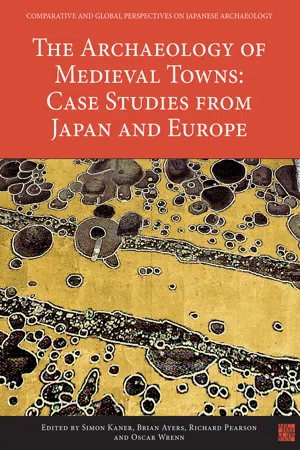
eBook - PDF
The Archaeology of Medieval Towns: Case Studies from Japan and Europe
- 154 pages
- English
- PDF
- Available on iOS & Android
eBook - PDF
The Archaeology of Medieval Towns: Case Studies from Japan and Europe
About this book
Information
Topic
Sciences socialesSubtopic
ArchéologieTable of contents
- Front cover
- Title page
- Copyright information page
- Sponsor page
- Contents
- Periodisation of Japanese history
- A comparative timeline including key episodes mentioned in the texts
- Foreword - Simon Kaner
- The archaeology of medieval towns in Japan and Europe:an introduction - Brian Ayers and Simon Kaner
- Japanese medieval trading towns: Sakai and Tosaminato - Richard Pearson
- Ichijōdani: the archaeology of a Japanese medieval castle town - Ono Masatoshi
- The establishment and transformation ofJapan’s medieval capital, Kamakura - Oka Yōichirō
- The development of Hakata as a medieval port town - Ōba Kōji
- The formation of medieval castle towns: a comparative archaeologyof encastlement in Japan and Europe - Senda Yoshihiro
- Five medieval European towns: Bruges, Göttingen, Norwich, Ribeand Rouen – a pictorial introduction - Simon Kaner
- Medieval urbanism and culture in the cities of the Baltic –with a comparison between Lübeck, Germany and Sakai, Japan - Manfred Gläser
- Permanent urban frameworks (‘armature’) and economic networks inNorthern France c.700 – c.1100 - Henri Galinié
- Medieval ceramic production in the Aegean, 1100-1600 AD:some considerations in an east-west perspective - Joanita Vroom
- Afterword - Richard Pearson
- Glossary
- List of contributors
- Index
Trusted by 375,005 students
Access to over 1.5 million titles for a fair monthly price.
Study more efficiently using our study tools.
Frequently asked questions
Yes, you can cancel anytime from the Subscription tab in your account settings on the Perlego website. Your subscription will stay active until the end of your current billing period. Learn how to cancel your subscription
No, books cannot be downloaded as external files, such as PDFs, for use outside of Perlego. However, you can download books within the Perlego app for offline reading on mobile or tablet. Learn how to download books offline
Perlego offers two plans: Essential and Complete
- Essential is ideal for learners and professionals who enjoy exploring a wide range of subjects. Access the Essential Library with 800,000+ trusted titles and best-sellers across business, personal growth, and the humanities. Includes unlimited reading time and Standard Read Aloud voice.
- Complete: Perfect for advanced learners and researchers needing full, unrestricted access. Unlock 1.5M+ books across hundreds of subjects, including academic and specialized titles. The Complete Plan also includes advanced features like Premium Read Aloud and Research Assistant.
We are an online textbook subscription service, where you can get access to an entire online library for less than the price of a single book per month. With over 1.5 million books across 990+ topics, we’ve got you covered! Learn about our mission
Look out for the read-aloud symbol on your next book to see if you can listen to it. The read-aloud tool reads text aloud for you, highlighting the text as it is being read. You can pause it, speed it up and slow it down. Learn more about Read Aloud
Yes! You can use the Perlego app on both iOS and Android devices to read anytime, anywhere — even offline. Perfect for commutes or when you’re on the go.
Please note we cannot support devices running on iOS 13 and Android 7 or earlier. Learn more about using the app
Please note we cannot support devices running on iOS 13 and Android 7 or earlier. Learn more about using the app
Yes, you can access The Archaeology of Medieval Towns: Case Studies from Japan and Europe by Simon Kaner, Brian Ayers, Richard Pearson, Oscar Wrenn, Simon Kaner,Brian Ayers,Richard Pearson,Oscar Wrenn in PDF and/or ePUB format, as well as other popular books in Sciences sociales & Archéologie. We have over 1.5 million books available in our catalogue for you to explore.