eBook - PDF
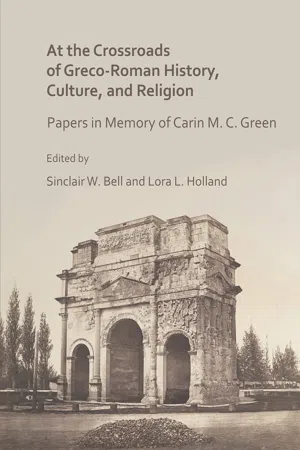
At the Crossroads of Greco-Roman History, Culture, and Religion
Papers in Memory of Carin M. C. Green
- 307 pages
- English
- PDF
- Available on iOS & Android
eBook - PDF
At the Crossroads of Greco-Roman History, Culture, and Religion
Papers in Memory of Carin M. C. Green
About this book
At the Crossroads of Greco-Roman History, Culture, and Religion' brings together recent research from a range of upcoming and well-established scholars to demonstrate the richness of the cross-cultural exchange of ideas around the ancient Mediterranean along with the reception of and continuing dialogues with these ideas in the medieval and modern worlds. The crossroads theme both honours the memory of our late colleague and friend Carin M. C. Green, who published an important book on the cult of Diana—one of whose aspects was Trivia, the goddess of crossroads—and emphasizes how each encounter of new topic or genre forces the reader to pause and think before proceeding down the new path. The contents are arranged accordingly under three headings: (1) Greek philosophy, history, and historiography; (2) Latin literature, history, and historiography; and (3) Greco-Roman material culture, religion, and literature. These papers also coincide in myriad ways across the three headings, tracing themes such as friendship, leadership, and the reception of ideas in the arenas of philosophy, historiography, manuscript studies, poetry, medicine, art, and war. Within this delimited framework, the volume's diversity of topics and approaches to a range of genres in the Greco- Roman world is intended both to appeal to the general scholar with varied interests and to offer students a wide scope through which to consider those genres.
Information
Table of contents
- Cover
- Title Page
- Copyright Page
- Carin M. C. Green (30 March 1948–2 July 2015).
- Contributors
- Contents
- Abbreviations
- Preface
- Acknowledgments
- Bibliography of Works by Carin M. C. Green
- Introduction
- Herakles’ Thirteenth Labor
- Thucydides’ Verdict on Nicias (7.86.5) and the Paradigm of Tragedy
- “Men, Friends”
- (Pre)historiography and Periegesis
- Catullus and the Personal Empire
- Ex opportunitate loci
- Sallust’s Allobrogian Envoys
- Horace, Satires 1.7 and the urbanissimus iocus
- Ovid among the Barbarians: Tristia 5.7a and 5.7b
- Figure 9.1. Structure of Tristia 5.7a
- Figure 9.2. Ring structure of lines 25–42 of Tristia 5.7b
- Figure 9.3. Ring structure of lines 43–68 of Tristia 5.7b
- 9.4. Ring structure framing the central section of Tristia 5.7b
- The Introduction of Characters in Petronius
- Playing the Victor: Triumphal Anxiety in Neronian Satire
- Theocritus’ First Idyll and Vergil’s First Eclogue: Two New Translations
- The Popularity of Hercules in Pre-Roman Central Italy
- Figure 13.1a–c. Hercules in assault. After Campanelli et al. 1997, 144, figs. 7–9.
- Figure 13.2. Hercules with stylized lion skin. After Colonna 1970, fig. 386.
- Figure 13.3. Votive statuette of Hellenized Hercules. After Campanelli et al. 1997, 147, fig. 20.
- Figure 13.4. Lion skin and Hercules. After Colonna 1970, fig. 374.
- Figure 13.5. Hercules in repose. After Campanelli et al. 1997, 147, fig. 14.
- Figure 13.6. Hercules of Cafeo. After Bonacasa 2013, 69 [fig. 37].
- 13.7. Votive statuette of Hercules Farnese type. After Moreno 1989, pl. VI.
- 13.8. Hercules with attributes of Dionysus. After Colonna 1970, fig. 476.
- Spolia as Strategy in the Early Roman Empire
- Ovid and the Legend of Capella (Fasti 5.111–128)
- Figure 15.1. Fountain frieze, marble, second century CE. Musei Vaticani inv. 9510. Photo: Vatican Museums, published with permission.
- Galen and the Culture of Dissection
- Warts and All: The Paratexts in the Iowa Lucan
- Three Editions of Lucan’s Bellum Civile
Trusted by 375,005 students
Access to over 1.5 million titles for a fair monthly price.
Study more efficiently using our study tools.
Frequently asked questions
Yes, you can cancel anytime from the Subscription tab in your account settings on the Perlego website. Your subscription will stay active until the end of your current billing period. Learn how to cancel your subscription
No, books cannot be downloaded as external files, such as PDFs, for use outside of Perlego. However, you can download books within the Perlego app for offline reading on mobile or tablet. Learn how to download books offline
Perlego offers two plans: Essential and Complete
- Essential is ideal for learners and professionals who enjoy exploring a wide range of subjects. Access the Essential Library with 800,000+ trusted titles and best-sellers across business, personal growth, and the humanities. Includes unlimited reading time and Standard Read Aloud voice.
- Complete: Perfect for advanced learners and researchers needing full, unrestricted access. Unlock 1.5M+ books across hundreds of subjects, including academic and specialized titles. The Complete Plan also includes advanced features like Premium Read Aloud and Research Assistant.
We are an online textbook subscription service, where you can get access to an entire online library for less than the price of a single book per month. With over 1.5 million books across 990+ topics, we’ve got you covered! Learn about our mission
Look out for the read-aloud symbol on your next book to see if you can listen to it. The read-aloud tool reads text aloud for you, highlighting the text as it is being read. You can pause it, speed it up and slow it down. Learn more about Read Aloud
Yes! You can use the Perlego app on both iOS and Android devices to read anytime, anywhere — even offline. Perfect for commutes or when you’re on the go.
Please note we cannot support devices running on iOS 13 and Android 7 or earlier. Learn more about using the app
Please note we cannot support devices running on iOS 13 and Android 7 or earlier. Learn more about using the app
Yes, you can access At the Crossroads of Greco-Roman History, Culture, and Religion by Sinclair W. Bell,Lora L. Holland, Sinclair W. Bell, Lora L. Holland in PDF and/or ePUB format, as well as other popular books in Social Sciences & Archaeology. We have over 1.5 million books available in our catalogue for you to explore.