eBook - PDF
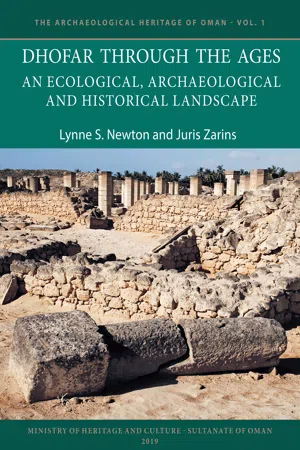
Dhofar Through the Ages
An Ecological, Archaeological and Historical Landscape
- 147 pages
- English
- PDF
- Available on iOS & Android
eBook - PDF
Dhofar Through the Ages
An Ecological, Archaeological and Historical Landscape
About this book
Dhofar, the southern governorate of Oman, lies within a distinctive ecological zone due to the summer Southwest Monsoon. It is home to numerous indigenous succulent plants, the most famous of which is frankincense (Boswellia sacra). The region, tied in the past to both Oman and Yemen, has a long and distinguished archaeological past stretching back to the Lower Paleolithic ca. 1.5 my BP. Dhofar is also home to a distinctive people, the Modern South Arabian Languages speakers (MSAL) since at least the last 15,000 years. Ancient Zafar (Al-Habudi), now called Al-Baleed, and its successor Salalah was and is the province's largest city. From the seventh century onwards until the arrival of the Portuguese in 1504 AD Al-Baleed dominated the central southern Arabian coastline politically and economically. Archaeological surveys and excavations in the governorate, beginning in 1954, have brought to light Dhofar's ancient past.
Information
Table of contents
- Cover
- Title Page
- Copyright Page
- Contents
- List of illustrations and tables
- Acknowledgments
- A note on terminology
- Figure i. Map of the Sultanate of Oman with indication of the area covered by Figure ii.
- Introduction
- Figure ii. Map of Dhofar with the major sites quoted in the Volume.
- The geomorphology and ecology of Dhofar and its larger ecological environs
- Figure 1.1. The coastal plain of Dhofar near Wadi Darbat (photograph by L. Newton).
- Figure 1.2. View from Jebel Samhan towards the coast (photograph by L. Newton).
- Figure 1.3. View of the Dhofar hills looking towards the coast (photograph by L. Newton).
- Figure 1.4. View from the Qatn towards the Nejd (photograph by L. Newton).
- Figure 1.5. The Nejd (photograph by L. Newton).
- Figure 1.6. View of the Rub Al-Khali from Jebel Samhan towards the coast (photograph by L. Newt
- Figure 1.7. The northernmost extent of the Intertropical Convergence Zone at present (upper) and in
- Figure 1.8. Frankincense tree (photograph by L. Newton).
- Figure 1.9. Boswellia sacra in flower (photograph by L. Newton).
- Figure 1.10. Wadi Darbat above the waterfall during the monsoon (photograph by L. Newton).
- Figure 1.11. A second travertine waterfall farther up Wadi Darbat during the monsoon season (phot
- Prehistoric archaeological chronology in Dhofar prior to the Islamic period
- Figure 2.1. Palaeolithic Sites: 1) DS-08-127 Ar-Rahat; 2) DS-09-281 Mudayy; 3-4) DS-09-262 Tudho; 5
- Figure 2.2. Acheulean handaxe from DS-09-190 (photograph by L. Newton).
- Figure 2.3. DS-09-281 near Mudhai. Site with Palaeolithic tool and debitage scatter on lower terr
- Figure 2.4. Distribution of Neolithic sites in Dhofar, note location of TA-93-72 Hailat Araka.
- Figure 2.5. Neolithic sites: 1-16) DS-09-88 Wadi Dhahabun; 17-26) DS-09-253 Harun village; Neolit
- Figure 2.6. DS-09-254 Neolithic village at Harun (photograph by L. Newton).
- Figure 2.7. DS-08-42 Rock shelter with associated Rock Art.
- Figure 2.8. DS-09-149 Hodor. Tabular flint scraper and blades.
- Figure 2.9. Bronze Age tomb at DS-09-149 Hodor.
- Figure 2.10. DS-09-282 Bronze Age “Tombs with Tails” near Mudhai.
- Figure 2.11. Taqa 60. Bronze and Iron Age houses.
- Figure 2.12. Taqa 60. Bronze Age house.
- Figure 2.13. Taqa 60. Iron Age shell beads.
- Figure 2.14. Map of DS-09-203 Trilith Site.
- Figure 2.15. DS-09-203 Trilith Site.
- Figure 2.16. Trilith Site distribution along with MSAL Group distribution (After Dostal 1967; Math
- Figure 2.17. Sumhuram, Khor Rori and the Taqa and Mirbat Jebels.
- Figure 2.18. The Italian Mission to Oman (IMTO) archaeological map of the Sumhuram area (After A
- Figure 2.19. Andhur (photograph by L. Newton).
- Figure 2.20. Annotated Ptolemy map. Note the squared off area is Dhofar (After B. Isenberger).
- Late Antiquity and Early Islamic trade in the Red Sea, Indian Ocean and the Arabian Gulf
- Figure 3.1. The Classical period (300 BC-300 AD) Indian Ocean (After Avanzini and Sedov 2005).
- Figure 3.2. Local Iron Age Ceramics: 1) TA-95-60, level 2, BA-83797 2340±100 BP; 2-29) DS-08-67 Al-
- Figure 3.3. Excavations under small mosque at Al-Baleed. The photo shows what lies below the stone
- Figure 3.4. DS-08-008 Jebel Nashib.
- Figure 3.5. DS-08-008 Jebel Nashib.
- Figure 3.6. Juweina island. Note the structures visible on the top of the island, most likely dated
- Figure 3.7. TA-08-101 Hinu.
- Figure 3.8. TA-95-121 Ras Jinjali.
- Figure 3.9. DS-08-03 Hasik.
- Figure 3.10. The fort complex at Ain Humran dated to the Iron Age-Medieval Islamic periods.
- Figure 3.11. Boat Graves at base of Ain Humran fort.
- Figure 3.12. Boat Graves at base of Ain Humran fort (photograph by L. Newton).
- The Medieval city of Zafar. Periods II-IV
- Figure 4.1. Ibn Mujawir’s map of Zafar (Al-Baleed) (After Löfgren 1951).
- Figure 4.2. Ibn Battuta’s itineraries in Southern Arabia (After H.A.R. Gibb 1929 reprint, Volume
- Figure 4.3. Chinese Map of Frankincense Trade (after Wheatley 1959).
- Archaeology of Zafar, Periods II-V (950-1700 AD)
- Figure 5.1. Landsat image of Al-Baleed on the coast of Salalah (Courtesy of W. Isenberger, Digital
- Figure 5.2. South side of the husn looking north.
- Figure 5.3. Al-Baleed/Zafar congregational mosque (ZCM).
- Figure 5.4. Landsat image of Al-Baleed, note the city wall and 18 towers (Courtesy of W. Isenberger
- Figure 5.5. Al-Baleed Southwest Gate.
- Figure 5.6. Jetty near the Southeast Gate, note the large blocks that once held a dock in place.
- Al-Baleed ceramic typology
- Figure 6.1. Amphorae: 1) Qana, 1st century BC- 3rd century AD (Sedov 1996: 15, fig. 3); 2-3) Mas
- Figure 6.2. Complete Celadon bowl from Al-Baleed.
- Figure 6.3. Complete glass vessel from Al-Baleed.
- Figure 6.4. Complete glass vessels from Al-Baleed.
- Al-Baleed and the international Indian Ocean trade
- Table 7.1. Textile types defined by geographical designation in the Mulakhkhas Al-Fitan (After Smith
- Table 7.2. Port tax revenues at Aden (in gold dinars) during the Rasulid period (1229-1451 AD).
- Table 7.3. Rasulid tax revenue generated from ports in 1411 (After Smith 2006: 40).
- Figure 7.1. “Abu Zayd and Al-Harith sailing” in Al-Maqamat of al Harīrī Al-Basrī, Folio 119 Verso, c
- Table 7.4. Sailing schedule for Zafar from the almanac al-Tabsira fi ilm al-nujum of Al-Malik Al-As
- The inland trade to the Hadhramaut and East Arabia
- Figure 8.1. Shisr/Ubar.
- Figure 8.2. The chess pieces from Shisr dating to the 10th century AD (Courtesy of the Museum of t
- The historical chronology of Al-Baleed/Zafar
- Suggested readings
- Index
Trusted by 375,005 students
Access to over 1.5 million titles for a fair monthly price.
Study more efficiently using our study tools.
Frequently asked questions
Yes, you can cancel anytime from the Subscription tab in your account settings on the Perlego website. Your subscription will stay active until the end of your current billing period. Learn how to cancel your subscription
No, books cannot be downloaded as external files, such as PDFs, for use outside of Perlego. However, you can download books within the Perlego app for offline reading on mobile or tablet. Learn how to download books offline
Perlego offers two plans: Essential and Complete
- Essential is ideal for learners and professionals who enjoy exploring a wide range of subjects. Access the Essential Library with 800,000+ trusted titles and best-sellers across business, personal growth, and the humanities. Includes unlimited reading time and Standard Read Aloud voice.
- Complete: Perfect for advanced learners and researchers needing full, unrestricted access. Unlock 1.5M+ books across hundreds of subjects, including academic and specialized titles. The Complete Plan also includes advanced features like Premium Read Aloud and Research Assistant.
We are an online textbook subscription service, where you can get access to an entire online library for less than the price of a single book per month. With over 1.5 million books across 990+ topics, we’ve got you covered! Learn about our mission
Look out for the read-aloud symbol on your next book to see if you can listen to it. The read-aloud tool reads text aloud for you, highlighting the text as it is being read. You can pause it, speed it up and slow it down. Learn more about Read Aloud
Yes! You can use the Perlego app on both iOS and Android devices to read anytime, anywhere — even offline. Perfect for commutes or when you’re on the go.
Please note we cannot support devices running on iOS 13 and Android 7 or earlier. Learn more about using the app
Please note we cannot support devices running on iOS 13 and Android 7 or earlier. Learn more about using the app
Yes, you can access Dhofar Through the Ages by Lynne S. Newton,Juris Zarins in PDF and/or ePUB format, as well as other popular books in Social Sciences & Archaeology. We have over 1.5 million books available in our catalogue for you to explore.