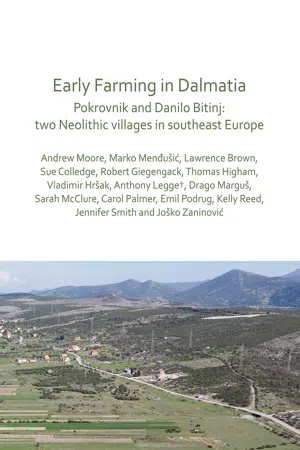
Contributions by Lawrence Brown, Sue Colledge, Robert Giegengack, Thomas Higham, Vladimir Hrsak, Anthony Legge†, Drago Margus, Sarah McClure, Carol Palmer, Emil Podrug, Kelly Reed, Jennifer Smith, and Josko Zaninovic. The origins and spread of farming are vital subjects of research, notably because agriculture makes possible our modern world. The Early Farming in Dalmatia Project is investigating the expansion of farming from its centre of origin in western Asia through the Mediterranean into southern Europe. This multidisciplinary ecological project combines comprehensive recovery of archaeological materials through excavation with landscape studies. It addresses several key questions, including when and how farming reached Dalmatia, what was the nature of this new economy, and what was its impact on the local environment. Excavations at Danilo Bitinj and Pokrovnik have demonstrated that their inhabitants were full-time farmers. The two sites were among the largest known Neolithic villages in the eastern Adriatic. A comprehensive program of AMS dating indicates that together they were occupied from c. 8, 000 to 6, 800 cal BP. Our research has begun to illuminate the details of their farming system, as well as the changes that took place in their way of life through the Neolithic. Their economy was derived from western Asia and it is likely that their ancestors came from there also. It was these people who brought agriculture and village life to the Adriatic and to the rest of the central and western Mediterranean. Once in place, this farming economy persisted in much the same form from the Neolithic down to the present.
eBook - PDF
Early Farming in Dalmatia
Pokrovnik and Danilo Bitinj: two Neolithic villages in south-east Europe
- 119 pages
- English
- PDF
- Available on iOS & Android
eBook - PDF
Early Farming in Dalmatia
Pokrovnik and Danilo Bitinj: two Neolithic villages in south-east Europe
About this book
Trusted by 375,005 students
Access to over 1.5 million titles for a fair monthly price.
Study more efficiently using our study tools.
Information
Table of contents
- Cover
- Title Page
- Copyright Page
- Contents Page
- List of Figures and Tables
- Preface
- Acknowledgments
- Background to the research
- Inception of the project
- Figure 1. Location map of Pokrovnik and Danilo, and other key sites mentioned in the text.
- Figure 2. Aerial view of the Danilo Valley looking west. The site of Danilo Bitinj is in the middle distance; the Adriatic Sea is visible on the horizon (photo Šibenik Museum).
- Figure 3. Aerial view of the site of Danilo Bitinj, looking southeast (photo Šibenik Museum).
- Figure 4. View of the site of Pokrovnik from the northeast. The Pećina spring is in the grove of hackberry trees to the left of center.
- History of research at Danilo Bitinj and Pokrovnik
- Excavations at Danilo Bitinj and Pokrovnik 2003-2006
- Figure 5. The site of Danilo from the northeast. The Dabar stream runs along the far side of the site beside the valley road.
- Figure 6. Plan of the site of Danilo showing the locations of the trenches we excavated. The locations of the trenches dug by Korošec (1953, 1955) and Menđušić (1992) are also indicated.
- Figure 7. Danilo, Trench A. General view of the Neolithic deposits looking southwest. Scale 2 m.
- Figure 8. Danilo, Trench A. Burial of a young child (Level 48, object number DA05 A895) beside a hearth, upper left, looking northwest. Scale 10 cm.
- Figure 9. Danilo, Trench B. The gully. Scale 1 m.
- Figure 10. Danilo, Trench C. Pits and postholes dug into the clay subsoil. Scale 1 m.
- Figure 11. Danilo, Trench E. The outline of a rectangular, single-roomed house. Scale 1 m.
- Figure 12. Danilo, Trench E. Stake impressions in the subsoil. Scale 1 m.
- Figure 13. View of the site of Pokrovnik from the Gradina hill looking northwest. The Čikola Gorge is visible in the middle distance.
- Figure 14. Location of the four trenches we excavated in a single field that transected the site.
- Figure 15. Plan of the site of Pokrovnik showing the locations of the trenches we excavated and also those excavated by Brusić in 1979.
- Figure 16. Pokrovnik, Trench D. View of a massive wall in the Impressed Ware levels from the north. Scale 1m.
- Figure 17. Pokrovnik, Trench A. View of a massive wall in the Impressed Ware levels and a pit dug from the overlying Danilo phase, looking north. Scales 1m.
- Figure 19. Pokrovnik, Trench D. A seated baked clay female figurine from the Impressed Ware levels. (Level 22, object number PK06 D380; Scale 5 cm.)
- Chronology of Pokrovnik and Danilo
- Pottery from Pokrovnik and Danilo
- Figure 20. Impressed Ware/Impresso pottery from Pokrovnik, illustrating characteristic shapes and decoration.
- Figure 21. Danilo pottery from Pokrovnik and Danilo, illustrating characteristic shapes and decoration.
- Pottery and the Early Farming in Dalmatia Project
- Table 2. Danilo Trench E pottery fragments.
- Table 3. Decorations recorded among fragments at Danilo, Trench E.
- Table 4. Lips, rims, handles and bases on fragments from Danilo Trench E.
- Table 5. Manufacturing and paste characteristics at Danilo, Trench E (n=49; except where noted).
- Table 7. Decorative techniques in Pokrovnik, Trench D, lower levels.
- The chipped stone, stone tools and other artifacts
- Table 8. The plant species with numbers of specimens recorded by Brusić in his excavations at Pokrovnik.
- The plant remains from Danilo Bitinj and Pokrovnik
- Table 9. Volumes of soil processed by flotation at Pokrovnik and Danilo.
- Table 10. Number of identified plant items recovered from Pokrovnik and Danilo.
- Table 11. Average number of identified taxa per phase.
- Table 12. Taxa identified in samples from Pokrovnik and Danilo.
- Animal husbandry and environment
- Table 13. Preservation conditions at the two sites.
- The faunal remains
- Table 14. Percentages of species based upon counts of identified bones.
- Table 15. Proportions of domestic species by mandible count*.
- Table 16. Ratio of identified caprine mandibles to identified limb bones at various sites.
- The mammalian species found at Pokrovnik and Danilo
- Table 17. Ages of cattle from Pokrovnik and Danilo.
- Table 18. Measurements of hare bones (mm)
- The fauna of Pokrovnik and Danilo: environmental and economic considerations
- Marine shells
- Table 19. Bivalve shells by taxa collected in the excavations at Danilo in 2004 and 2005, and at Pokrovnik in 2006.
- Table 20. Finds of bivalve shell fragments by taxa collected in the excavations at Danilo in 2004 and 2005, and at Pokrovnik in 2006.
- Table 21. Bivalve shells and shell fragments found by taxa collected in excavations at Danilo in 2004 and 2005, and at Pokrov ik in 2006.
- Table 22. Bivalve taxa collected in research at Danilo in 1953, 2004 and 2005, and at Pokrovnik in 2006.
- Geomorphology and soils in the vicinity of Danilo and Pokrovnik
- Contemporary vegetation around Danilo and Pokrovnik
- The agricultural survey
- Commentary on results achieved thus far and their significance
- References
Frequently asked questions
Yes, you can cancel anytime from the Subscription tab in your account settings on the Perlego website. Your subscription will stay active until the end of your current billing period. Learn how to cancel your subscription
No, books cannot be downloaded as external files, such as PDFs, for use outside of Perlego. However, you can download books within the Perlego app for offline reading on mobile or tablet. Learn how to download books offline
Perlego offers two plans: Essential and Complete
- Essential is ideal for learners and professionals who enjoy exploring a wide range of subjects. Access the Essential Library with 800,000+ trusted titles and best-sellers across business, personal growth, and the humanities. Includes unlimited reading time and Standard Read Aloud voice.
- Complete: Perfect for advanced learners and researchers needing full, unrestricted access. Unlock 1.5M+ books across hundreds of subjects, including academic and specialized titles. The Complete Plan also includes advanced features like Premium Read Aloud and Research Assistant.
We are an online textbook subscription service, where you can get access to an entire online library for less than the price of a single book per month. With over 1.5 million books across 990+ topics, we’ve got you covered! Learn about our mission
Look out for the read-aloud symbol on your next book to see if you can listen to it. The read-aloud tool reads text aloud for you, highlighting the text as it is being read. You can pause it, speed it up and slow it down. Learn more about Read Aloud
Yes! You can use the Perlego app on both iOS and Android devices to read anytime, anywhere — even offline. Perfect for commutes or when you’re on the go.
Please note we cannot support devices running on iOS 13 and Android 7 or earlier. Learn more about using the app
Please note we cannot support devices running on iOS 13 and Android 7 or earlier. Learn more about using the app
Yes, you can access Early Farming in Dalmatia by Andrew Moore,Marko Mendusic in PDF and/or ePUB format, as well as other popular books in Social Sciences & Archaeology. We have over 1.5 million books available in our catalogue for you to explore.