eBook - PDF
Experimental Archaeology: Making, Understanding, Story-telling
- 116 pages
- English
- PDF
- Available on iOS & Android
eBook - PDF
Experimental Archaeology: Making, Understanding, Story-telling
About this book
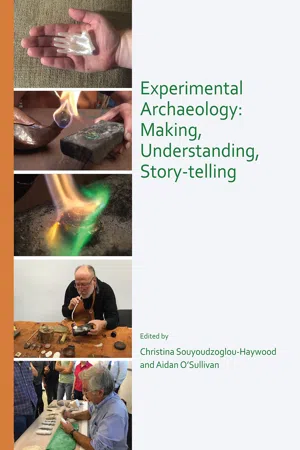
Experimental Archaeology: Making, Understanding, Story-telling is based on the proceedings of a two-day workshop on experimental archaeology at the Irish Institute of Hellenic Studies at Athens in 2017, in collaboration with UCD Centre for Experimental Archaeology and Material Culture. Scholars, artists and craftspeople explore how people in the past made things, used and discarded them, from prehistory to the Middle Ages. The papers include discussions of the experimental archaeological reconstruction and likely past experience of medieval houses, and also about how people cast medieval bronze brooches, or sharpened Bronze Age swords, made gold ornaments, or produced fresco wall paintings using their knowledge, skills and practices. The production of ceramics is explored through a description of the links between Neolithic pottery and textiles, through the building and testing of a Bronze Age Cretan pottery kiln, and through the replication and experience of Minoan figurines. The papers in this volume show that experimental archaeology can be about making, understanding, and storytelling about the past, in the present.
Information
Table of contents
- Cover
- Title Page
- Copyright page
- Contents Page
- Introduction Defining Experimental Archaeology: Making, Understanding, Storytelling?
- Figure 2. Ulrikka Mokdad demonstrating the weaving of Neolithic patterns, with Kalliopi Sarri.
- Figure 3. Epaminontas Venieris explaining the manufacture of Cycladic marble figurines, with Brendan O’Neil experimenting.
- Figure 4. Akis Goumas creating gold granules for the decoration of the Mycenaean bead.
- Experimental archaeological reconstructions and the investigation of houses from the past
- Figure 1. Artist’s reconstruction painting of a hypothetical early medieval rath, with its enclosure defences, entrance, interior structures and activities. The houses are shown as straight-sided walls with a conical roof, the typical interpretation of th
- Figure 2. The early medieval rath at Deer Park Farms, Co. Antrim, a site plan showing its Phase 6A features, radiocarbon dated to the late seventh to eighth century AD. A distinctive, paved entranceway, flanked by low walls, is at the east side. There are
- Figure 3. Building the early medieval roundhouse at UCD Centre for Experimental Archaeology and Material Culture (CEAMC) in June 2015. The inner wall is being pulled in to form a dome, and the outer wall, used to retain insulation material, serves as a u
- Figure 4. The completed early medieval roundhouse at UCD Centre for Experimental Archaeology and Material Culture (CEAMC), thatched with heather, in September 2016. The house is settling in form, though the roof thatch will flatten further and change col
- Figure 5. The early medieval roundhouse at UCD Centre for Experimental Archaeology and Material Culture (CEAMC), under snow i the winter of 2018. Investigations of the house in terms of heat, smoke, light and other environmental factors have provided ins
- Figure 6. The interior of the early medieval roundhouse at UCD Centre for Experimental Archaeology and Material Culture (CEAMC), showing central hearth, bedding area against north wall, and a range of furniture and domestic objects —pots, wooden buckets,
- Figure 7. A view of the destroyed early medieval roundhouse at UCD Centre for Experimental Archaeology and Material Culture (CEAMC), burnt in an arson attack in May 2019. The site provides an opportunity to investigate the survival of burnt structures in
- Crafting prehistoric bronze tools and weapons: Experimental and experiential perspectives
- Figure 1. Forged bevelled edge of later Bronze Age sword from Ireland (exhibiting combat damage in this image also).
- Figure 2. Replica hammer and anvil based on the Bishopsland Hoard from Ireland. Note the wear at the edges of the working-face on the anvil and the degradation of the line demarcating the inner edge (relative to the user) of the hammer face.
- Figure 4. Replica sword following initial round of hammering the complete article and then cut into 10 sample sections prior to further work.
- Figure 6. Annealing a section of sword blade in a charcoal charge with air pumped in via a double-bellows (with thanks to Brendan O’Neill and Črtomir Lorenčič).
- Table 1. Details of treatment of sample sections of bronze sword test piece including hammering phase, annealing duration and temperatures reached (core and edge differentiated where appropriate), if quenched in water (at room temperature).
- ‘Cutting edge technology’: new evidence from experimental simulation and use of Late Bronze Age woodworking cutting tools. The saw as ‘case study’
- Figure 1. The saw from Prosymna, Argolid (Blegen 1937: fig. 244:1).
- Figure 2. The saw from Androniani region, Central Euboea. Photo provided by Dr C. Paschalidis.
- Figure 3. The Prosymna saw tooth geometry: sharpness angle (a), hook angle (b), tooth tip line (cc’).
- Figure 4a. The teeth density of the Androniani saw.
- Figure 4b. The Androniani saw teeth geometry.
- Figure 4c. The setting of the Androniani saw teeth printed on a slab of plasticine (a), amount of set (b), and the bevel (fleam) of the saw teeth cutting edge (c).
- Figure 4d. Traces of filing preserved on some of the teeth of Androniani saw (a) the teeth are one side bevelled (left or right) according to setting (b).
- Figure 5. The ideogram of the saw as depicted on the scripts of the Bronze Age period (Evely 1993: 28 fig.12).
- Figure 6a. Representations of sawyers on the walls of Egyptian tombs (Evely 1993: 38 fig. 17).
- Figure 6b. Egyptian sawyer. Detail of a carpenter’s workshop model from the tomb of the Chancellor Meket-Re at Thebes dated to 11th Dynasty. (http://nefertiti.iwebland.com/trades/carpenters.htm)
- Figure 7. Boeotian figurine representing a craftsman sawing with a bow saw (late 6th century BC) (Breitenstein 1941: 18, no. 157, pl. 17).
- Figure 8. Part of the Telephos frieze from the Altar of Zeus in Pergamon at the scene of the construction of the raft of Auge (photo based on Pollitt 1986: 203 fig. 216).
- Figure 9a. Two-piece moulds of stone with covers made of sand for casting the smaller (a) and the larger (b) saws.
- Figure 9b. A two-piece sand mould for casting the larger saw.
- Figure 10. The blades of the larger saws removed from the sand moulds, as cast.
- Figure 11. Shaping the saw serration.
- Figure 12a-c. The setting of the larger saws: (a) hammer blow on the baseline of a three teeth group, (b) teeth traces on the surface of the softwood board used as saw blade support, left after hammer blow during setting, and (c) saw blade after setting
- Figure 13. Filing (sharpening) the teeth of reconstructed saw blades: (a) cross-cutting and (b) rip-cutting.
- Figure 14a. The saw from Akrotiri (Doumas 1997: pl. 87d).
- Figure 14b. Detail of the remains of its handle. Photo provided by Mrs A. Michailidou.
- Figure 15. Hafting the reconstructed saws.
- Figure 16a-c. Reconstructed saw evaluation during cross-cutting of a hull fraction plank.
- Figure 17. The body posture of an Egyptian craftsman while sawing (a), and the wide-legged stance of the modern operator, while using the reconstructed saw (b).
- Figure 18. Sawing a plank along the grain with a reconstructed saw (a), and using a wedge to keep the saw-cut open (b).
- Figure 20. Using the small reconstructed saw to cross-cut the head of the wooden pegs of the hull fraction.
- Experimenting on Mycenaean goldworking techniques: the case of the granulated cone
- Figure 1. Conical beads (trochus shell) from the cemetery of Deiras, Argos, 15th century BC, NAM Archive, Hellenic Ministry o Culture and Sports. Photo: Ph. Collet, French School at Athens.
- Figure 2. The conical bead from Argos: a) granules joined by fine ‘necks’, b) granule ‘flooded’ in the binding material, c) molten granule.
- Figure 3. The disc-shaped foil is embossed with wooden punches in successive cavities of increasing depth.
- Figure 4. Shaping the gold cone: a) the positive mould, b) pressing the cone with the mould into a cavity, c) chasing the spiral groove from the exterior.
- Figure 5. Production of granules: a) the gold sheet is cut into minute pieces of standard size, b) each piece is heated with the help of a blowpipe, c) when heated close to its melting point, the gold fragment becomes a sphere.
- Figure 6. Adding the granules on the body: a) preparation of a mixture of copper-salts, a resin (mastic) and water, b) the mixture is applied to the groove, c) granules are placed in the groove after they have been dipped in the mixture.
- Figure 7. The firing process: a) heating the bead with a blowpipe, b) the oxidization of copper salts, c) the ornament takes a bright reddish colour as it approaches the joining temperature.
- Figure 8. Repairs: a) the missing granules, b) cutting tiny pieces of a gold-copper-silver alloy, c) setting the granules i place and adding gold-copper-silver solders (for joining through brazing).
- Figure 9. High-magnification SEM images showing the morphology of the granules and the fine ‘necks’: a) original bead, b) replica (National Centre for Scientific Research ‘Demokritos’).
- Figure 10. Suspension holes: a) on the original bead, b) on the replica.
- Figure 11. Schematic reconstruction of the successive stages of manufacture of the bead. Drawing: Akis Goumas.
- Thinking through our hands: making and understanding Minoan female anthropomorphic figurines from the peak sanctuary of Pri ias, Crete
- Figure 1. Diagrammatic representation of stylistic variation between (and within) peak sanctuaries, showing the interplay between overall figurine types and local preferences/choices.
- Figure 2. Male figurine from Prinias, a good fit for the human hand.
- Figure 3. Female figurine from Prinias, preserved height 13 cm. Ayios Nikolaos Museum: HN5932.
- Figure 4. Female figurine from Prinias, preserved height 17.7 cm. Ayios Nikolaos Museum: HN6036.
- Figure 5. Replica figurine showing various stages of production: ‘A’ shows the initial stages of the skirt; ‘B’ is a top down view of same showing socket perforation; ‘C’ shows initial lower torso frame; ‘D’ shows pegged skirt and torso; ‘E’ shows initial
- Figure 6. Seated figurine with folded skirt, from Prinias, preserved height 8.9 cm. Ayios Nikolaos Museum: HN6028. Left: front view of figurine; right: view of the clay pushed in to create the fold.
- Figure 7. Views of HN5932 (photograph and 3D scan) showing the peg pushed through the skirt (which the modern conservator has also used for inserting the modern museum mount).
- Figure 8. HN5932, 3D scan showing remains of added ‘collar’ of clay on the upper back.
- Figure 9. View of replica figurine looking down on neck socket perforation (A). ‘B’ shows the initial shaping of head and polos; ‘C’ shows initial face pinching; ‘D’ shows finished head and polos.
- Figure 10. Replica figurine before (left) and after (right) the application of decorative elements (belt, breast pellets, ears and incised facial features).
- Reconstructing a Bronze Age Kiln from Priniatikos Pyrgos, Crete
- Figure 1. Priniatikos Pyrgos headland, viewed from Vrokastro to the east. Photo J. Day.
- Figure 2. Kiln H1004 at Priniatikos Pyrgos. Photo taken before excavation of two channels, showing firebar and fire-cracked rock at head of central pier. Photo B. Hayden.
- Figure 3. The completed base of the reconstructed kiln. Photo: M. Kobik.
- Figure 4. The dome nearing completion as courses are adjusted and sealed. Rear loading door visible, with entrance to firing chamber at front. Photo: M. Kobik.
- Figure 5. The fully reconstructed kiln drying. Photo: M. Kobik.
- Figure 6. Two of the largest firebars from Priniatikos Pyrgos (06-0273 and 07-0569). Photo: J. Day.
- Figure 7. Cross-sections of broken firebars from Priniatikos Pyrgos (top) and replica ones (bottom). Photos: J. Day and M. Kobik.
- Figure 8. Firebar from Priniatikos Pyrgos matching clay packing (left) and replica firebars in situ inside reconstructed kiln (right). Photos: J. Day and M. Kobik.
- Figure 9. Looking up into the firing chamber of the reconstructed kiln. Photo: M. Kobik.
- Figure 10. Replica firebar after removal from kiln, displaying similar break pattern to the archaeological examples. Photo. M. Kobik.
- Where have all the early medieval clay moulds gone? An experimental archaeological investigation of bi-valve clay moulds in Ireland, AD 400-1100
- Figure 1. Two halves of a bi-valve clay mould (replica) illustrating the component parts of ‘male’ (left) and ‘female’ (right) valves. Based on an early medieval artefact (‘male’ valve) from Dooey, Co. Donegal held in the National Museum of Ireland. Photo
- Figure 2. Finished bi-valve clay mould looking at the exterior surface of the ‘male’ valve (left) and side view (right). Both valves are joined with an outer ‘skin’ of clay around the seam. Photo: Brendan O’Neill, UCD School of Archaeology.
- Figure 3. Overview pictures of exposure contexts. From right to left, a shallow pit before being infilled, the ground surface after being cleared of vegetation and a section of ditch cut into boulder clay. Photo: Brendan O’Neill, UCD School of Archaeology
- Figure 4. Moulds 1 (Top) and 3 (Bottom) of the Reuse Test after use. The inner face of the centre of the ‘male’ valve of Mould 1 has been detached and the ‘female’ valve of Mould 3 is terminally broken. Photo: Brendan O’Neill, UCD School of Archaeology.
- Figure 5. Graph indicating the casting success and mould valve condition after test. Please note all ‘Unsuccessful; Casting Error’ valves were undamaged and in near perfect condiction after use. Image: Brendan O’Neill, UCD School of Archaeology.
- Figure 6. Graph indicating the results for the ‘Water Exposure’ control group. This provided a baseline dataset against which he other groups could be interpreted. In this graph deviation from 0% represents the level of impact on the mould. Image: Brenda
- Figure 7. Graph (A) and image (B) of results from the Surface Exposure test (legend same as Figure 6). Note the frost shattered valves (B), each of which broke during exposure. Image: Brendan O’Neill, UCD School of Archaeology.
- Figure 8. Graph (A) and image (B) of results from the PitExposure test (legend same as Figure 6). Note that samples werelargely protected from water and abrasion by the infill of soil within the pit. Image: Brendan O’Neill, UCD School of Archaeology.
- Figure 9. Graph (A) and image (B) of results from the DitchExposure test (legend same as Figure 6). Note that samples were in part protected from the vegetation growth within and around the ditch (removed in this picture). Image: Brendan O’Neill, UCD Sc
- Recreating Neolithic textiles: an exercise on woven patterns
- Figure 2. Neolithic pottery from the Sporades island of Gioura, decorated with a canvas pattern. Courtesy: S. Katsarou-Tzeveleki.
- Figure 3. Frame loom and tapestry bobbins used for the weaving experiments. Photo: K. Sarri.
- Figure 4. Cup with stepped decoration from the Tzani Μagoula: prototype of the sample 1. Volos Museum K 289. After Papathanasopoulos 1996, 255, fig. 101.
- Figure 5. Weave representation of the pattern from the Tzani Μagoula (woven by U. Mokdad).
- Figure 6. Stemmed bowl from the island of Saliagos decorated with incised checker pattern: prototype of the sample 2. Paros museum 1496. After Papathanasopoulos 1996, 277, fig. 114.
- Figure 7. Sample 2. Woven representation of the Saliagos pedestal bowl decoration (woven by U. Mokdad).
- Figure 10. Late Neolithic jar from Dimini, decorated with overlying woven (?) bands: prototype for sample 4. National Archaeological Museum 5922.
- Figure 8. Deep bowl with black and white angular motifs from Dimini: prototype of sample 3. Volos Museum BE 14484. After Papathanasopoulos 1996, 261, fig. 113.
- Figure 9. Woven representation of the decoration of sample 3 (woven by U. Mokdad).
- Figure 11. Sample 4. Textile representation of the Dimini textile bands (woven by U. Mokdad).
- Figure 12. Late Neolithic jar from Dimini, decorated with bands, stepped patterns and spirals: prototype of sample 5. National Archaeological Museum 5920.
- Figure 13. Sample 5. Woven representation of the decoration with stepped patterns and spirals (woven by U. Mokdad).
- Figure 14. Middle Neolithic cup from with zig-zag and a flame-band decoration: prototype of Sample 6.
- Figure 15. Sample 6. Woven representation of the decoration with zig-zag and flame-band patterns and spirals (woven by U. Mokdad).
- Experimental archaeology and the investigation of the methods, materials and techniques of fresco wall-paintings
- Figure 1. Sample 30113 Lily-sq. Left: the sample with the incised drawing. Middle: after 10 minutes part of the surface was compressed. Right: the sample after it had dried completely.
- Figure 2. Sample 7714 Palmette Flower. Left: the freshly painted sample a few minutes before its internment. Middle: the sample after the container was opened 1.5 month later. Note that the container had an amount of water, which came from the mortar an
- Figure 3. Sample 241112-25213 Persephone and Cloth. Left: the drawing that was incised on the dry surface, before the application of the limewash. Right: the painted sample after it had dried completely (one month later).
- Figure 4. Sample 281012 My Persephone. Left: the incised drawing (indirect incision) on the surface of the sample. Right: the impression left on the sample, photographed when it was completely dry (one month later).
- Back cover
- Contents
- List of Figures
- The Contributors
- Introduction Defining Experimental Archaeology: Making, Understanding, Storytelling?
- Experimental archaeological reconstructions and the investigation of houses from the past
- Crafting prehistoric bronze tools and weapons: experimental and experiential perspectives
- ‘Cutting edge technology’: new evidence from the experimental simulation and use of Late Bronze Age woodworking cutting tools. The saw as ‘case study’
- Experimenting on Mycenaean goldworking techniques: the case of the granulated cone
- Thinking through our hands: making and understanding Minoan female anthropomorphic figurines from the peak sanctuary of Pri ias, Crete
- Reconstructing a Bronze Age Kiln from Priniatikos Pyrgos, Crete
- Where have all the early medieval clay moulds gone? An experimental archaeological investigation of bi-valve clay moulds in Ireland, AD 400-1100
- Recreating Neolithic textiles: an exercise on woven patterns
- Experimental archaeology and the investigation of the methods, materials and techniques of fresco wall-paintings
Trusted by 375,005 students
Access to over 1.5 million titles for a fair monthly price.
Study more efficiently using our study tools.
Frequently asked questions
Yes, you can cancel anytime from the Subscription tab in your account settings on the Perlego website. Your subscription will stay active until the end of your current billing period. Learn how to cancel your subscription
No, books cannot be downloaded as external files, such as PDFs, for use outside of Perlego. However, you can download books within the Perlego app for offline reading on mobile or tablet. Learn how to download books offline
Perlego offers two plans: Essential and Complete
- Essential is ideal for learners and professionals who enjoy exploring a wide range of subjects. Access the Essential Library with 800,000+ trusted titles and best-sellers across business, personal growth, and the humanities. Includes unlimited reading time and Standard Read Aloud voice.
- Complete: Perfect for advanced learners and researchers needing full, unrestricted access. Unlock 1.5M+ books across hundreds of subjects, including academic and specialized titles. The Complete Plan also includes advanced features like Premium Read Aloud and Research Assistant.
We are an online textbook subscription service, where you can get access to an entire online library for less than the price of a single book per month. With over 1.5 million books across 990+ topics, we’ve got you covered! Learn about our mission
Look out for the read-aloud symbol on your next book to see if you can listen to it. The read-aloud tool reads text aloud for you, highlighting the text as it is being read. You can pause it, speed it up and slow it down. Learn more about Read Aloud
Yes! You can use the Perlego app on both iOS and Android devices to read anytime, anywhere — even offline. Perfect for commutes or when you’re on the go.
Please note we cannot support devices running on iOS 13 and Android 7 or earlier. Learn more about using the app
Please note we cannot support devices running on iOS 13 and Android 7 or earlier. Learn more about using the app
Yes, you can access Experimental Archaeology: Making, Understanding, Story-telling by Christina Souyoudzoglou-Haywood,Aidan O'Sullivan, Christina Souyoudzoglou-Haywood, Aidan O'Sullivan in PDF and/or ePUB format, as well as other popular books in Social Sciences & Archaeology. We have over 1.5 million books available in our catalogue for you to explore.